Prehistoric
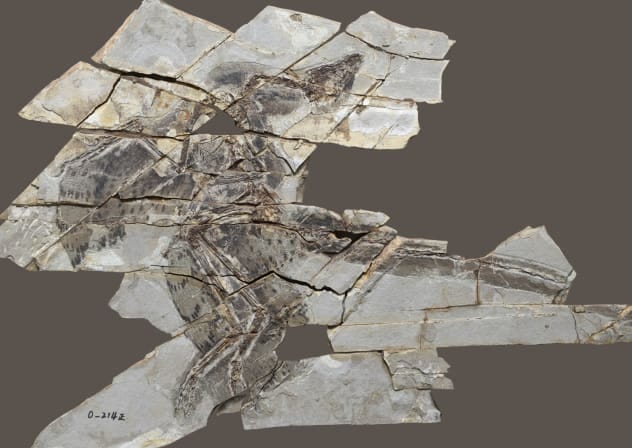
160 million years later: This rare fossil is overturning everything we knew about how birds evolved
Research on the Anchiornis specimen reveals hidden feather structures that contradict old theories on dinosaur flight. Scientists are now re-evaluating how and when animals first took to the skies.

Oldest-known fire-making found in Britain, pushing Neanderthal mastery back 415,000 years

Stone age site in Germany yields Europe's oldest blue pigment, rewriting prehistoric art palette

Scientists reconstruct face of 10,000-year-old prehistoric woman found in Belgian cave
Did prehistoric Europe have a non-binary view of gender? - study
Biases and sources of error make it difficult to determine the sex and gender of ancient remains.

After nearly 100 years, scientists solve puzzle of ancient predator's skull
Crassigyrinus would have likely been a feared predator in its day, as it would have behaved somewhat like a modern crocodile.

How did Europe's first farmers survive disease? New study uncovers answers
Early Neolithic groups from Anatolia spread and settled across Europe in the period from 10,000 to 5,000 years ago and became the first farmers.

Oldest known Ichthyosaur remains discovered in Arctic
Scientists discovered the oldest known Ichthyosaur remains. The paleontological find is changing how scientists see the emergence of the species as a whole.

Prehistoric ‘moss animals’ are millions of years younger than previously thought
The delayed appearance of these animals shows that this was not a unique period of rapid evolutionary advances, as previously believed.

Discovery of ancient 'marine crocodiles' could fill fossil record gap - study
Experts believe that the discovery will help fill a gap in the fossil record.

Headless Maya statue discovered in excavation of ancient city
The limestone statue has been nicknamed "Yum keeb" - or the god of phallus and fertility.

A lost world: Scientists find 2 million-year-old oldest recorded DNA
The DNA found in Greenland is the oldest on record and revealed an ecosystem with an ancient open forest teeming with animals.

UK Boxgrove fossils highlight complexities of human evolution in new study
A comparison between the UK's Boxgrove fossils and the Sima de Los Huesos in Spain has led to new understandings of the links between some of Europe's earliest humans.

Immigration among Neolithic people caused Mesopotamia to be genetically diverse - study
Findings show that Çayönü was a genetically diverse population because it carried mixed ancestry from the west and east sides of the Fertile Crescent - caused by immigration.
