Archaeological Site
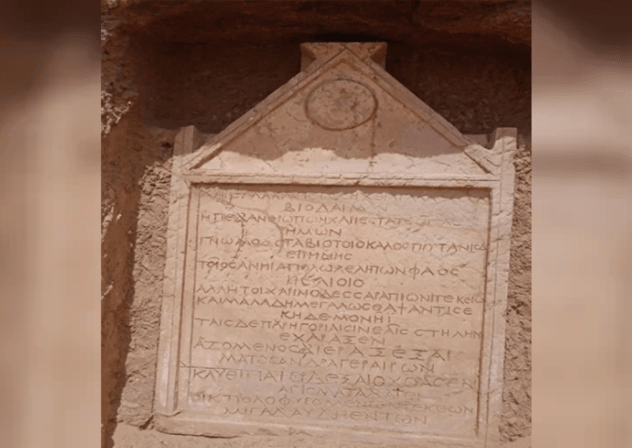
Ancient Greek elegy dedicated to judge found in ancient Egyptian tomb sealed with protection spells
Its 19-lines of ancient Greek text is written in red ink, dedicated to a person named "Pesikhtis," who, according to preliminary study, may have held the position of judge.

Excavations near ancient Turkish port may have found Alexander the Great’s soldiers tombs - report

Noah’s Ark? Researchers claim radar scan reveals 'man-made' structure at Turkey site

Ancient Egyptian fortress uncovers soldiers’ homes, royal inscriptions, and horse burial
Ancient tablet found at Roman fort in Netherlands bears Greek curse against enemies
The lead curse tablet found in the Netherlands was discovered by a team of Dutch archaeologists in a pit beneath the town hall square of the Roman military settlement of Coriovallum.

Mudbrick Byzantine city unearthed during excavations at Egypt's western desert oasis
The discovery helps “highlight the cultural diversity witnessed by the Egyptian oases throughout different historical periods," said Egyptian Tourism and Antiquities Minister Sherif Fathy.

Secrets of Huqoq: New Galilee exhibit premieres mosaics, coins found at ancient Jewish settlement
The ruins of the ancient settlement of Huqoq, which reached its peak during the Roman-Byzantine period, sits in the heart of the Amiad Forest in an open space near a spring of the same name.

New sections of ancient Egyptian temple reveal inscriptions of Pharaoh Psamtik I
The temple dates back to Egypt’s 26th Dynasty, the last native dynasty of ancient Egypt before the Persian conquest in 525 BCE.

Turkey places site of Alexander the Great’s first battle with Persians under historic protection
Under the Çanakkale Regional Board for the Protection of Cultural Heritage’s decision, both the battlefield and its surrounding areas have gained the protected status.
Israel damaged heritage sites during ops. against Hezbollah, Lebanese culture minister says
Israel's security zone in southern Lebanon includes the medieval Beaufort Castle as well as centuries-old villages that were home to Christians, Shi'ite Muslims, and Sunni Muslims.

Ancient stone at Tel Eton may provide new proof of King Hezekiah’s religious reform, study suggests
The stone, known also as a massebah, was discovered during excavations of the First Temple era site, inside a large residence named by archaeologists as "Building 101," or the Governor's Residency.

AI helps recover complete text of Herculaneum scroll burnt by Mount Vesuvius
The blackened, fragile scrolls cannot be physically opened without severe damage. Researchers have instead used high-resolution scans and computational techniques to "virtually unwrap" them.

Damascus synagogue tours highlight renewed interest in Syrian Jewish history and diaspora ties
Tours of synagogues and meetings with religious leaders highlight renewed interest in Jewish history and unresolved questions over historic sites, property, and diaspora ties.

New identification technique pushes back timeline of fire use to over a million years ago - study
Researchers explained that when bones exposed to high levels of heat are illuminated with specific light wavelengths, they light up with a distinctive glow.
