Ancient history
3,500 years of history: Haifa’s oldest site reopens
After two years of work and a NIS 3 million investment, the hill housing ancient purple-dye city remains and a Byzantine church with mosaic floors has been opened to the public.


Israeli Second Temple drama ‘Legend of Destruction’ now available in the US

On This Day: Jean-Francois Champollion announces his success at decoding the Rosetta Stone
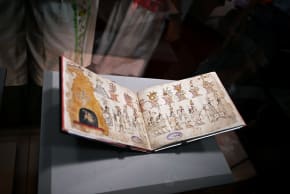
France loans Mexico rare Aztec manuscript as nations celebrate 200 years of diplomatic ties
Hangzhou offers a glimpse of China’s journey from silk to silicon
A journey through Hangzhou and Zhejiang reveals a China embracing both its ancient heritage and a high-tech future, from tea fields and historic canals to AI and robotics.

A short history of games of chance in the Middle East
From ancient dice and royal game boards to modern digital platforms, the Middle East's long relationship with games of chance reveals a timeless fascination with luck, fate and uncertainty.

Frescos from famed Etruscan tomb go on display in Rome after multi-million euro purchase by Italy
The Italian state spent €15 million on a series of celebrated frescoes found in the central hall of the tomb, which were painted between 340 and 320 BCE.

A historical overview of gambling in the Middle East
Explore gambling in the Middle East from ancient dice and maysir to Islamic law, Ottoman coffeehouses, casinos, and UAE regulation.

Turkey places site of Alexander the Great’s first battle with Persians under historic protection
Under the Çanakkale Regional Board for the Protection of Cultural Heritage’s decision, both the battlefield and its surrounding areas have gained the protected status.

WATCH: A Paleolithic time capsule: Rare prehistoric cave discovered near highway outside of Haifa
The cave dates back to 400,000 and 250,000 years ago, to the time of the Acheulo-Yabrudian culture – a collection of archaeological cultures in the Levant from the end of the Lower Paleolithic era.

British Museum delays Jewish Culture Month event after learning of planned protest
The British Museum postponed its Jewish Culture Month talk on Ancient Israel and Judah after learning some registered attendees intended to deliberately disrupt the event.

What is the Thucydides Trap, raised by Trump’s China visit? - analysis
Beijing is waiting and wondering what comes next, much like Sparta did prior to the outbreak of war in 431 BCE.

Stone stele depicting Roman emperor, Egyptian gods found near Karnak temple site in Luxor
The stele was discovered during the three-year-long restoration efforts of a gateway from the time of Ramesses III in Karnak.

Roman fort found north of Hadrian’s Wall may have been used to defend against unconquered Scotland
According to GUARD, the fort was constructed on high ground along the Antonine Wall, granting it an unobstructed view of the surrounding area, and intervisible with a much larger fort to the west.
