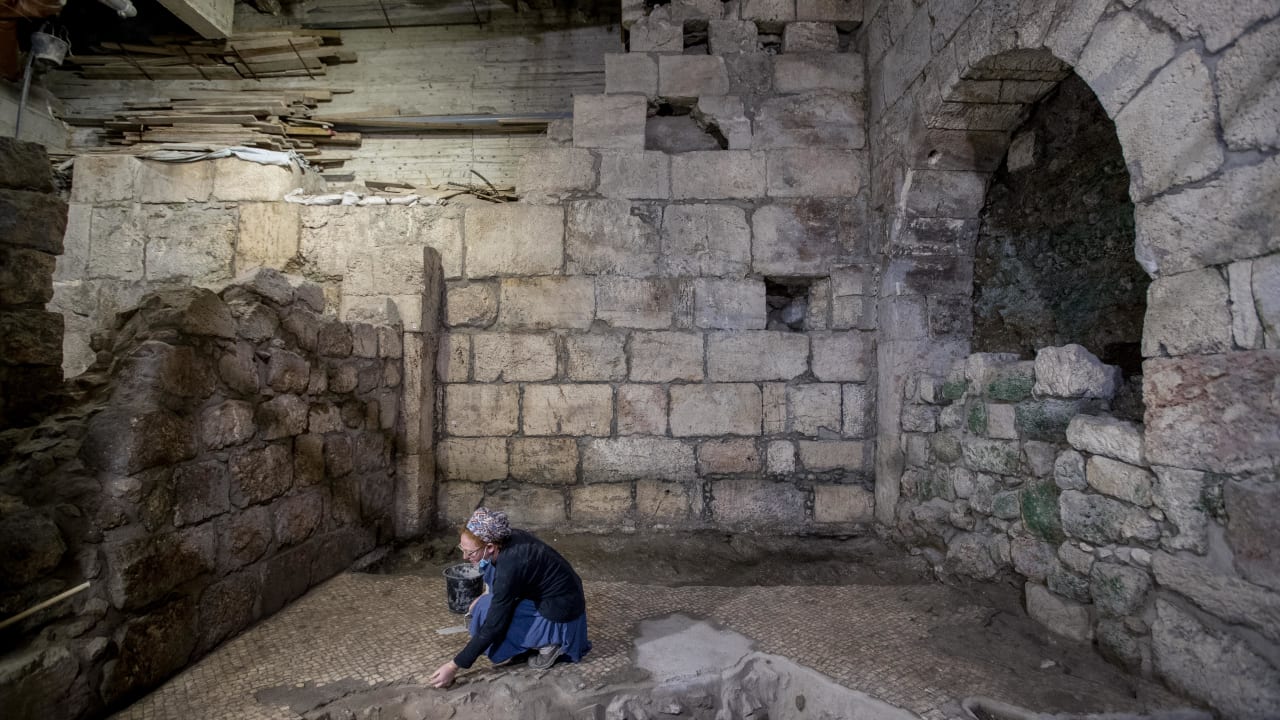
A new geological and archaeological study has mapped dozens of ancient stone quarries hidden beneath today’s Jerusalem, detailing how generations extracted the “Jerusalem stone” that still defines the capital’s skyline, according to a paper published last week in Heritage.
The team analyzed 117 Israel Antiquities Authority (IAA) excavation reports from 2012 to July 2024 and identified 39 sites with clear quarry evidence inside the city’s current municipal boundaries.
Lead author Adi Sela Wiener of the Bezalel Academy of Arts and Design in Jerusalem and Sapienza University of Rome worked with Italian researchers Laura Medeghini and Gabriele Favero to compile a new spatial database from the IAA’s open Hadashot Arkheologiyot reports.
A ‘lithic journey’ from bedrock to building block
The authors describe a multi-stage “lithic journey,” from identifying suitable rock layers to quarrying, dressing, and transporting stones to construction sites across the city. The study focused on the earliest stage of that journey, mapping where quarries were opened within Jerusalem’s contemporary boundaries.
Jerusalem’s distinctive stony appearance, the study notes, stems from the Judean Mountains’ geology and policy choices such as the 1918 “Stone Ordinance,” introduced under the British Mandate, which required stone cladding for facades in much of the city. The paper also records the living craft vocabulary of local masons, including terms such as "mizzi hilu" and "meleke" for specific limestones used for paving and fine ashlar.

Giant quarry systems in the north
The clearest concentration emerged in northern Jerusalem. The city's north, home to the majority of large and giant quarries, accounted for 14 of the 39 quarry discoveries, or 36% of the total. Many of these large quarries were opened in dense Turonian limestone of the Nezer Formation in the Judea Group, a unit prized for high-quality building stone.
Across 90% of the sites, archaeologists documented technical extraction marks, such as severance channels and cutting traces, and in 68.5% of the sites, partially cut stones were left undetached from the bedrock. Block sizes varied widely at single quarry faces, reflecting diverse construction needs.
From Iron Age to early Islam
Dating is often difficult, but about 80% of the reports offered at least approximate periods, indicating quarrying from Iron Age II through the Second Temple, Roman, and Byzantine eras into the Early Islamic period, with evidence for reuse and multi-period activity at some sites.
Roughly three-quarters of the quarries in the dataset were uncovered during IAA salvage excavations ahead of modern building and infrastructure works, underscoring the link between development and archaeological discovery. The authors suggest that quarry reports should include mandatory stratigraphy, systematic rock sampling, and the use of GIS to connect ancient quarries with road networks and planning layers. This will help people make better decisions in the future.
Evidence of extraction marks at 90% of the examined sites, coupled with stones preserved in the site, offers a rare, technical window into how builders transformed mountains into masonry for Jerusalem’s walls, homes, and holy places.