

Have you ever wondered why challahs on Rosh Hashanah are round and not braided the way they are the rest of the year?
Before we opened our artisan bakery in 2008, I always thought that the reason had something to do with cycles, the end of a year and the beginning of a new one. Braiding a challah in a circular shape is symbolic of the cyclical nature of the year.
Then a neighbor provided a different insight. “Rosh Hashanah challahs are round and not braided like they are regularly because the pressure on the bakers before Rosh Hashanah is much greater than the rest of the year. It is much quicker to braid a round challah than a six-braided challah. The consideration is purely commercial.”
Although when I initially heard this, it made sense. Now 17 years later in the trade, I can debunk that supposition.
From decades of repeatedly braiding challahs, week in and week out, the baker becomes so proficient that it matters little if there are six braids or one. A professional baker can do both in practically the same time. You can wake him up at 2 a.m., and he can do it even with his eyes closed (my wife has actually tested that theory on me).
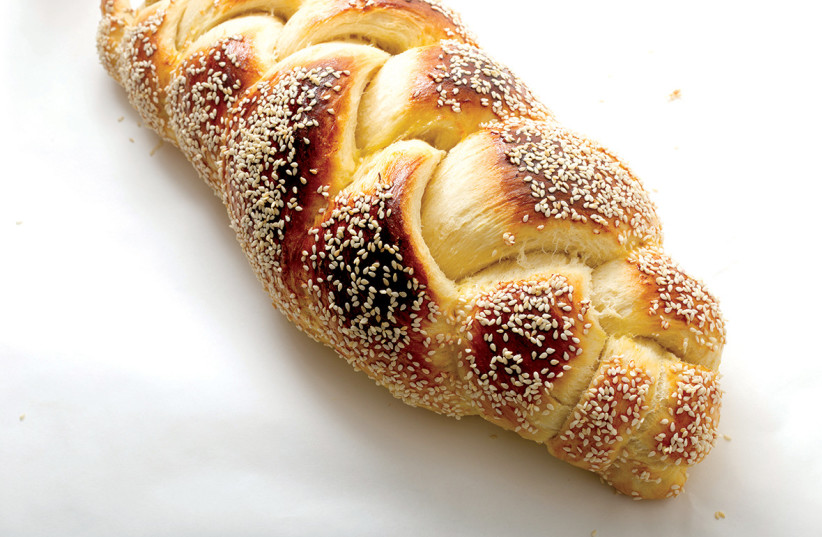
In industrial bakeries in recent years, we also see the increasing use of robotic braiding machines that can braid challahs with almost any number of braids in the amount of same time (right now I am still a match for the robots, but I don’t know how long that will last as technology advances).
IF PRACTICALITY and time constraints are not the reason we eat round challahs on Rosh Hashanah, we must revert back to the original premise – that it is symbolic of something. I would like to propose another reason for this phenomenon, which I call “Saidel’s Round Rosh Hashanah Challah Theory of Relativity” (with apologies to Albert).
After much research and digging into the sources, I have discovered that the main reason for having round challahs on Rosh Hashanah has something to do with the first “relatives” in history, husband and wife – Adam and Eve.
If you are wondering why Jews braid challah at all (year-round), it has to do with Adam and Eve’s wedding. According to Talmudic sources, after God created Eve from Adam’s rib, He presented the new bride to her new groom in a ceremony resembling a huppah wedding canopy.
As a gift to Adam, God braided Eve’s hair to make her beautiful in his eyes. Braided hair is a sign of modesty – it minimizes the exposure of one’s hair. This, coupled with the fact that intertwined braids are symbolic of intimacy and love, are the two main reasons that our challah is braided year-round.
The reason Rosh Hashanah challah is round and not braided like regular challah is because of the sin with the Tree of Knowledge. According to one Talmudic source, the Tree of Knowledge was a wheat tree, towering up to heaven. After the sin, it was demoted to the lowly grass as we know it today. On that same day (which was Rosh Hashanah), Adam and Eve were created and also sinned.
In the aftermath of the sin, Eve’s braided hair became unraveled and wild. By not braiding the challah thousands of years later (5786 to be exact) on Rosh Hashanah, we remember that sin and pray for forgiveness, both for our sins and for those of the first two relatives in history.
In Jewish tradition, round foods are eaten as a symbol of both mourning and new life; for example, after a funeral and when a woman gives birth.
On Rosh Hashanah, we mourn the first sin in history and, at the same time, celebrate the possibility of new life, a new year for our people – free of pain, suffering, and mourning, and filled with hope for a better tomorrow.
Round Honey Challah
Makes two challahs.
- 4 cups flour
- 1 cup and 2 Tbsp. lukewarm water
- 4 Tbsp. honey
- 1 egg (size L)
- 1 Tbsp. salt
- 1 Tbsp. instant dry yeast
- 2/3 cup sugar
- 3 Tbsp. oil
Mix ingredients together and knead for 15 minutes by hand (you may rest periodically), or for 10 minutes in the mixer. Cover and leave to rise for 30 minutes. Divide dough into two. Roll each piece into a single braid.
Starting at one end, twist the braid into a circular/spiral shape, resembling a snail’s shell. Baste with oil and leave to rise for 2½ hours or until doubled in size.
Baste with egg wash (50:50 egg:water, beaten together) and sprinkle with sesame seeds (optional). Bake for 25-30 minutes at 180 degrees C or until golden brown.
The writer, a master baker originally from Johannesburg, lives in Karnei Shomron with his wife, Sheryl, and four children. He is CEO of the Saidel Jewish Baking Center (www.jewishbakingcenter.com), specializing in baking and teaching how to bake healthy, traditional Jewish bread. He also manages the Showbread Institute (www.showbreadinstitute.org), researching the biblical showbread.