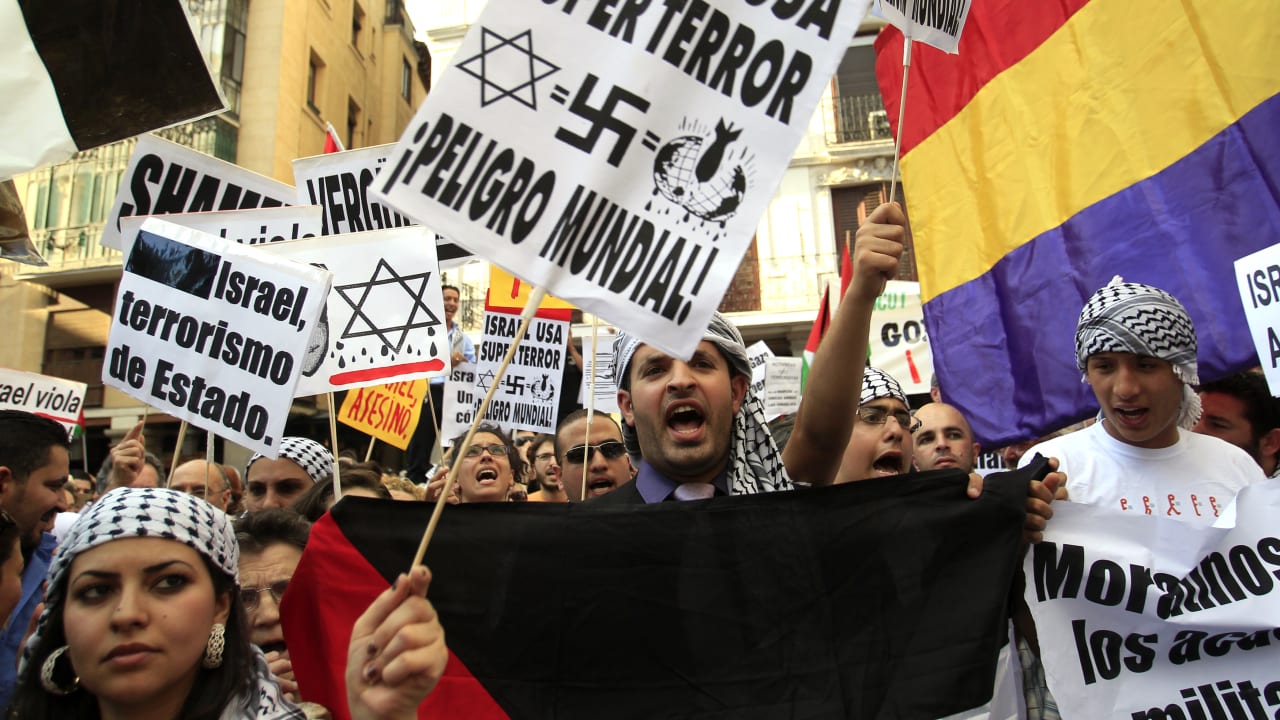
As the world marked International Holocaust Remembrance Day on Tuesday, the argument that antisemitism is behind the rise of anti-Israel sentiments seen since the start of the war against Hamas is “weak,” according to a new study.
The report, published by the Center for the Study of Contemporary European Jewry at Tel Aviv University, instead saw history, diplomacy, and impact as the dominating factors.
Published in the annual ‘For a Righteous Cause report,’ ahead of International Holocaust Remembrance Day, the study sought to understand why the Israel-sceptic bloc of Europe had not backed the Jewish state, abandoning the popular reasons of Muslim migration and anti-Jewish sentiment.
Naming Iceland, Ireland, Luxembourg, Malta, Norway, Slovenia, Spain, and Belgium as the P-8, researchers based their understanding of the countries’ attitudes toward Israel on an analysis of dozens of opinion polls and hundreds of speeches, statements, social media posts, and opinion columns, as well as interviews with over 30 European politicians, diplomats, journalists, and scholars.
While the study’s authors acknowledge the linkage between antisemitism and the political climate, they argue that it is difficult to determine when criticism of Israel is an antisemitic double standard or a legitimate stance.
Additionally, countries in the P-8 bloc enjoy relatively low rates of antisemitic attacks, in correlation with their relatively small Jewish populations.
A comparative survey by the Pew Research Center from 2018 of 15 European countries showed publics in Norway (95%), Belgium (89%), Spain (79%) and Ireland (70%) have higher contention rates with the prospect of having Jews as family members than in Germany and Austria, countries considered to have a more favorable stance to Israel.

The study’s authors did not find credible evidence to suggest that the public in P-8 countries is driving their governments with “distinctly deep-seated hateful or prejudiced views against Jews,” which would otherwise explain the anti-Israel policy trends or official statements.
Recent surveys on public attitudes towards Jews have indicated a higher level of antisemitism than in other European countries, including European countries that have observedly taken a more pro-Israel stance.
Disputing the argument that the P-8 has readily opposed and condemned Israel as a result of Muslim migration, the researchers stressed that the Muslim populations in the P-8 countries are politically insignificant, especially given that many of the migrants do not have voting rights in their host country.
Additionally, six of the P-8 countries have Muslim populations smaller than the European average, suggesting there is no correlation between Muslim population and a European’s stance on Israel.
Assessing that neither antisemitism nor migration is behind the wave of anti-Israel sentiments, the researchers assessed that there are six common factors in the P-8 that may have determined its political alignment.
Disclaiming that none of these aspects can independently explain the intensity of anti-Israel views and policies in P-8 countries, the researchers assessed that there are six key conditions that contributed to the political climate in P-8 nations since October 7, 2023.
These conditions include left-oriented coalition governments; the minimal role of antisemitism and Holocaust remembrance in political discourse; national narratives receptive to identification with the Palestinian cause; pre-existence of deep-seated anti-Israel views; the meager international and national implications of diplomatic decisions regarding the Middle East; and the modest scopes of pro-Israel public diplomacy.
European left-wing parties more critical of Israel than conservatives
Noting that European socialists and other left-leaning parties are “distinctly more critical of Israel than conservative and populist ones,” the P-8 countries are dominantly governed by left-wing coalitions. Though Belgium and Luxembourg are exceptions, the researchers claimed this did not disprove the trend.
For almost half a century, Israel has been governed by conservative coalitions, and the researchers claimed that a coalition with a “distinct radical-religious and populist bent” since 2022. The priorities and political vocabulary of these conservative coalitions have alienated the European left, the researchers claimed.
Additionally, as a democracy with close ties to Europe, the researchers claimed that the expectations placed on Israel are naturally higher.
It is expected that, as a European partner, Israel maintain a level of human rights standards, and the researchers claimed that left-wing politicians felt the close relationship meant criticism was more likely to make a difference.
For other countries in the P-8 bloc, Israel is just a suitable distraction from domestic failings, the researchers noted.
“The current government was trying to divert attention from domestic problems and build an international image that would help its electoral prospects,” said Victor Blazquez Martin, associate professor of political science at Universidad Carlos III de Madrid.
In Spain’s case, researchers noted that forming such a strong anti-Israel stance was used as a tool to demonstrate a separation from the dominating role of the US.
Daniel Fernandez de Miguel, scholar of contemporary history at Universidad Complutense de Madrid, explained, “Spain’s current government is the most left-wing in Europe. [Its anti-Israel policy was designed] to demonstrate independence from Washington and the Western bloc, so it aligned with the Global South and Arab countries.”
History has also played a large role in the stance of P-8 countries, the researchers noted while pointing special focus on the role of the Holocaust in public discourse.
While the researchers noted that World War II was a source of shame and reflection for Germany, impacting German willingness to take a strong stance against the Jewish state, the same trend does not apply to the P-8 countries.
As is the case in Ireland, Malta, and Iceland, the Holocaust does not play a central role in education or public discourse, countries that played no major role in the Holocaust, the researchers noted.
Some of the P-8 countries had a more complex role in the Holocaust, as the researchers noted was the case of Spain, which cooperated with Nazi Germany and fascist Italy, but gave refuge to thousands of Jews.
Under Nazi and Italian occupation, Slovenia also saw the majority of Jews murdered and never fully reckoned with its pro-Nazi collaborators.
A similar story is true in Belgium, where almost half of the Jewish population was murdered in the Holocaust, but which witnessed both collaboration and the underground resistance.
Stretching in some cases beyond the 80 years since the Holocaust ended, the researchers noted that the P-8 countries shared national narratives that could be identified with that of the Palestinian cause. In six of the countries, independence was gained only through immense struggle and often at the expense of a stronger force.
“That memory encourages perceptions of the Palestinians as a David whose struggles are reminiscent of their own, and of Israel, or what Israel has grown to become, as the Goliaths from which they were liberated,” the researchers explained.
The P-8 has also either had a distant or recent legacy of bias toward the Arab world’s perspective, the researchers claimed. Pro-Palestinian stances were formed long before Hamas’s devastating October 7 attacks, and the framing of Palestinian victimhood was too deeply embedded for Hamas’s atrocities to shake the narrative.
Spain, which recognized Israel in 1986, had already received PLO leader Yasser Arafat in 1979.
Beyond identifying with the Palestinian cause, the research noted that the countries had a limited capacity to influence Middle Eastern politics due to the limited scope of their bilateral economic, defense, and other ties with Israel.
Another political condition shared by P-8 countries is that they are currently less reliant on the US than most other European countries. They are not at immediate risk of the expansionist ambitions of Russia, unlike many of the countries in Eastern Europe. They are also not heavily invested in NATO, unlike the UK, France, and Germany, so do not need to follow Washington’s warm stance toward the Jewish state.
“The combination of relative immunity from American wrath and relative incapacity to affect Middle Eastern politics placed the P-8 countries in an awkward win-win situation,” the researchers noted.
“Their hostile views regarding Israel had little direct impact, yet involved few risks. Where their demands regarding the reaction to the war were not heeded, P-8 leaders benefited from basking in virtue signaling.”
Finally, the P-8 shares weak levels of hasbara (public diplomacy) and less immediate diplomatic contact.
In Luxembourg and Iceland, Israel is represented through neighboring embassies. In Malta and Slovenia, Israel is represented through a non-resident ambassador, and in Ireland, Israel closed its embassy.
The countries also share small Jewish communities, not all pro-Israel, with less significant levels of Jewish activism as a result.
Roger A. Strickland Jr, the Honorary Consul of Israel to Malta, said, “If, say, I was a full-time ambassador here, and it was my full-time job, then Monday I would go have coffee with the Foreign Minister. Tuesday, with the French ambassador, she is completely pro-Palestine. Just have coffee, talk to her. Then with the Italian ambassador, the Spanish. Then with different ministers, with the Prime Minister, with the media. Speak for Israel around the clock.
Organize a celebration on Independence Day. Meet up with the Chamber of Commerce. An honorary consul doesn’t have the time todo all these things. I have four companies, I have 170 employees, that is my first job.”
While Israel’s diplomatic efforts have been thinly stretched, the same cannot be said for the Palestinians, Strickland said. “They have an ambassador here [Fadi Hanania]. He is very active on social media. Somebody is funding him, and somebody is obviously paying for his suits and the nice cars, and his driver.”
Taking the above points into consideration, the researchers recommend that Israel’s next government present a creative and well-intended plan that offers a prospect of Palestinian independence and avoids infrastructural changes that would threaten the feasibility of such a move.
The plan should demand continued American and European commitments for the elimination of Hamas as a political and armed faction, an unequivocal Palestinian recognition of Israel as the national home of the Jewish people, and the intensive de-radicalization of Palestinian schools, the researchers advised.
Second, it was advised that Israeli officials begin reaching out to the moderate elements of European social democracy and engage in open dialogue that involves “less preaching and more listening,” rather than virtue signalling and confrontation.
The researchers also advised that Israeli officials should exercise more caution in labeling criticism and hostile diplomatic initiatives as antisemitic, arguing that usage of that term should be preserved to clear-cut Jew-hatred.
More materially, it was advised that Israel open fully functional embassies in every European country, and that funding for such an undertaking should come from closing the “gratuitous and damning Ministry of Diaspora Affairs and Combating Antisemitism.” The researchers accused the ministry of doing a disservice to the causes it is tasked with promoting.
Every Israeli embassy in Europe should also employ a full-time trained official responsible for communication with the traditional media and engagement with NGOs and Jewish organizations, the researchers added. Another full-time trained official responsible should also be employed for social media and for engagement with youth organizations.
Finally, it was advised that Israel invite more influencers to visit, including from P-8 and other hostile countries.
In opposition to current policy, the researchers put that inviting influencers from all countries to experience Israel first-hand was the most effective way to dispel false narratives.
As part of this mission, it was suggested that Israel could increase the number of scholarships awarded to non-Israelis interested in attending Israeli institutions of higher education, in particular those training to be politicians, diplomats, and journalists.
The study was written by Prof. Uriya Shavit with research assistance from Antonio Pena and Dmitrii Sukhanov.