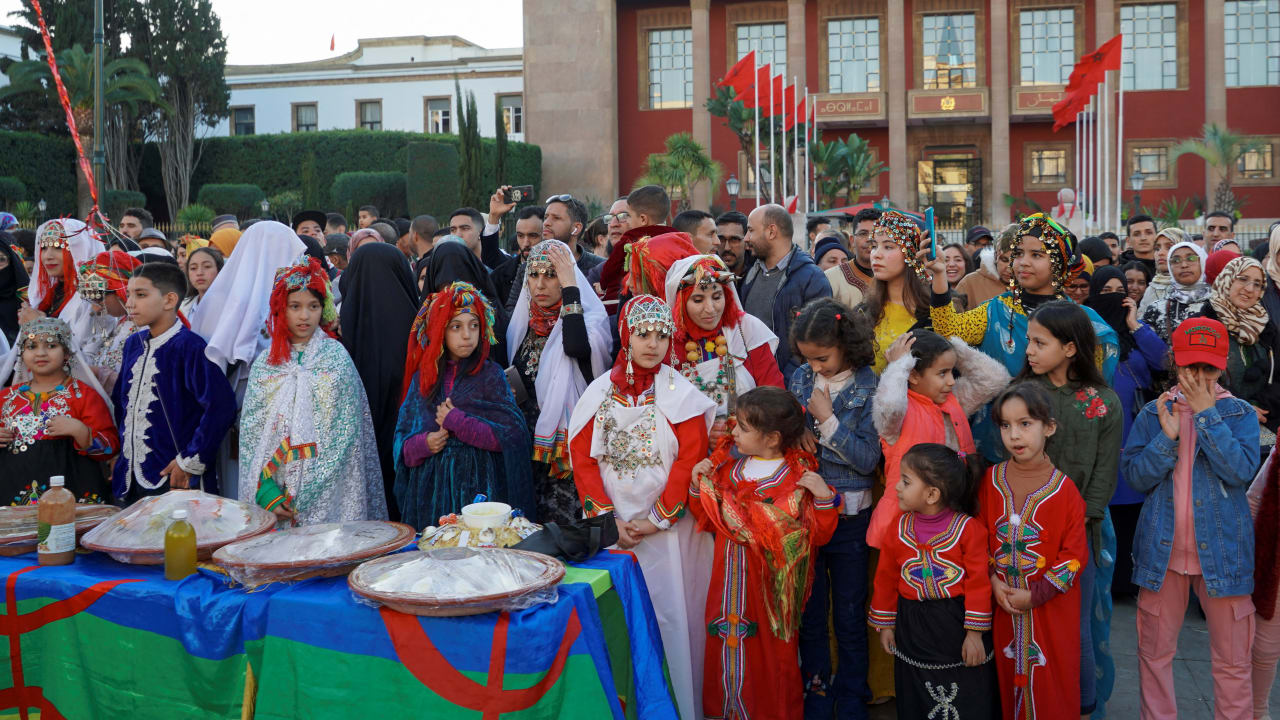
In Morocco, the Amazigh language and identity have been experiencing a revival that bridges millennia-old traditions with the realities of a modern, multicultural nation. Once marginalized, the Amazigh - often referred to as Berbers - are now gaining renewed recognition as Morocco embraces the cultural diversity at the heart of its society.
For more stories from The Media Line go to themedialine.org
The turning point came under King Mohammed VI, who in 2000 recognized the Amazigh language and established IRCAM, the Royal Institute for Amazigh Culture.
A decade later, in 2011, Amazigh was granted official status in the constitution. These steps were more than symbolic: They signaled a national effort to integrate a culture that had formed the bedrock of Morocco for more than 10,000 years.
“Amazigh culture is the basis and the core of Moroccan culture,” Dr. Mohamed Chtatou, professor of Middle Eastern and Mediterranean studies at the International University of Rabat and a political analyst, told The Media Line.
“We are speaking of a civilization that is 10,000 years old. The Arabs only arrived in Morocco in the year 700, so the Amazigh ruled themselves for over 9,000 years, creating the culture that spread across North Africa, the Sahel and even the Atlantic islands. Morocco’s substratum is Amazigh - it is in the music, the carpets, the jewelry, the crafts, the very fabric of daily life,” he said.

That history is not one of isolation, but of coexistence. Jews fleeing Babylonia 2,500 years ago settled among Amazigh communities in Morocco’s mountains, forming what Dr. Chtatou described as a “Judeo-Berber cultural substratum.”
“Jews lived among Berbers, became Berbers, while keeping their religion and language. This explains Morocco’s tolerance still today,” Chtatou said. “For centuries they led the Saharan trade caravans to Mali and Niger. Even those who moved to Israel still tell me, ‘Our feet are in Israel, but our hearts are in Morocco.’”
For him, this blending of cultures is what makes Morocco unique. “When you look at Morocco’s history, you find a constant ability to absorb, to integrate, without losing its core. The Amazigh did not reject the Jews or the Arabs who came later; they integrated them. That is why Moroccan identity is plural, and why coexistence is not just a slogan, but a lived tradition,” he said.
The idea of “convivencia” - peaceful coexistence - resonates throughout Amazigh history. Berbers ruled Morocco and expanded into Spain and Portugal, where they maintained relations with Christians and Jews. “This is Morocco’s real history,” Chtatou said. “It must be reclaimed in our schools, not mainly a narrative glorifying Arabism and Islam, since Amazigh converted to it historically.”
Language is central to this reclamation. Amazigh, written in the Tifinagh script, is a phonetic alphabet that Chtatou described as “easy to learn and write.” While dialects vary across Morocco’s regions - from the south to the Atlas Mountains - the underlying grammar remains consistent. “There is no difficulty in communication,” he said. “Neo-Tifinagh has modernized the language and helps unify the dialects without erasing their uniqueness.”
For many Moroccans, identity is reflected in names, place names and dialects. “All Moroccan cities are Amazigh in name: Marrakesh, Tangier, Fez, Rabat,” Chtatou said. “Activists today are asking to restore these original Amazigh names, rather than the Arabic transliterations. It is a matter of reclaiming memory.”
He added: “Language is not just a tool of communication - it is the soul of a people. The day we stop speaking Amazigh is the day we risk losing a part of who we are.”
King Mohammed VI has been instrumental in elevating Amazigh culture. Though descended from the dynasty of the Prophet Muhammad, the king is also tied by blood to Amazigh heritage. “His mother was Berber, as were the mothers of his ancestors,” Chtatou said. “He himself speaks Berber. That is why he recognized the culture officially in 2000 and gave it prominence.”
This recognition, however, has not erased tensions. Arabization policies from past centuries still weigh heavily, and Moroccan censuses do not record ethnic affiliation. Estimates place Amazigh heritage at around half the population, though no official figures exist.
“Many people in Morocco have been Arabized and believe themselves to be Arabs,” Chtatou said. “Ironically, they are the ones most resistant to the generalization of Amazigh culture, fearing it will erase their identity. But their origins are Amazigh. Morocco must face this contradiction if it truly wants to embrace its roots.”
For Chtatou, the survival of Amazigh identity over millennia - outlasting Greek, Roman and Persian civilizations - comes down to what he calls the “Amazigh cultural trinity”: land, language and family. “These three pillars explain why Amazigh culture has resisted,” he said. “Other civilizations had mountains too, but they vanished. The Berbers survived because of their will to keep the language and identity alive.”
Today, that willpower is strongest among the youth. “Young people are building the future in this sense,” Chtatou said. “My students want to rediscover their Berber origins, their family names, their tribal roots. In the south, young people revive traditions through festivals and tourism. They use modern tools - even artificial intelligence - not to replace their identity, but to strengthen it. They show that you can be modern and Amazigh at the same time.”
Heritage as a lived reality
For Hassan El Kadi, a tour guide at Nomadik Morocco, this heritage is not only an academic subject but a lived reality.
“Being Amazigh today in a multicultural Morocco means first and foremost being proud of my roots, but also proud of how our country has managed to bring together many identities within one nation,” El Kadi told The Media Line.
“The Amazigh identity is part of who I am: It is my mother tongue, the history of my ancestors, and also a way of life - close to nature, the mountains, and values such as hospitality and solidarity. At the same time, I also feel fully Moroccan, because our strength comes precisely from this cultural diversity that unites us.”
Through his work in tourism, El Kadi sees himself as a bridge. “I make it a point to show visitors what it means to be Amazigh: taking them to discover our villages, our traditions, the symbols you can see in crafts or on the walls of houses, and above all the richness of our language and our history. It is important to keep this memory alive, both within our communities and for those who come to discover Morocco,” he said.
Looking ahead, El Kadi believes Morocco offers a model for the region. “I believe Morocco is already an example in Africa and in the Arab world for the recognition of Amazigh culture. The language is now official, and His Majesty the King has played a key role in this recognition. It is a strong message: preserving our roots while opening ourselves to the future. For me, the future lies in balance: continuing to pass on the traditions of our villages and mountains, while showing that Amazigh culture is a richness not only for Morocco but for the world,” he said.
The Amazigh story in Morocco is both ancient and modern: a culture that has survived invasions, assimilation and marginalization, and that today finds new expression through state recognition, village traditions and youthful activism. It is a story of coexistence - between Berbers, Arabs, Jews and Europeans - that continues to shape Morocco’s identity.
As Dr. Chtatou put it: “Amazigh culture has survived for 10,000 years because of the will of its people. It will continue to survive, because it is the core of who Moroccans are.”