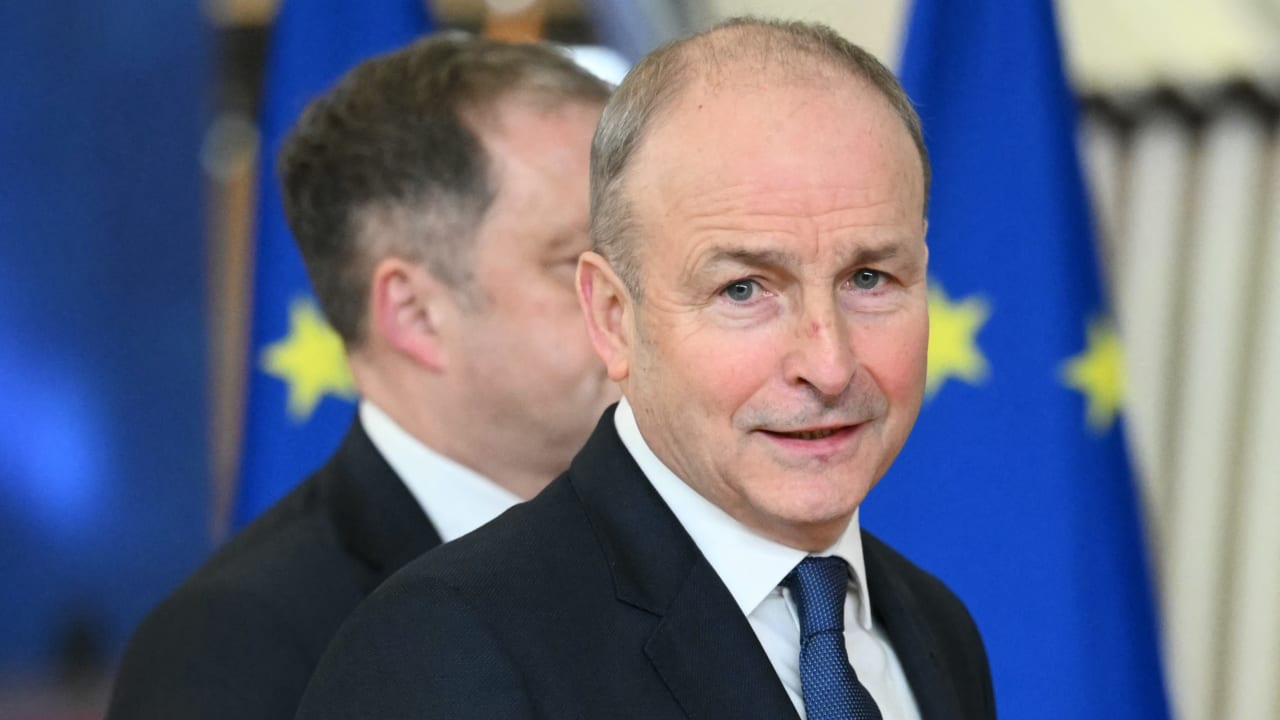
During a national ceremony for Holocaust Remembrance Day, Irish Prime Minister Micheál Martin devoted a significant portion of his speech to the findings of the Claims Conference survey published this week.
Martin described the data as “sobering” and “shocking,” and called for immediate action. He also expressed strong support for the proposal by the Claims Conference and the Representative Council of Irish Jews to provide schools with access to meetings with Holocaust survivors via video calls.
Martin began his speech by saying that it was a great honor to speak at Ireland’s Holocaust Memorial Day, and to share the room with survivors of the Holocaust and their families. He also paid tribute to the late Joe Veselsky, who recently passed away as Ireland’s oldest man and oldest Holocaust survivor.
“This is a very important and emotional afternoon for our Jewish community in Ireland,” said Martin. “We unite to remember the six million Jews who were persecuted and murdered and the millions of other victims targeted on the basis of their ethnicity, disability, sexual orientation or political and religious beliefs.
“The shocking atrocities and cruelty perpetrated during those darkest of times inflicted profound intergenerational wounds that go to the very heart of the Jewish community today.”

Martin then spoke about the results of the Claims Conference’s first survey on attitudes towards the Holocaust in Ireland. Among the most “sobering” findings was that almost 10% of Irish people aged 18 to 29 believe the Holocaust is a myth, and that almost 20% of the same age cohort believe that it happened, but that its scale has been “greatly exaggerated.”
“The Holocaust is the most clearly documented crime in world history,” said Martin. “This level of ignorance and denial is shocking and must be opposed and dealt with.”
A percentage of Irish people never heard of the Holocaust
Additionally, 12% of the survey’s respondents said they had never heard of the Holocaust, with that number rising to 15% among 18-29 year olds.
Martin added that the level of Holocaust denial and distortion is not unique to Ireland, but that it makes clear the importance of Holocaust education. One of the more positive statistics was that 90% of participants said it was important to teach about the Holocaust.
Martin announced that the Minister for Education, Hildegarde Naughton, and her department are working with the Department of Foreign Affairs to develop an education program along with the Jewish Representative Council of Ireland to give schools access to survivors via video conference to discuss and to learn from their experiences. He also reiterated his commitment to the International Holocaust Remembrance Alliance working definition of antisemitism.
Martin also spoke about the incident concerning Herzog Park in Dublin, which local councilors proposed to rename due to Chaim Herzog’s connection to Israel.
“When a group of people decide that they will seek to rename the only public park in our capital city named after an Irish Jew without any consultation with the Jewish community, and when they then announce later that they will find a Jew they deem worthy enough to provide a new name, then frankly the community has every right to be deeply concerned and to express that concern because that behavior is not acceptable,” he said.
“It is vital that all of us actively remember the horror of the Holocaust and redouble our efforts to ensure that the antisemitism and racism that enabled it are never again allowed to take hold,” he concluded.