The aftermath of the recent US military strike on Iranian nuclear facilities – authorized by President Donald Trump without congressional approval – stretches beyond geopolitical implications. The strike raised very real concerns about rising antisemitism in the US, the precarious state of US-Israel relations, and the security of American Jewish communities.
Jewish community organizations quickly rallied in the wake of the attack, sending out official statements.
Jim Berk, CEO of the Simon Wiesenthal Center in Los Angeles, stated: “Israel is not seeking escalation; it is seeking survival… Israel is acting to defend its citizens from an existential threat that the world has too often chosen to ignore… No sovereign nation would tolerate what Israel has endured; the world shouldn’t expect Israel to, either.”
In a statement to The Jerusalem Post, Berk said, “The US strike was not a favor to Israel; it was a strategic and necessary move to prevent the world’s most dangerous regime from obtaining the world’s deadliest weapons.
“For years, Israel has done the dirty work for the Western world by hobbling Iran’s nuclear infrastructure, and last weekend the US dealt the final blow. This is the moment for responsible leaders, communicators, journalists, and academics to rise above the noise and do their job of informing the public with facts, not fiction.”
Security implications for American Jews
Anti-Defamation League CEO Jonathan Greenblatt issued a statement saying, in part, “Since 1979, the Iranian regime has been the largest exporter of antisemitism and terror on the planet. The Iranian regime and its proxies have murdered Jewish people and hundreds of Americans around the world for decades.”
In a statement to the Post, Greenblatt said, “History shows that when the Islamic Republic of Iran and other countries run by terror regimes are under duress, they scapegoat the Jewish people, Israel, and the United States. ADL is deeply concerned about voices on the far Right and far Left falsely and dangerously blaming Jews or Israel for ‘dragging’ the US into war… Legitimate policy debates must not become vehicles for antisemitism, and policymakers must forcefully reject these distortions.”

The Jewish Federations of North America and the Conference of Presidents of Major American Jewish Organizations rallied in response to these concerns. On Monday, they announced a joint emergency leadership mission to Washington, DC. William C. Daroff, CEO of the Conference of Presidents, stated, “American Jews are not bystanders to global terror and domestic extremism – we are deliberate targets. After the unprecedented barrage of missiles fired at Israeli cities in recent days, the stakes have never been higher. The fight for Jewish security is not just domestic – it is global.”
Federation President and CEO Eric Fingerhut added, “We are facing an unprecedented situation in American Jewish history where every Jewish institution and event is a potential target for antisemitic violence.”The coalition laid out a Six-Point Security Policy Plan to enhance federal grants, bolster local law enforcement, and combat online hate. More on the plans were set to be announced on the Capitol steps after press time.
In their public statement, the Jewish Democratic Council of America’s CEO Halie Soifer stated, “This is an incredibly difficult moment for the vast majority of American Jews, who are supportive of Israel, concerned about the security and safety of the Israeli people and Jews in the United States and around the world, and fearful that President Trump lacks a clear strategy about what happens next with Iran.”
In a statement to the Post, Soifer said, “Holding Jewish Americans collectively responsible for the policies of the US or Israeli governments is inherently antisemitic. We have recently seen the dangerous manifestation of anti-Israel views manifesting in antisemitic violence in DC and Boulder [Colorado], where lives were tragically cut short, and many were injured…We certainly hope that the situation in Iran does not generate consternation – or even worse, violence – directed at American Jews.”
These concerns were echoed by Dov Waxman, the Rosalinde and Arthur Gilbert Foundation Chair of Israel Studies at UCLA and a leading scholar of US-Israel relations. He told the Post, before the tentative ceasefire between Israel and Iran went into effect, that he was concerned about a possible backlash domestically against American Jews “because of the perception that the Israel lobby was dragging the United States into a war that Israel initiated against Iran.”
That fear, he said, is real and rooted in historical evidence. “We saw this very clearly in the run-up to the invasion of Iraq in 2002–2003, and there’s still the narrative which says that it was a war for Israel. Back then, I think that was a completely groundless allegation. In this case, there was more substance to the argument that Israel was pulling the United States into this conflict… Given there is already rising antisemitism in the United States on the Left and the Right, bringing this new conflict into the mix heightened that danger.”
Waxman also has concerns, given fringe theories about Jewish influence in American foreign policy that are becoming more mainstream.
“People might have talked about the ‘Israel lobby’ in the past,” he said, “but now you see much more explicit rhetoric blaming American Jews” – which is part of a long history of anti-Jewish conspiracy theories that is now becoming more mainstream courtesy of both left- and right-leaning political figures.
Two examples are right-wing provocateur Steve Bannon (Trump’s chief of staff during his first administration) and Republican Rep. Thomas Massie. Bannon declared that the United States was being pulled into war by “those who put another country’s interests first,” while Massie posted that America was becoming “entangled in conflicts because of outside pressure.”
When people like Bannon make those allusions, said Waxman, “we’re seeing the normalization and the mainstreaming of that kind of antisemitic discourse… which would have initially been voiced within the far Right or chat rooms, [but] is now much more explicit.”
The Democratic political divide
While mainstream Jewish organizations by and large came out in favor of the Iran strike, progressive lawmakers and Jewish groups overall did not.
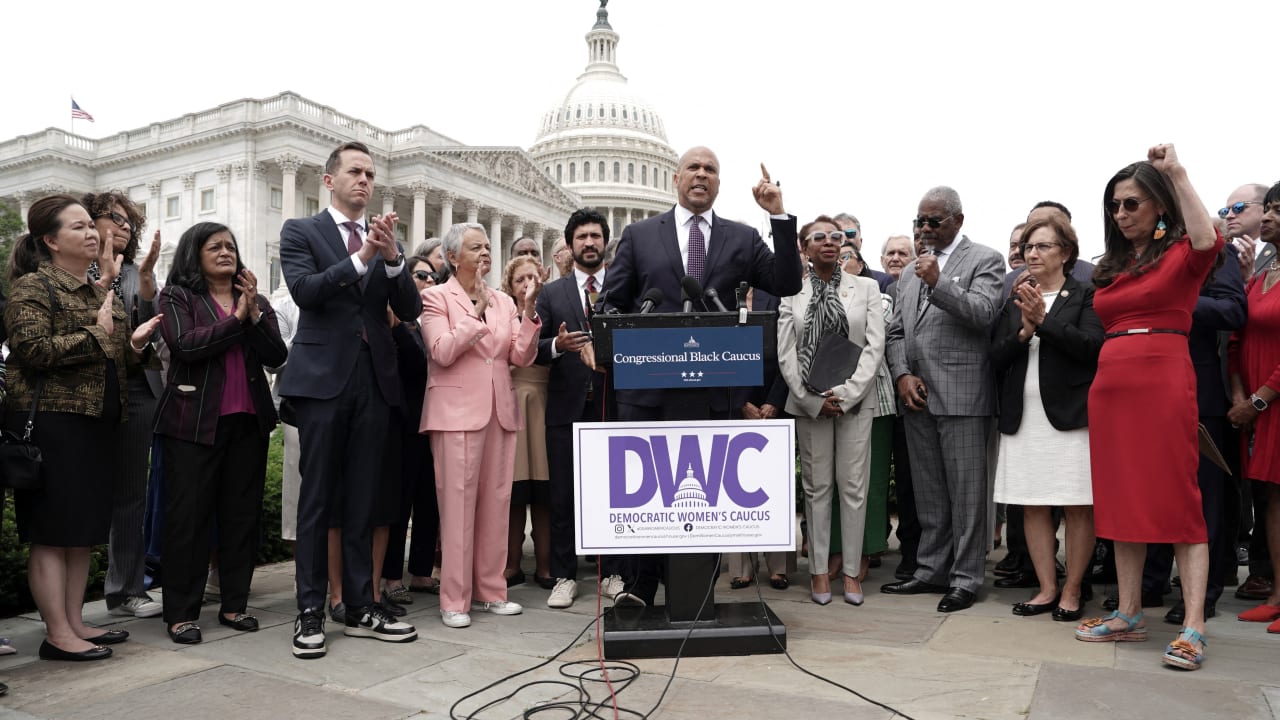
Democratic senators Cory Booker from New Jersey and Chris Van Hollen from Maryland criticized Trump for authorizing the strike without congressional approval and for failing to have any clear strategy.
Van Hollen also accused Israeli Prime Minister Benjamin Netanyahu of “dragging the US into war,” stating, “It’s clear that President Trump has been outmaneuvered by Prime Minister Netanyahu, who opposed the JCPOA negotiated by President Obama and has long favored drawing America into a war against Iran. The United States has rightly supported Israel’s defense, but it should not have joined Netanyahu in waging this war of choice.”
David Kaufman, a scholar of American Jewish history and expert on antisemitism and Zionism, told the Post, “There’s some truth to the idea that the Israeli government influenced the decision, but that’s just geopolitics. Netanyahu has spent years warning the world about Iran. You can question the policy choice without calling it a conspiracy.”
Booker did acknowledge in his statement the very real threat of Iran, but noted that Trump “put American lives at risk, particularly service members in the region; increased the likelihood of Iranian attacks against the US; and dramatically heightened the danger of an expanded US military entanglement.”
Several congresspeople, including Van Hollen and fellow Democrat Rep. Ro Khanna from California, introduced a bipartisan War Powers Resolution to restrict future strikes without congressional approval, stating, “No president should bypass Congress’s constitutional authority over matters of war.”
However, former Democratic House member and now head of the American Jewish Committee, Ted Deutch, posted a list of reasons why the strike was necessary, including that “The Iranian regime’s stated policy since 1979 has been ‘death to America’ and ‘death to Israel’… They have targeted Americans, Israelis, and civilians around the world… They’ve lied about their nuclear weapons program for decades… [Therefore], these limited, targeted US strikes were necessary, justified, and vital to global security.”
J STREET President Jeremy Ben-Ami, along with members of the Progressive Israel Network – which include New Jewish Narrative President and CEO Hadar Susskind; Partners for Progressive Israel Executive Director Rabbi Margo Hughes-Robinson; T’ruah CEO Rabbi Jill Jacobs; and Habonim Dror North America Executive Director Judah Altman – issued a statement condemning Trump for bypassing congressional approval and stating that the US strike on Iran “risks a dangerous escalation into a new, broader Middle East war of choice.” While acknowledging the danger posed by the Iranian regime, the statement added that the goal of deterring Iran from a nuclear program should have been achieved through diplomacy.
“We worry deeply now that Prime Minister Netanyahu and President Trump have, in resorting to the use of force before diplomacy had been fully exhausted, raised the risk of escalation and harm to Israelis, Iranians, and Americans.”
Waxman said that there has always been a long-running partisan divide when it comes to US-Israel policy, with progressive Democrats being more skeptical of military action, especially in the Middle East.
“The Democratic Party is by no means unified when it comes to its position on Israel,” he said. “You had progressive Democrats much more critical of Israel’s actions, and more mainstream centrist Democrats more supportive.”
Kaufman concurred, saying, “There’s a growing anti-Israel sentiment among progressive Democrats. That rift isn’t going away.”
Waxman believes mainstream Democrats are more supportive of Israel, “but much of the Democratic opposition to this particular strike was less about Israel itself and more about process – whether Trump had the authority to enter this conflict without congressional oversight.”
Republican outliers
However, it’s not just Democrats who have come out against Trump’s decision to strike Iran. Beyond Bannon and Massie, Georgia Rep. Marjorie Taylor Greene, Tucker Carlson, and Charlie Kirk, among others, have voiced their opposition.
Carlson, once the darling of Fox News, called out the president for not honoring his promise to keep the country out of foreign entanglements. In response, Trump called Carlson “kooky.”
In a recent conversation with Texas Sen. Ted Cruz, Carlson accused him of protecting Israel when he had little understanding of foreign policy. After Cruz admitted he knew nothing about Iranians’ ethnicity or the country’s population, Carlson said, “You don’t know anything about Iran… You’re a senator who’s calling for the overthrow of a government, and you don’t know anything about the country.”
Taylor Greene defended Carlson on X, saying that America’s “foreign wars/intervention/regime change put America last, kill innocent people, are making us broke, and will ultimately lead to our destruction.”
Following the strike, provocateur Charlie Kirk posted on social media, “Trump voters, especially young people, supported President Trump because he was the first president in my lifetime to not start a new war,” adding, “The last thing America needs right now is a new war. Our number one desire must be peace, as quickly as possible.”
US-Israel relations and the future
As the world waits to see how these latest tensions play out, Waxman said that a definite shift has occurred. Although “this is not new for Jews in Europe, who have long felt the repercussions of escalating violence in the Middle East on their own security, it’s a new consideration for Jewish Americans who fear that events in the region can directly impact their own sense of security in the United States,” he said. “That connection is much more apparent today as a result of everything that’s happened over the last 18 months,” since Oct. 7, 2023.
The US-Israel-relations scholar added that this will affect how Jews now respond to these events “because they’re looking [not only] at what this is going to mean for Israel, for the security of Israelis, but also their own well-being and security.”
Ultimately, Kaufman said that there needs to be better public diplomacy, or hasbara, to explain Israel’s actions to a broader audience. “We waste time trying to persuade the avowed antisemites,” he said. “Our job is to explain the context to the broader public – why Israel needs to exist and defend itself – before misinformation takes root.”