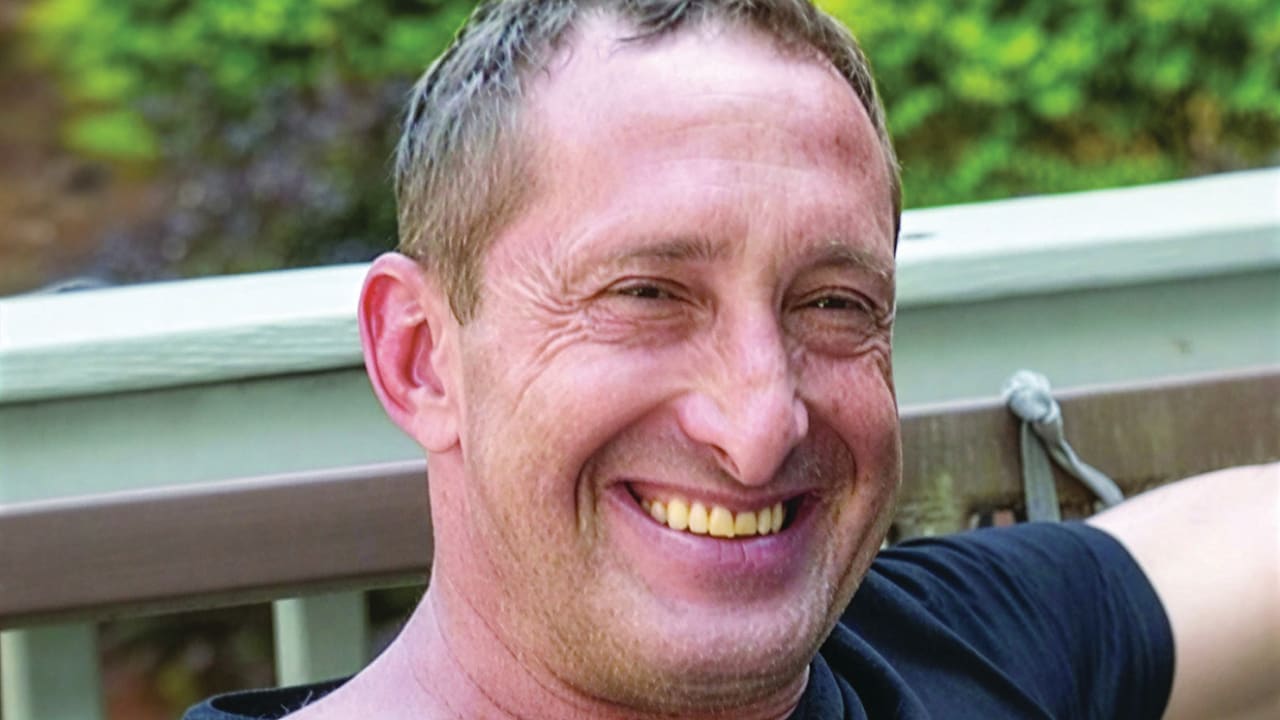
‘My cooking is more an expression than a profession,” says Larry Liss. “The plate is a canvas that I paint with colors, taste, and texture. Some people dance, some people sing, some people draw and paint. I cook.”
For most of his life, cooking has been the skill that has sustained Liss, not only financially but spiritually, emotionally, and psychologically. It is his muse.
Liss, who was born in Valencia, Venezuela, but grew up in the American South – he had lived in Maryland, Virginia, Mississippi, North Carolina, South Carolina, and Georgia by the time he was 10 – still retains the southern drawl typical of those who have lived below the Mason-Dixon Line. After his parents divorced when he was nine, his mother remarried and moved, together with young Larry and his two sisters, to Tega Cay, a planned community in South Carolina, not far from Charlotte, North Carolina.
“We were the only three Jewish kids in the Fort Mill school system,” recalls Liss.
The family attended a Reform synagogue in Charlotte, but despite his relatively meager Jewish background, Liss always had an affinity for Jewish practice.

“When I grew up, I had an uncanny connection to Judaism. I would walk around the house wearing a sweater in the middle of the summer. My mother would ask me, ‘What are you doing?’ I’d say, ‘I heard it’s really hot in Israel, so I need to get used to it.’ I asked her if I could wear tefillin to school one day. She said, ‘I don’t think it’s a great idea.’”
Liss majored in psychology and religious studies at the University of North Carolina at Chapel Hill and graduated in 1989. Another facet of his interest in religion stemmed from a year he spent in India after his second year of college, studying Tibetan Buddhism in Dharamsala, in the outer Himalayas.
As a child, Liss enjoyed assembling model trains and planes. “It really interested me to put these pieces together and create something,” he says. “As a teenager, I don’t remember how it started, but food became these pieces. I couldn’t draw or sing to be creative, but I could put all these pieces together in interesting and unique ways and create something. I had some innate way to combine spices and knew how much to use to get the idea in my head onto a plate.”
A child of the South, Liss grew up on southern cooking. “I know it. I love it. I never ate pork in my life, regardless of my religious practice. In the South, there’s a lot of pork. They throw a piece of pork together with green beans. I had to learn how to develop some of the same flavors without pork. I had a good friend, a black woman who grew up on a farm in the country, and she said my collard greens were some of the best she’d ever had. With no pork.”
Toward the end of his college years, he was asked to cater an event. “I started realizing that I could make money with my hobby.” Liss began cooking at a few small restaurants in Chapel Hill. He studied at the Crook’s Corner restaurant under Bill Neal, the legendary chef and restaurateur, who was instrumental in spreading the culinary significance of the American South. “I learned a lot there because he took me under his wing,” says Liss.
Still searching for culinary excellence, Liss set out for France in 1990, where he spent five months in culinary training, first in Bordeaux, and then in Arles, where he worked at a family-owned restaurant.
“Here comes your Israel part,” says Liss with a smile, as we proceed to the next part of his life story. “Go to Israel and do a kibbutz ulpan, like everybody does when they’re in their 20s, right?”

In 1990, Liss traveled to Israel and visited with friends living on a kibbutz. He became disillusioned when they served bread in the cafeteria during his Passover visit. “I can do this in South Carolina,” he recalls. “I don’t need to be in Israel.”
To ease his disappointment, one of his friends suggested he try a free ulpan program at the Ohr Somayach yeshiva in Jerusalem. The agreeable Liss headed to Jerusalem and spent the next three years studying in yeshiva.
Strong Jewish identity
“The interesting thing about this,” he says, “is that even if I would study the other religions in depth and would be offered to take initiations [the rituals that activate a practitioner’s Buddha-like nature] by the Buddhas, I would say no, because I really had such a strong Jewish identity, and I felt that I was there to study it, not to be it.” But when Liss was introduced to Jewish practices, he eagerly embraced them. “Within the three months that I was at Ohr Somayach, I was shomer Shabbat and shomer kashrut.”
Liss returned to the US to study at an Ohr Somayach branch in Monsey, New York, but soon felt a bit disconnected from his studies. He returned to his culinary world and began working at the Levana kosher restaurant on the Upper West Side of Manhattan. Eight months later, he connected with Edna Lewis, the well-known chef celebrated as the “Grand Dame of Southern Cooking,” who sent him to a restaurant in Durham, North Carolina, where he worked as a pastry chef for a year or two.
The peripatetic Liss returned to New York and worked as a waiter at a Bergdorf Goodman store café before taking another culinary leap, becoming the chef for billionaire investor and philanthropist George Soros at his summer home in Southampton.
After five years, Liss was on the move once again, this time to Washington, DC, for a 10-year stint that lasted from 1996 until 2016. During that period, he worked as a chef for a family, catered events, and, for the last six years, worked for the Franciscans at Capuchin College, a Catholic seminary.
By this time, Liss had tired of his life in Washington and was considering returning to Israel. “The reason I came here was not for any particularly Zionistic or religious reasons,” he muses. Rather, he says, it came from his fascination with seeing how people could move from country to country throughout Europe. “I just thought it was so fascinating that somebody could live in a completely different place, and I thought I’d like to do that one year and try it with Israel.”
Liss became friendly with one of the senior fathers at Capuchin, who tutored him in Hebrew and offered him the possibility of staying in Israel at the Franciscan friary in Jerusalem until he got settled.
Arriving in Israel in 2015, Liss cooked for the friary members in Jerusalem. After a two-month stay at the friary, he decided to try living in Israel. He returned to the US, packed up his things, and arrived in Israel in January 2016. “It was a two-year experiment,” he says, “and we are now 10 years later.”
Liss decided to open his own catering business, which he dubbed Chef at Home, in which he cooks and prepares food in the client’s home. “There’s no way for me to satisfy everybody’s level of kashrut,” he points out. “I come to your house and cook there. This way, I’m using your pots and pans and your kitchen. You don’t need to worry about where I cook the food. I can buy the ingredients, or you can buy them and have them there when I get there.”
While the business has not been a rousing financial success, Liss has made many friends in Jerusalem, young and old, through his culinary adventures and pleasant disposition. Smiling, he recalls an Independence Day barbecue he hosted when his mother was visiting several years ago. “My mother came here after two years, and I was a little embarrassed because, financially, I hadn’t done very well. But the apartment was completely full. I looked around the room, and I told my mom, ‘You know what? I did great.’”
In addition to his traveling chef business, Liss also works at a pizza diner in the evenings, and has recently started another business, selling homemade pareve chocolate chip cookies through the eponymously named Larry’s Cookie Company.
Liss enjoys taking classic American dishes and adding a special touch with indigenous ingredients. “I might make étouffée [French for ‘smothered’], a southern dish that’s smothered with onions, peppers, or carrots. I might add a little tehina to it or za’atar and use the same technique.
“I like being creative with cooking. I like taking things and designing. It gives me the most pleasure when somebody lets me do a seated dinner rather than drop off some food. Because then I can present what I want to. It really gets me going when I can create something that somebody hasn’t ever tasted or seen. It’s an art for me.”
Liss admits that life in Israel is not easy, especially without any family, but his close friends have made it all worthwhile. “There have been plenty of times when I’ve said, ‘I’m out of here. But it’s because I have so many good friends – not just friends you meet for coffee a couple times a month, but ones that if I say I need them, they’re right at my door.
“I had my 60th birthday at the diner, and the place was full. Somebody came up to me and asked, ‘How do you know all these people?’ I don’t know – they just came to me, and that’s the most amazing thing about being here.”
With a lifetime of culinary skills, what foods does Liss prepare for himself? “Cooking for me is eggs and oatmeal. Sitting in the corner of the counter with a cup of cottage cheese is a perfectly fine lunch for me. But if I have one person show up at my house, I pull out all the stops. I like to flex my culinary muscles.”
Larry Liss From Washington, DC to Jerusalem, 2016