Fossil
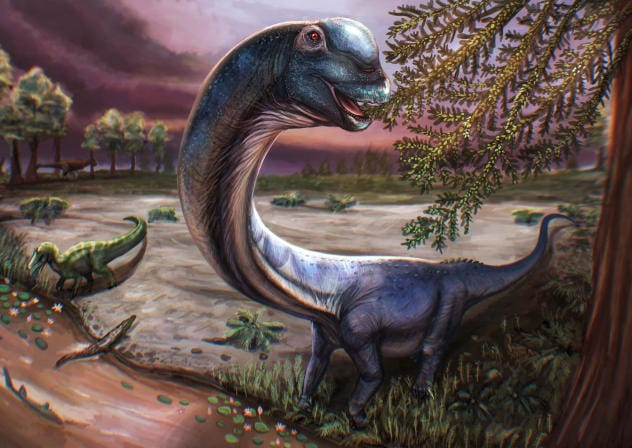
Scientists unearth fossil of Southeast Asia's largest dinosaur in Thailand
Nagatitan lived at a time when Earth's atmospheric carbon dioxide levels were rising, coinciding with high global temperatures.

Newly discovered fossil challenges idea of ape origins in east Africa - study

Stone handaxes found in Galilee show early humans valued aesthetics of their tools - study

Fossils of a new species of huge dinosaur Spinosaurus unearthed in Niger
25,000-year-old elephant ancestor found in Chandrapur
Along with the fossils, paleolithic tools were also found at the site, indicating that early humans lived with these giant elephants and perhaps hunted them.

Study: Private collectors own majority of T. rex fossils, limiting research
Commercial collectors have discovered 2.4 times more T. rex fossils than public institutions since the early 1990s.

Mass spectrometry identifies mysterious jawbone as Male Denisovan, rewriting prehistory
Researchers used ancient protein analysis to identify the fossil.

Paleontologists unearth 230-million-year-old mass grave of giant amphibians in Wyoming
The fossil find includes at least 19 individuals of the species Buettnererpeton bakeri, which were as large as adult alligators.

Previously unknown dinosaur species discovered in Portugal's Lusitanian Basin
‘This specimen reflects that iguanodonts had a much greater diversity than previously thought,’ said Bruno Silva of Universidade Nova de Lisboa.

Volcanic ash preserved the feathers of this 30,000-years-old vulture in exquisite detail
This discovery marks the first-ever record of such preservation, representing an entirely new form of soft tissue preservation.

Meet ‘Fiona’, the pregnant “Sea Dragon” fossil
The fetus, measuring around 50 centimeters, was positioned in a way that indicates it was in the final stages of prenatal development, suggesting it was possibly ready to be born.

Oldest known ceratopsian dinosaur fossil discovered in Morocco
The femur shows distinctive traits observed exclusively in ceratopsians, confirming their existence in the Middle Jurassic.

Australian scientists find 15-million-year-old previously unknown fish species
The fossil preserved the stomach contents, allowing for insights into the behavior of ancient fish.

New species of primitive lizard 'Marmoretta drescherae' identified in Portugal
A new species of primitive reptile, named Marmoretta drescherae, was identified from fossils unearthed in Portugal dating back 150 million years ago.
