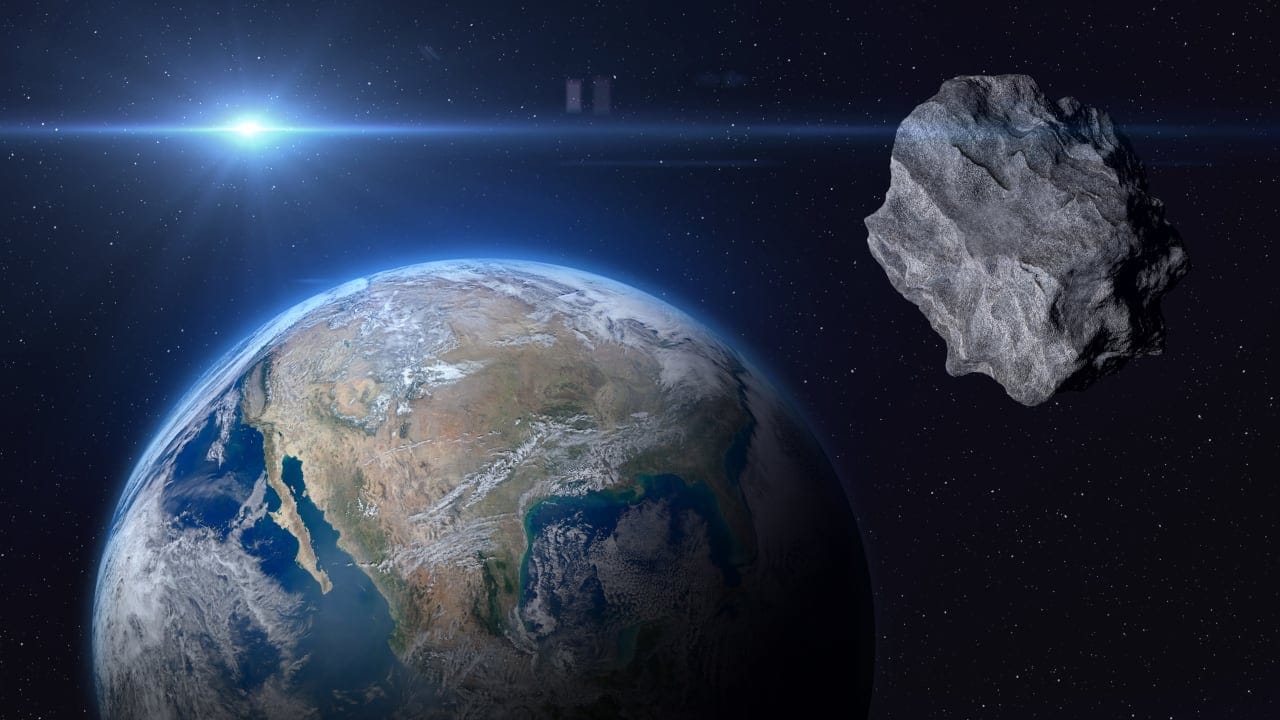
An asteroid is set to fly within 176 Bulgarias of the Earth on Monday, May 18, according to NASA's asteroid tracker.
The asteroid in question has been designated 2026 JH2 and is one of several asteroids set to fly past the planet on Monday, according to the Center for Near-Earth Object Studies (CNEOS) at NASA's Jet Propulsion Laboratory (JPL).
Noteably, while the asteroid's expected distance from the Earth is several times greater than that of Bulgaria – a country that, in no way coincidentally, won the 2026 Eurovision Song Contest shortly before this article was written – the asteroid's expected diameter is several orders of magnitude smaller than the large Balkan country.
How big is the asteroid in respect to 2026 Eurovision winner Bulgaria?
To answer the question posed by that in-no-way-geared-for-SEO subhead (doesn't sarcasm just convey so well over text?), asteroid 2026 JH2 is said to be 33 meters in diameter at most, based on NASA's estimations.
This may come as a surprise to some (American) readers, but Bulgaria, which, as mentioned earlier, won the 2026 Eurovision Song Contest with the song "Bangaranga," is considerably bigger than 33 meters, to say the least.

Multiple studies and analyses have put Bulgaria's total length at 520 kilometers. So, how much bigger is Bulgaria than asteroid 2026 JH2? Over 15,000 times bigger.
That, again, is not a surprise. But what is a surprise is the distance of how close the asteroid will fly past the Earth. And spoiler alert: It's very close.
Sofia and sound: How close will asteroid 2026 JH2 fly to the Earth? In terms of Bulgaria?
Asteroids fly past the Earth all the time, but they usually don't come too close, with the notable ones being millions of kilometers away.
But that's not the case here. At its closest approach during its flyby, asteroid 2026 JH2 is predicted by NASA to come within 91,600 kilometers of the Earth.
Now let's use a more entertaining measuring stick: The nation of Bulgaria.
Since Bulgaria's diameter is around 520 kilometers, we just need to do simple division to find out that the distance of 91,600 kilometers is equal to roughly 176 Bulgarias. In other words, you could fit Bulgaria 176 times between the Earth and asteroid 2026 JH2.
Now, in retrospect, using countries as a unit of measurement does make the distance between this asteroid and Earth seem a bit large. However, it is in fact much closer than it seems.
Let's use a different example: the Moon.
The Moon orbits the Earth at an average distance of 387,000 kilometers. To go back to our handy Balkan measuring stick, that's over 744 Bulgarias.
Asteroids coming between the orbits of the Earth and Moon are much rarer, putting it closer to some satellites.
However, current calculations say that asteroid 2026 JH2 will safely pass the Earth.
But... what if it didn't?

Bangarangasteroid! How much destruction would asteroid 2026 JH2 cause if it hit the Earth?
Generally speaking, most asteroids that hit the Earth burn up in the atmosphere, with asteroids needing to be above a threshold of 140 meters in diameter to be considered especially dangerous and catastrophic.
But at 33 meters, asteroid 2026 JH2 wouldn't necessarily be entirely harmless.
As seen with other smaller asteroid impacts, the result would cause a massive airburst when it explodes in the atmosphere, creating a loud sound and force spreading out from the epicenter.
For instance, in 2013, an asteroid between 17-20 meters in diameter exploded above Chelyabinsk, Russia. In that case, the shockwave caused thousands of windows to shatter, and many people were injured and in need of medical attention due to the shattered glass. But that was the extent of the incident.
At 33 meters, asteroid 2026 JH2 would likely be a bit stronger, but not too much. However, this depends heavily on the composition of the asteroid as well as its density. Since many, if not most, asteroids are theorized to be rubble piles – as in conglomerations of small rocks and space dust held together loosely by gravity – the actual mass and makeup of the asteroid isn't clear. But considering it isn't going to impact the Earth, there's nothing to worry about.
Regardless, scientists are hard at work trying to prevent an asteroid from becoming a threat in the future.
The field of planetary defense has been pushing hard for solutions to defend the planet against menacing space rocks. Models such as kinetic deflection (punching an asteroid with a spacecraft of some kind to shift its orbit slightly), explosives (exactly what it sounds like), and more have been proposed, with NASA's Double Asteroid Redirection Test (DART) Mission being a landmark effort in this regard.
And that's without mentioning the numerous private sector efforts.
Luckily, there hasn't been a major risk of catastrophic asteroid impacts lately, and estimates by NASA put the 21st century as largely risk-free of these possible disasters.
Still, the space sector has seen rapid growth, with many countries having signed on to NASA's Artemis Accords, which provide a common set of principles regarding space exploration and the use of outer space in general.
And, fitting the overall theme of this article, one such signatory is, of course, Bulgaria.