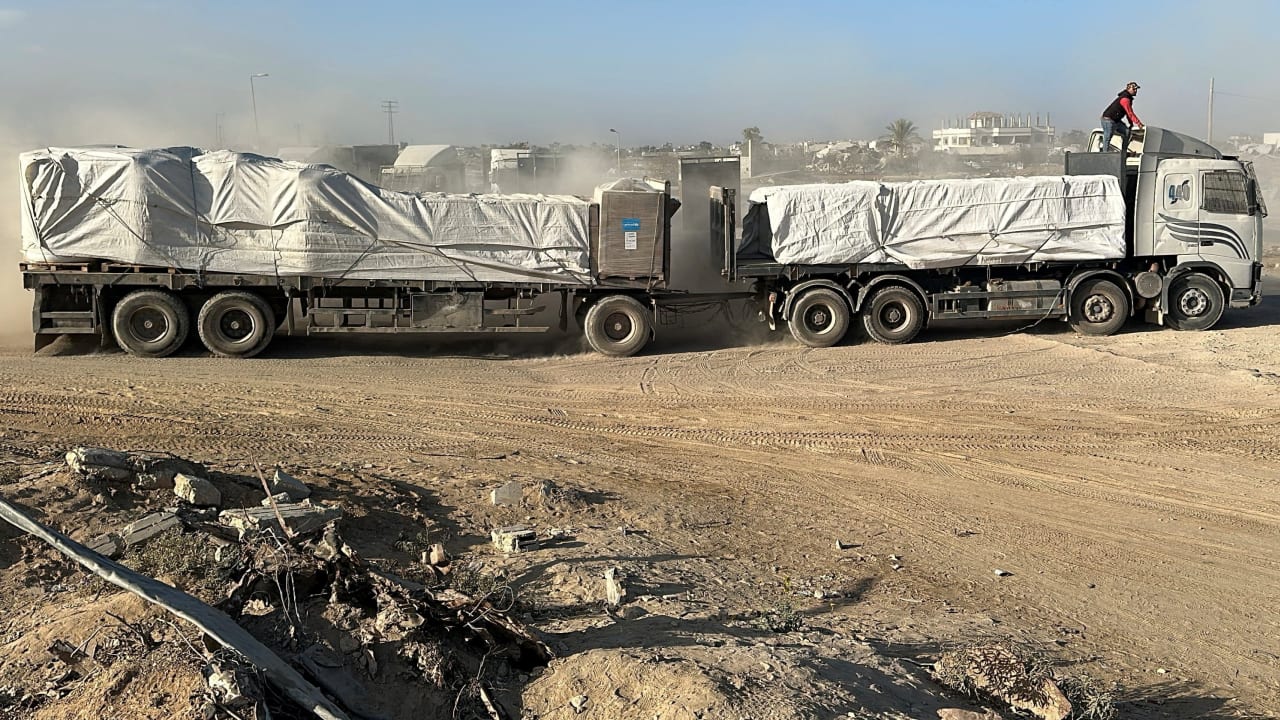
The volume of humanitarian aid trucks should be reduced from 600 to around 200 per day as part of Phase II of the US ceasefire plan, IDF sources recommended on Thursday, since pre- and post-war professional evaluations show that the Gazan population only requires 200 trucks per day.
In that light, the IDF said that almost all trucks that enter Gaza above the 200-point mark, and certainly up at levels like 600, are taken by Hamas and used to solidify its control of the Strip.
The IDF believes that although Israel was obligated to send 600 trucks per day as part of Phase I of the ceasefire in October 2025, partially to restore long-term food security and partially simply to build goodwill with the Trump administration, Phase II can and should be different.
IDF sources contend there is no obligation to maintain the 600-truck pace in Phase II, which is far above the pre-war average of closer to 200 trucks per day, especially as international NGOs are getting exhausted by keeping up such a pace.

What could happen next in Gaza?
What else should or will happen regarding civilian issues in Gaza during Phase II besides the humanitarian aid issue?
According to the IDF, Hamas will accept the Palestinian technocrat committee, the National Committee for the Administration of Gaza (NCAG), as a tactical retreat with the goal of controlling it from behind the scenes, as Hezbollah has done in Lebanon.
Further, the IDF stated that in many ways, handing over civilian functions to the NCAG makes Hamas’s life easier, as they do not need to invest time on civilian issues, which matter to them less than maintaining their military power.
Moreover, the IDF said that even though the NCAG will not be formally controlled by Hamas and is mostly informally under the sway of the Palestinian Authority, it will still need to rely on lower-down officials in the field who are under Hamas control.
The IDF described a three-level structural breakdown of how Gaza had and will run in the future.
At the top will be the NCAG, who will give directives to the higher-level regional administrators, who will in turn direct the local administrators.
These two lower levels are both staffed by Hamas officials or at least associated officials.
The IDF also predicted that even if the NCAG has started some of its work, it will need two to three months to actually get in touch with the two lower levels of Gazan officials in order to truly impact what is going on in the field.
Only after a substantial amount of time, noted the IDF, will the NCAG be stable enough – and have a clear idea of the various officials involved – to begin a gradual process of replacing some of the lower-level officials who are too deeply connected to Hamas.
Likewise, only at a later stage will the NCAG be able to fully approve the continued employment of other lower-level officials whose loyalty to Hamas was always looser and could be broken given the new environment.
Hamas may pretend to give up control
The IDF said that Hamas may pretend to give up control in certain areas, and even allow some of its civilian officials to be replaced.
However, this would just be a tactical retreat, and the terror organization would still seek to control key institutions, such as Shifa Hospital, key water authorities, and critical education officials.
Another IDF prediction was that, over time, a mix would emerge combining a Hezbollah-style model of behind-the-scenes control with a process of replacing some Hamas officials, but that this would not succeed in truly dislodging Hamas from power absent an additional, later round of military pressure.