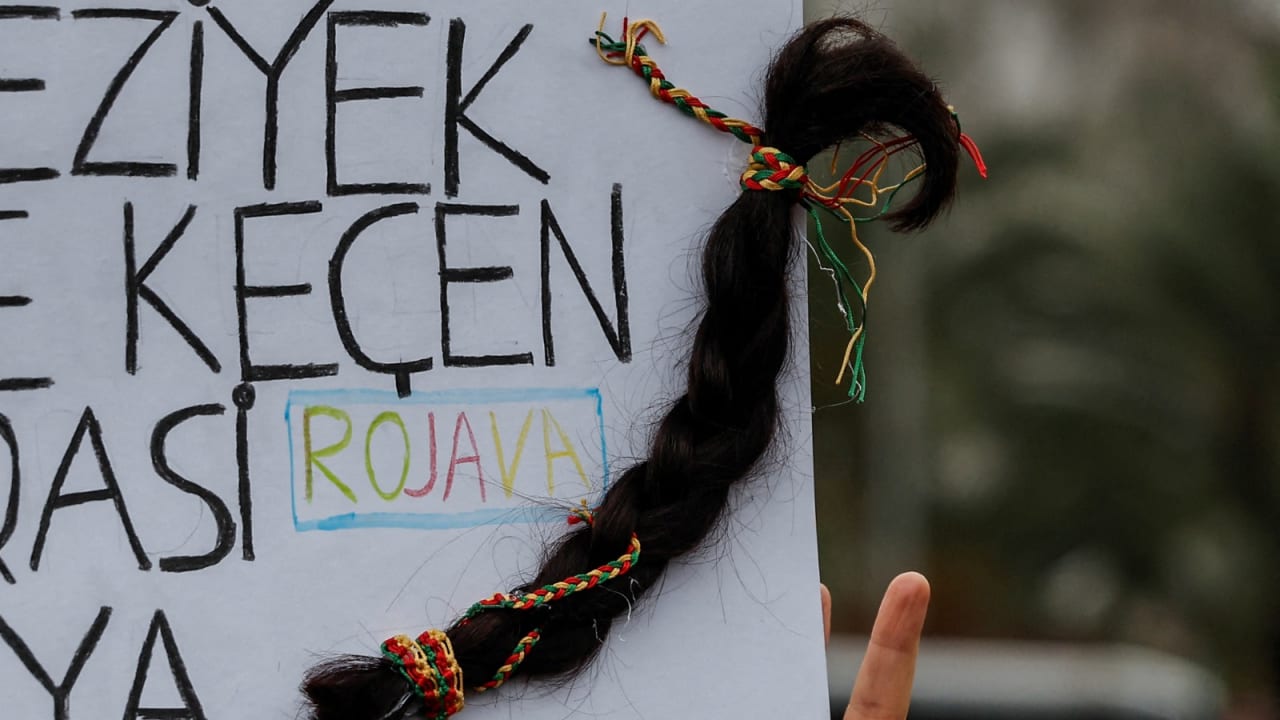
Across global demonstrations and in thousands of videos posted online, Kurdish women and their allies have begun braiding their hair in honor of a female Kurdish Syrian Democratic Forces (SDF) fighter believed to have been murdered by a member of the Syrian army.
The campaign was sparked by a viral video, which The Jerusalem Post was unable to independently verify. In the footage, a man alleged to belong to the Syrian regime’s military can be seen holding a severed braid of hair.
When questioned in the video why he would cut a woman’s hair off, the alleged militiaman responded, “She was already dead,” according to a translation provided by the Kurdish outlet Rudaw. The man referred to the hair’s owner as “Haval,” meaning comrade, which indicated that she was a fighter.
The New Arab later reported that the man posted another video denying that the braid was real hair, claiming the incident was “a joke.”
The Switzerland-based Kurdish-Jewish Alliance told the Post it condemned the incident, describing it as “a blatant insult to women and a grave violation of human dignity.”
As Syrian regime forces have launched attacks on the Kurdish-controlled Rojava, demanding full control be handed over from the formerly US-backed SDF, civilians have increasingly been caught in the crossfire.
Human rights organizations and Kurdish groups have warned of massacres of civilians, the use of sexual violence, and an emerging humanitarian crisis driven by supply disruptions and displacement.
“In the propaganda ping-pong between the SDF and Syrian government forces around who is committing which abuse, civilians are paying the highest price,” said Adam Coogle, a deputy director with the Middle East and North Africa division of the Human Rights Watch. “Taking or holding territory militarily shouldn’t come by violating the rights of people living there.”
Human Rights Watch also noted that it had received videos showing members of the Syrian army desecrating the bodies of female fighters. In one video, a Syrian soldier can be seen yelling “God is great” while throwing a woman from a building. The organization noted it was unclear whether the woman was alive before being thrown.
Gülistan Savgat, a board member of the Kurdish-Jewish Alliance and a women’s rights advocate, said Kurds would continue braiding their hair in “kezi” – “the braid of unity” to show “that we Kurds will always resist and will not allow Kurds to be oppressed.”
“The aim of this solidarity campaign was to draw attention to the systematic violence, demand accountability from those responsible, and speak out against the widespread hate speech on social media that justifies and glorifies such practices,” she said.
According to Savgat, “In Kurdish culture, a woman’s braid is more than just hair. It embodies identity, origin, dignity, and memory. The braiding styles reflect regions of origin and are passed down through generations from mothers and grandmothers.”
Elyana Elyan, a political researcher, adviser to the Kurdish Jewish community, and activist based in Israel, explained that much of Kurdish culture and belief revolves around women’s hair. Women’s braids are considered so treasured among Yazidi Kurdish women that widows cut off their braids and place them on the graves of their loved ones as a sign of loss and mourning.
Nesrin Abdullah, a commander and spokesperson for the all-female Women’s Defense Units YPJ in Syria, shared on social media, “Tell the Islamists who want to cut off our braids: ‘My dignity is not in my braid.’”
“These developments have opened a Pandora’s box of complications not just associated with the failure to resolve post-ISIS issues, but broader crises around the transitional authorities’ ability to protect minority communities in Syria,” Coogle said. “So long as these questions remain unresolved, we can continue to expect instability in Syria.”
Turkish authorities deem Kurdish solidarity campaign criminal
While the braids have come to represent solidarity with Kurdish women brutalized in Syria, Turkish authorities have seemingly decided that participating in the campaign is a criminal act.
A nurse in Turkey’s northwestern province of Kocaeli was arrested earlier in the week after she participated in the online hair braiding campaign, according to Peoples’ Equality and Democracy Party politician Ömer Faruk Gergerlioglu.
The nurse recorded herself braiding her hair with the caption, “It may not be the same braid, but it is the same pain, the same feeling.”
Turkey views several Kurdish groups, including both the YPJ and the SDF, as terrorist organizations.
Since its founding in 2013, the YPJ is largely credited with helping reclaim the Syrian city of Kobane from the Islamic State and with providing protection to the Yazidi community trapped on Mount Sinjar in Iraq in 2014.
Much of their success is attributed not only to their skill as fighters, but also to the common belief among Islamist terrorists that those killed by a woman will not make it into heaven, according to PBS.
Elyan said that, ahead of battles, women would braid their hair to keep it out of their faces as they fought in the mountains. “They would also adorn their hair,” she said, describing videos of fighters braiding each other’s hair in the mornings.
“Hair is very much connected to honor,” she concluded.