
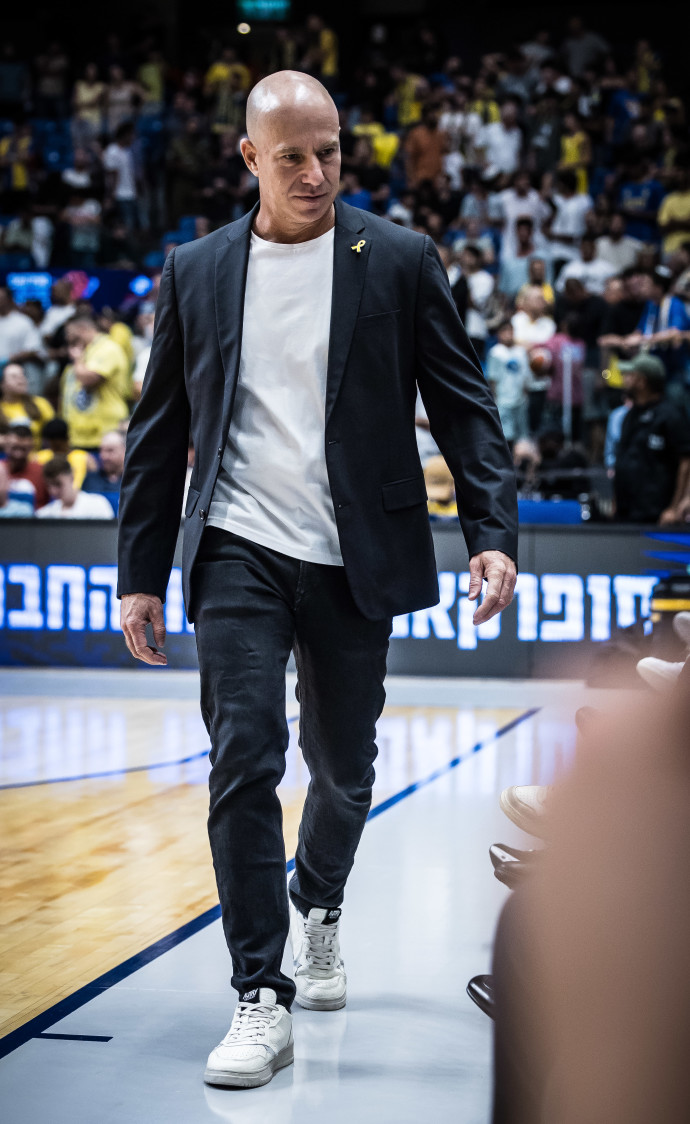
Ari Steinberg, chairman of Israel’s National Basketball League and the Wingate Sports Institute, and CEO of Ashmoret, the financial company of Israel’s teachers’ union, has his finger on the pulse of Israeli sports and education, and maintains that the two are intertwined and integral to the future of Israeli society.
“Sports and education are inseparable,” he said emphatically. “Both are built on the same foundation of values.” Teamwork, discipline, perseverance, and the pursuit of excellence are just as essential in the classroom as they are on the playing field, said Steinberg.

“Sports teach people how to compete with integrity, push beyond their limits, and work hard toward a goal. They also have the power to bridge social divides, strengthen communities, and build resilience both in individuals and in society as a whole,” he continued.
Commenting on the future of Israeli sports, Steinberg said that a great deal depends on the state of the country. If Israel can resume a normal, non-emergency, and non-war footing, then sports will grow and prosper. “Quiet is what we need. If we have that, our achievements will be incredible,” he promised.
Steinberg, who entered the Israeli sports world after a successful career in both the business and public sectors, previously served as Deputy CEO at The Federation of Local Authorities in Israel. He lives in Herzliya with his wife Noa and their three children, all of whom are competitive athletes in various sports.

Since Oct. 7, he observed, Israeli athletes have been forced to endure hardships that no other athletes in the world have encountered. In Israel, training has been disrupted by war, professional leagues have had to cancel games and, at times, halt entire seasons, and Israeli teams lost the ability to host international matches at home.
Referring to the enemies of the Jewish people and to those who oppose Israeli participation in international sports, he said firmly, “They will not break us. Israeli and Jewish athletes will continue to compete, to stand tall in the face of these attacks, and to bring pride, medals, and international achievements.
“We want to increase Israel’s sporting achievements. The more people who participate, the more achievements and accomplishments we will have.”
Even Israeli sports fans have been threatened. In November 2024, during the match between Maccabi Tel Aviv and AFC Ajax in Amsterdam, Israeli fans were violently attacked outside the stadium by organized anti-Israel groups. Supporters – including families and children – were chased and assaulted in scenes that shocked Jewish communities around the world.
Overseas, Israeli athletes competing for international teams are increasingly confronting serious challenges, including harassment by antisemitic groups, anti-Israel protests, boycotts from competitors, and even reluctance by some clubs to sign Israeli players out of concern over fan backlash.
The only way to counter the threats to Israeli sport, Steinberg says, is by being resilient and not giving up
Paradoxically, added Steinberg, the difficulties Israeli athletes have encountered have hardened them and contributed to their success. “If you can survive, you can fly,” he said.
Another reason he cited for the increased success of Israeli athletes internationally is today’s interconnected world: “Once, if you were talented, no one might know about you. Now, if you are talented, they will find out about you, and you can achieve great things.”
In recent years, Israeli athletes have distinguished themselves in team sports, such as basketball, as well as individual competitive sports, such as judo, gymnastics, and swimming.
“Sports require a healthy mental outlook, and in light of this, our accomplishments are remarkable,” he commented.
Israeli athletes have made their mark around the world in a wide variety of sports.
This year, Portland Trail Blazers forward Deni Avdija became the first Israel-born player to be named an NBA All-Star, while judokas Raz Hershko, Timna Nelson Levy, and Itzhak Ashpiz earned medals at the recent European Judo Championships (Hershko received a gold medal, Levy a silver, and Ashpiz a bronze).
Artistic gymnast Artem Dolgopyat was the 2023-2024 world champion in floor exercise and won a silver medal at the 2024 Paris Olympics.
Underscoring Steinberg’s point regarding the difficulties Israeli athletes have encountered in competition, he noted that Dolgopyat, along with the entire Israeli delegation, was barred from participating at the 2025 World Artistic Gymnastics Championships in Indonesia.
Steinberg noted that the war and the antisemitism that has accompanied it have cast a pall on sports in this country: “When one is dealing with personal and national security, sports are the last thing that interests people.
“Apart from the security issues, there was a great deal of antisemitism. I deal specifically with basketball, and we were dealt a serious blow when Israeli teams couldn’t play in Europe and couldn’t host their home games in Israel because other teams wouldn’t come here.
“Imagine if, in the NBA, the New York Knicks couldn’t play their home games at Madison Square Garden and had to play in Canada. That’s what this was like for us,” he said.
This past June, the 2024-25 Israeli Basketball Premier League season concluded without a champion being named due to ongoing safety and security concerns.
As for individual competitive sports, Steinberg said that many Israeli athletes were unable to participate because either there were no flights to the countries hosting the competitions, or the number of flights was so limited that they could not obtain a reservation.
In these competitive sports, he noted, “If you are not in the competition, you lose the opportunity to compete in the Olympics.”
“We have had three years of this,” he said sadly.
The only way to counter the threats to Israeli sports, Steinberg concluded, is by being resilient and not giving up. “In Israel,” he said, “sports are a vital necessity. You have to live. And sport is life.”
One of the key factors contributing to the increased excellence among Israeli athletes, explained Steinberg, is the Wingate Institute, the National Center for Physical Education and Sport – the home of Israel’s Olympic athletes.
He pointed to the Wingate Academy for Sports, which provides talented teenagers aged 13 and up with a rigorous environment that combines academic education with high-performance athletic training. But Steinberg’s vision extends beyond developing champions.
Wingate is preparing to expand, with new branches planned for Beersheba in the south and northern Israel – an effort he sees as transformative not only for Israeli sport, but for society as a whole.
“This will be a game changer,” he said. “It will open doors for young talent in the periphery who may never have had access to these opportunities before. There are future champions out there we simply haven’t reached yet.”
Steinberg next discussed his role as CEO of Ashmoret, the financial company of the Teachers Union in Israel. Ashmoret is Israel’s largest credit card club for educators and members of the Israel Teachers Union, with annual credit card revenues of $5 billion.
It serves teachers, principals, inspectors, education students, and their families, offering financial services, benefits, cultural events, and a branded credit card program for its hundreds of thousands of cardholders.
“Teachers and educators are not among the highest paid workers in our society,” said Steinberg, “and that is not good, because education is the most important thing. We need to continue investing in education to survive.
“At Ashmoret, we use our buying power for good, for those who have Ashmoret cards. In addition, Ashmoret owns almost 50% of Massad Bank, providing additional benefits to Ashmoret members, including attractive loans, car purchase discounts, and real estate opportunities.
“We are a major part of the financial well-being of teachers and educational personnel, and it is a great honor to work on their behalf,” he concluded.
Steinberg will be speaking at the Jerusalem Post Annual Conference, which will be held in New York on June 1, and will urge members of the Jewish community in the Diaspora to use their influence to help them overcome the various bans and antisemitic activity that Israeli athletes have been facing.
He views his work in sports and education as contributing to the strengthening of Israeli society.
“I see it as a civic mission for the public good, and as something that contributes to the resilience of the state of Israel,” he said.
This article was written in cooperation with Ari Steinberg.