Yashar party leader Gadi Eisenkot received the mandate to form a government from President Isaac Herzog on Sunday during an official ceremony at the President’s Residence, as the opposition bloc, seeking to replace Prime Minister Benjamin Netanyahu, has continued its efforts to secure coalition partners.
By law, Eisenkot will now have 28 days to form a government, and the president may grant an extension of up to 14 additional days if necessary.
The Yashar leader said at the ceremony that “unconventional steps” would be required to form a government, reiterating his call for a “national emergency government.”
Party leaders in the opposition bloc have recently opened the door to negotiations with the haredi (ultra-Orthodox) parties after once drawing a red line to partnering with them. In contrast, Democrats party leader Yair Golan has called for forming a coalition with the Arab parties.
Eisenkot said that the country is in a state of emergency, “approaching a point of no return for the State of Israel.”
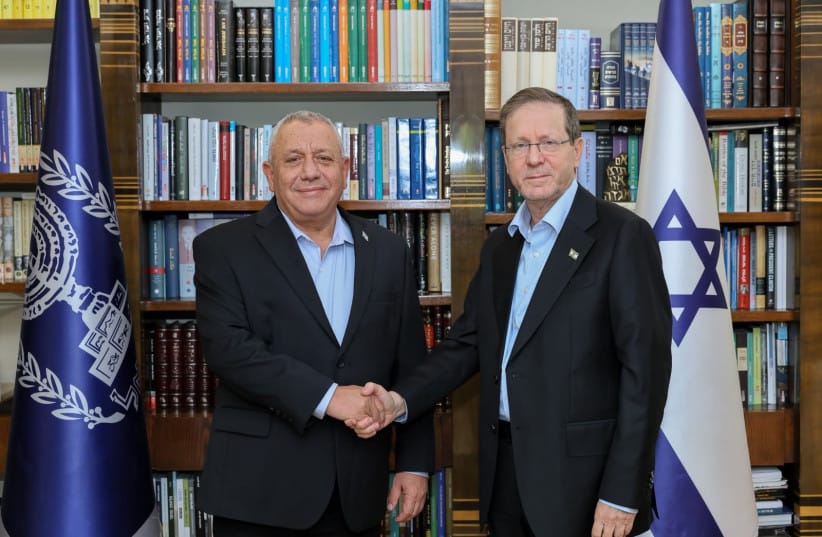
“We must establish a national emergency government. Creative and unconventional political steps will be required,” he added.
Eisenkot said that things must be done differently following this round of elections and after “the difficult years [Israel] has endured.”
“The days when Israelis felt excluded by their government must come to an end and must never return,” he said.
'A full heart and a willing spirit'
Addressing all Knesset parties and their members, Eisenkot called on them to cooperate with him and accept the four principles he has recently laid out as a condition for joining his coalition.
He said that his “door was open” and his “hand was extended with a full heart and a willing spirit.”
“If Likud and the Religious Zionist Party members truly believe that this is a time for unity, as they declared before the president, I cannot imagine a reason why they would not join and support a government under my leadership and based on the principles I presented,” Eisenkot said.
Herzog called for unity during the ceremony as he handed Eisenkot the mandate.
The president said that Israel was in need of a stable government and that the time had come “to reach out a hand, to do everything for the unity of our people, and to strive for the best and most stable government possible for the people of Israel who yearn for it.”
Eisenkot receives 67 recommendations in the week following elections
Addressing Eisenkot, Herzog said: “I expect you to do everything in your power to establish a government that will serve the entire people.”
Herzog also acknowledged that while Netanyahu’s Likud remains the largest faction in the Knesset, holding 27 seats, Eisenkot received the most recommendations from Knesset parties during the consultations stage.
It was “evident” that Eisenkot had received the “clear and unequivocal support” of a majority of Knesset members on the most central question of “who has the better chance of forming the next government that will win the confidence of the Knesset,” the president said.
Eisenkot received 67 recommendations during consultations Herzog held throughout last week with representatives of all the parties set to serve in the incoming Knesset.
Netanyahu received 46 recommendations overall.
Eisenkot earned the backing of both Arab parties – Ra’am and the Joint List – although their recommendations do not commit them to ultimately joining his coalition.
The election results showed a political deadlock: no bloc won a 61-seat Knesset majority, leaving the path to forming the next government unclear.
Netanyahu’s bloc secured 53 seats, while the opposition bloc won 48. Ra’am and the Joint List won a record-breaking 19 seats combined.
All parties from the opposition bloc seeking to oust the sitting prime minister – Yashar, the Democrats, Naftali Bennett’s B’Yachad, and Avigdor Liberman’s Yisrael Beytenu recommended Eisenkot to form the next government.
Meanwhile, in Netanyahu’s bloc, the parties that recommended the prime minister included Likud, National Security Minister Itamar Ben-Gvir’s Otzma Yehudit, Finance Minister Bezalel Smotrich’s Religious Zionist Party, Moshe Feiglin’s Zehut, and Arye Deri’s Shas.
The haredi United Torah Judaism (UTJ) party, a longtime coalition partner of Netanyahu, declined to recommend a candidate for prime minister.
UTJ’s decision to abstain comes amid reported tensions between the haredi party and Netanyahu, and it benefits the opposition bloc seeking to replace him.
Opposition party leaders have recently signaled greater openness to including haredi parties in their coalition, beginning to hold talks with them as well.
The political deadlock could ultimately lead to another election. Other possible outcomes include a unity government between Netanyahu and members of Eisenkot’s bloc, or a minority government.
What happens next?
Under Israeli law, if the candidate who receives the mandate fails to form a government within the allotted time, informs Herzog that the effort has failed, or presents a government that fails to win a confidence vote, the president must decide within three days whether to assign the task to another MK or inform the Knesset speaker that he sees no possibility of forming a government.
A second candidate would then have 28 days to establish a coalition, without the possibility of an extension.
If the second attempt also fails, or Herzog decides not to appoint another candidate, there are 21 days next in which at least 61 MKs can jointly request that the president assign the task to a particular lawmaker. That candidate would have 14 days to form a government.
Should all attempts fail, the Knesset would be dissolved, and another election would be held. Until a new government wins the Knesset’s confidence vote and takes office, the outgoing government remains in place in a caretaker capacity.
Shir Perets contributed to this report.