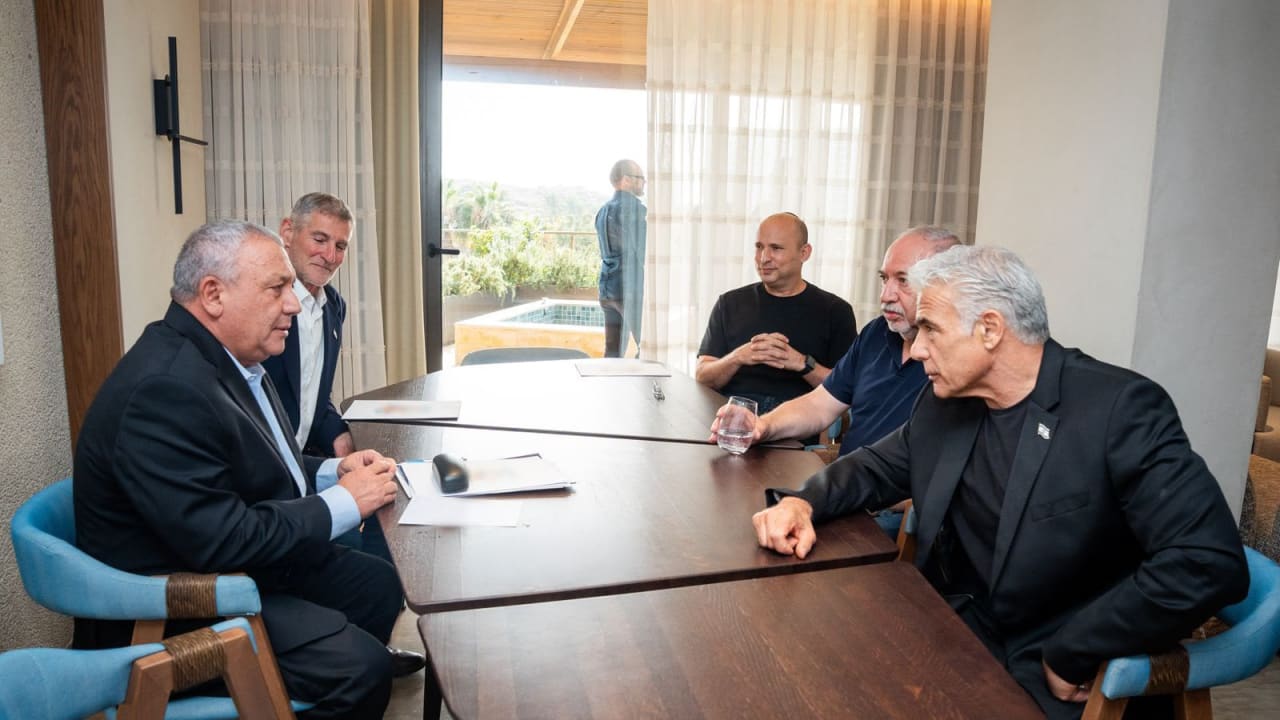
Israel's opposition party leaders agreed to work toward forming a "national emergency government" as soon as possible, saying they would act immediately to do so in a joint statement following a meeting on Tuesday.
The leaders of the opposition bloc seeking to replace Prime Minister Benjamin Netanyahu met for the first time since the election, amid disagreements and a political deadlock between the two blocs, with no clear path toward forming a government.
Those attending the Herzliya meeting included prime ministerial candidate Gadi Eisenkot (Yashar), Naftali Bennett (B'Yachad), Avigdor Liberman (Yisrael Beytenu) and Yair Golan (the Democrats), along with outgoing opposition leader Yair Lapid, who holds the second slot on the B'Yachad Knesset slate.
The leaders said they were committed to honoring what they described as a clear voter mandate for change and against the continued tenure of the current government, which they referred to as the “October 7 government.”
“The party leaders are in agreement on the need to establish a Zionist government based on the four principles set out by Eisenkot, as soon as possible,” the statement said. The Yashar leader outlined the four principles on Saturday.
The statement added that the parties’ negotiating teams would begin working immediately to formulate the government’s guiding principles and the agreements for the formation of the 38th government, and to "put the clear parliamentary majority in the Knesset to work."
The party leaders also agreed that all five parties would recommend to President Isaac Herzog that the Yashar chairman receive the first mandate to form a government, with the aim of establishing a new government as quickly as possible and avoiding another election.
Bennett: Eisenkot has opposition's full backing to form gov't 'as soon as possible'
As a potential alternative to securing a parliamentary majority, the party leaders reportedly agreed to explore negotiations with the haredi (ultra-Orthodox) parties, Channel 13 reported.
The report added that Golan had insisted on “leaving the door open” to a government with the Arab parties.
However, the party leaders did not reach an agreement on who the candidate to replace Knesset Speaker Amir Ohana would be, according to Hebrew media reports.
In a statement given following the meeting, former prime minister Bennett said Eisenkot had the opposition's full backing to "act as quickly as possible to establish a Zionist government of repair," arguing that the bloc needs to act "with great urgency.
"We have no time. We need to act with great urgency. Therefore, as soon as possible, we will take control of the Knesset, secure the mandate to form a government, and act as quickly as possible to establish a Zionist government of repair in order to bring about a revolution for those who serve and begin repairing the country," Bennett said.
Prior to the meeting, B'Yachad deputy Lapid also stressed the need for the opposition bloc to form a government.
"We are facing a serious and dangerous attempt to undermine the election results. We must form a government," he said. Netanyahu's Likud has alleged in recent days that there was election interference and that the Arab parties had “stolen” the election.
"The events of the past few days are just another reminder that we need to remove Netanyahu from the Prime Minister's Office," Lapid added.
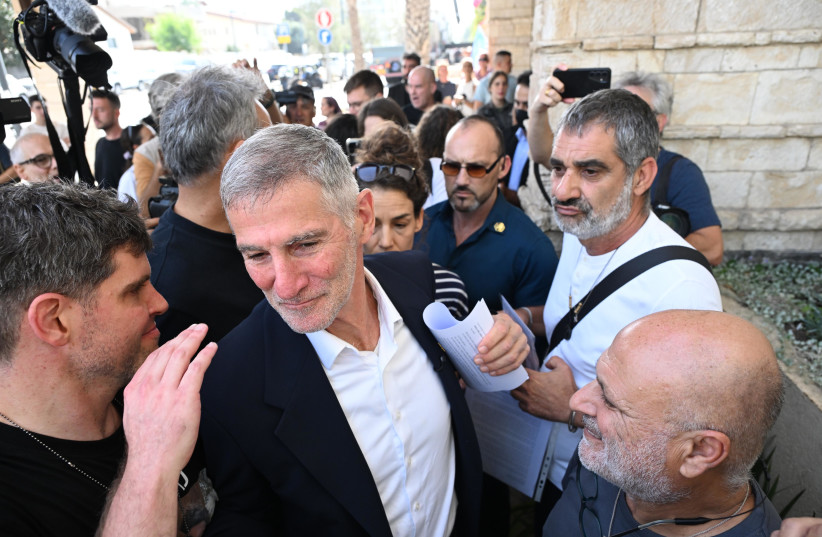
Victims and family members of those killed in the October 7, 2023, Hamas attacks arrived outside the meeting of party leaders to demand that they form a government to replace Netanyahu.
"You have a mandate. Do not lend a hand to legitimizing the leaders who were at the helm during the October 7 massacre. Establish a change government," they stated.
"The people voted no confidence in the October 7 government and gave 67 seats to the demand for change. You have received a mandate. Do not waste it on compromises that would legitimize those who were at the helm on October 7," they added.
Following the meeting, Eisenkot met with the bereaved family members and victims of the attacks, who presented him with a letter calling on him to “swear in the Knesset and establish a change government.”
The meeting comes amid numerous disagreements between the party leaders, although all have agreed to recommend Eisenkot, whose party won the most seats within the opposition bloc, to President Isaac Herzog as the candidate to form the next government.
Consultations at the President's Residence are set to begin on Wednesday. By law, the president is required to consult the Knesset factions before deciding who receives the task of forming a government.
Golan has called on the opposition party leaders to form a government with the Arab parties - Ra'am and the Joint List - who won a record-breaking 19 seats combined in the elections. With Arab parties, the opposition bloc would have a Knesset majority of 67 seats.
Yet Liberman reiterated on Tuesday ahead of the meeting that a coalition with the Arab parties was not an option. Bennett had also drawn a red line ahead of the elections against forming a government with the Arab parties.
However, Liberman has appeared more lenient about joining a coalition with the haredi parties Shas and United Torah Judaism (UTJ). On Monday, he said he would “have no problem” with anyone who accepted his set of principles and supported a conscription law requiring haredim to enlist in the IDF.
The support of the haredi parties could open a path for the opposition bloc to form a government. With their backing, the bloc would have 61 seats.
Political deadlock could lead to another election
The opposition bloc lacks the required 61-seat Knesset majority without the support of the Arab parties. The election results showed that Netanyahu’s bloc maintained its lead, securing 53 seats in the next Knesset, while the opposition bloc won 48.
The political deadlock could ultimately lead to another election, although the parties may still reach an agreement through coalition negotiations. Other possible outcomes include a unity government between Netanyahu and members of Eisenkot’s bloc, or a minority government.
Liberman also said on Monday that he opposed both a minority government and a unity government with Netanyahu.
Eisenkot's principles, which he laid out on Saturday, included bringing together elected representatives who agree on Israel’s fundamental character, national service obligations, and the need to eliminate Hamas’s military and governing capabilities in the Gaza Strip.
Meanwhile, the Arab parties have expressed willingness to cooperate with the opposition bloc to replace Netanyahu.
The meeting between the opposition party leaders also comes amid debate regarding who to select as the candidate to replace Knesset Speaker Amir Ohana, who is a member of Netanayhu's Likud.
Opposition party leaders have reportedly agreed that their first move after the new Knesset is sworn in on November 10 would be to oust Ohana.
The move would require a majority in a Knesset vote and could be achievable with the support of the Arab parties, bringing the potential backing to 67 seats.
Replacing Ohana would give the opposition bloc greater control over the parliamentary agenda, including votes, legislation, and committee appointments, even if Netanyahu remains in office as head of a caretaker government.
The Knesset is expected to be sworn in on November 10, regardless of any government or coalition talks.