
Fifty years ago, 90% of Israel’s wine vineyards were in the coastal area, around the southern slopes of Mount Carmel, and in the plain southeast of Tel Aviv. The authorities, in their wisdom, devised an official wine map in 1977.
It featured Samson and Shomron (curiously, one in Hebrew, the other in English) and had subregions like Nazareth, Kafr Kanna, Sharon, Dan, Latrun, Hebron, and Jerusalem. No one really understood what Samson represented, and everyone was confused by Shomron, which took in the hilly area from Zichron to Samaria.
With regard to the famous place names reeking of biblical history, they were inappropriate from the start. Wine grapes were simply not planted there. The map also divided Israel horizontally, when in fact the topography is vertical (coastal plain, rolling hills, mountains, valley).
Pretty soon it became obvious that the map was unsuitable. Furthermore, the Israeli wine scene changed so much each decade from then on. As the pursuit of quality became more important, the concentration of vineyards gradually moved northwards and eastwards in search of altitude, and the wine industry, a monopoly in the 1970s, became far more open and competitive as new wineries were formed. Big wineries began to chip away at Carmel in size, and a rush of boutique wineries challenged the Golan Heights Winery in quality.
It has taken an agonizing 50 years for the wine map to be updated. For half of that time, since the turn of the century, creating a new wine map has been a stated objective. Maybe there was too much politics and too much interested-party influence from the larger wineries.
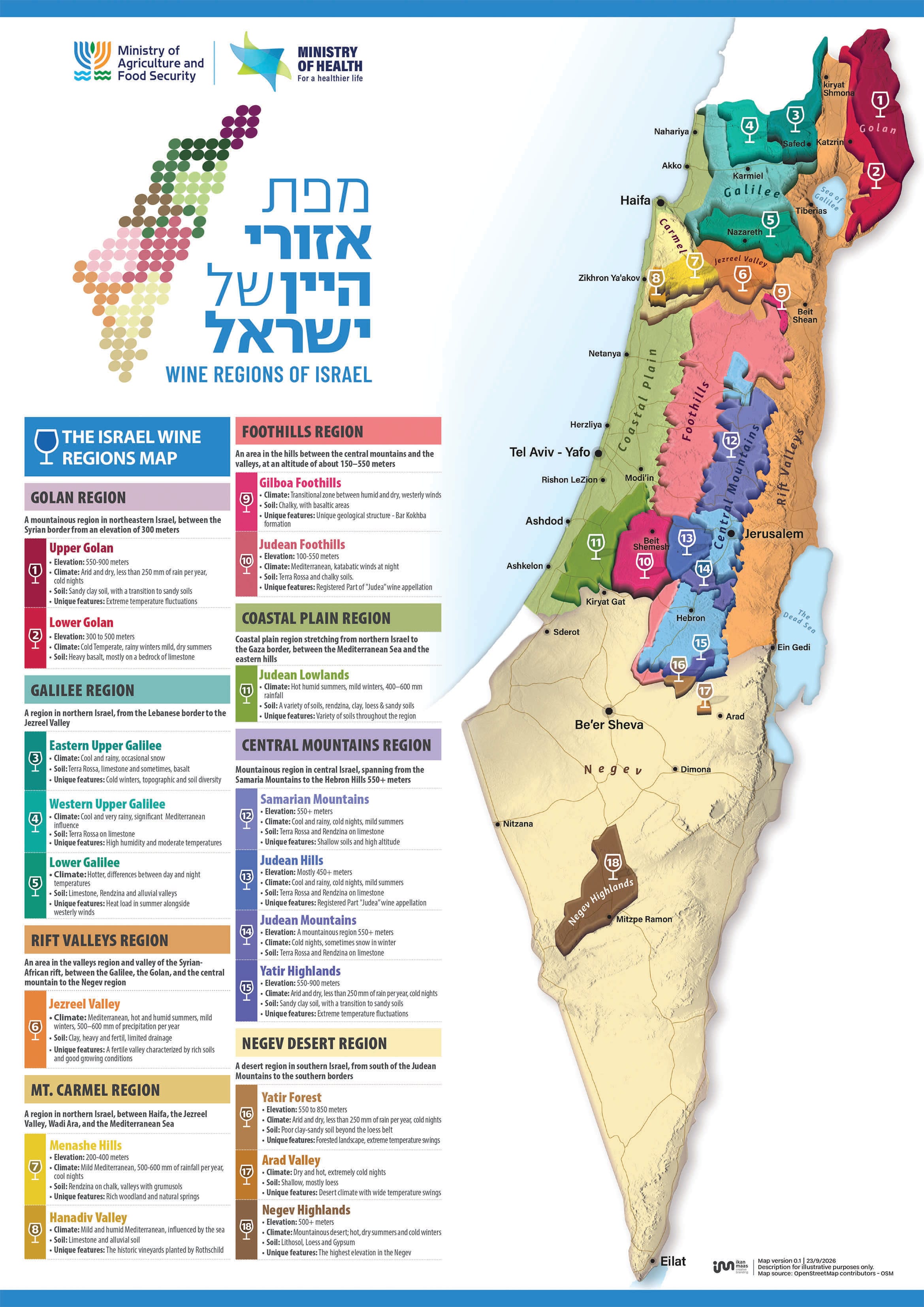
Anyway, it finally happened. A new wine map has been launched, outlining eight wine regions and 18 subregions. The credit for the drive in pushing it over the line goes to the Health and Agriculture ministries, the Wine & Vine Council, and IPEVO, the professional organization for winemakers and viticulturists, who worked together in an exemplary manner.
Those who led the charge to get this over the line were Penina Oren Schneider, director of the Food & Alcoholic Beverages Regulatory Affairs Division at the Health Ministry; Nataly Brudner Mor, deputy director-general of the Agriculture & Food Security Ministry and also chairwoman of the Israel Wine & Vine Council; Tzachi Dotan, director of the Wine & Vine Council; and, last but not least, Noa Maoz, viticulturist of the Wine & Vine Council.
Oren Schneider was chairwoman of the committee. Luckily, she is a bulldozer (meant as a compliment). Brudner Mor and Dotan gave support and credibility, and Maoz was the real star, heading a specialist sub-committee tasked with building the proposal based only on professional criteria. Due to these four heroes, what was not achieved in the previous quarter of a century was achieved in 2026. All is well that ends well.
I was not sure how the launch would be marked. So many events flatter to deceive. I should not have worried. I drove to the Agriculture Ministry, situated not far from where the first experimental vineyards were planted in 1882 and near where Baron Edmond de Rothschild built Rishon Le Zion Cellars in 1890. This was the real rebirth of a modern Israeli wine industry after 2,000 years. Flags with a specially designed logo fluttered from flag posts as I drove up. It all looked rather grand.
Then I saw a huge white tent erected next to the car park. They had gone to some trouble and no little expense. This was divided into two halves, one for schmoozing and food (we are Jews after all), and the other was set out as an auditorium. They were obviously expecting a great many people. The space was decorated with posters and video screens all suitably and stylishly marking the event. Everything was branded, even the tabletops. Most impressive and innovative of all was a mosaic in the image of Baron Rothschild, cleverly made using only red and white grapes.
Sure enough, the tent began to fill up with a who’s who of the Israeli wine scene. The place was awash with CEOs, winemakers, and growers. The cream of the wine trade was there. When you see the CEOs of Carmel, Barkan, and Golan Heights Winery talking together, you know it is an important event. That is 70% of the Israeli wine industry at a snip.
The presentation was informative, and all the necessary explanations were given. The only downside was the wine service, which, considering the subject of the event, was hilarious. The wines were warm, and it was a blistering hot day. They were also served in small glasses like large egg cups of the type Carmel Mizrahi used in the 1980s. It was an amusing slip-up on what was otherwise a very well-organized event.
Using a wine region on the label is optional in Isreal, but mandatory for exports
IN ISRAEL, using a wine region on the label is optional, but in export it is mandatory. Every exported wine has to have a region on the label. I observed how the late Shlomo Cohen, director of the Israel Wine Institute (part of the Economy and Industry Ministry), and then Tzachi Dotan struggled with the task of updating the wine map. I was always an interested party.
My unofficial job is to represent Israel’s wine regions to the world of wine, in particular the classic tomes like The World Atlas of Wine and The Oxford Companion to Wine. I was always left looking stupid when I said to authors of the most important wine books in the world, “Any minute now, there will be a new Israeli Wine Map.” I said this repeatedly over 20 years. But it never happened. I have represented Israel for the books of Hugh Johnson, Robert Parker, and Jancis Robinson MW, the three most famous wine writers or critics of the last 40 years. The problem of explaining the wine regions was always an issue that slightly belittled our wine industry.
I once got into a conversation with Tom Stevenson, author of The Sotheby’s Wine Encyclopedia. While struggling to give an explanation, I said something like, “Well, we are a young country without final borders yet, which may explain why we have not got an appellation system.” This was quoted in the published text, which was a little embarrassing. But it explains the tightrope I have had to walk.
In 2020, there was a breakthrough. IPEVO, the official body representing Israeli winemakers and viticulturists, published a professional map divided into 15 regions. Since then, I have been able to use this map in my explanations.
This acted as a catalyst. Subsequently, there have been committees, suggestions, and revisions. Then, at the beginning of this year, the clouds blew away, the sun came out, and Israel finally got its act together. The aforementioned committee was appointed with the express objective of fast-forwarding decisions to a successful conclusion. Herzl said, “If you will it, it is no dream,” or as we might say, “Where there is a will, there is a way.”
Sure enough, a few months later, white smoke could be seen coming from the meeting rooms of the Health and Agriculture ministries. The first new Israeli wine map for 50 years was agreed upon. Hallelujah! All’s well that ends well. The four people mentioned deserve a great deal of credit. I sat as a member of the committee, and therefore I was able to contribute and watch with joy as this came to fruition.
The most important use for this new map is marketing
THOUGH WINEMAKERS, viticulturists, and growers will swear on the importance of these wine regions, I am a little more cynical. The most important use for this new map is marketing. We are at a stage when the varietal dominance is declining. Blends are becoming more prominent, and soon, people will be talking more in terms of regions, subregions, single vineyards, and individual plots. Whereas once we identified a wine as a Cabernet Sauvignon or Merlot, in the future, we will be talking about the region. It is all a question of discovering our wine identity.
The main regions cover larger areas, while the subregions are places where there is a concentration of vineyards. Names like Galilee, Samaria, Judea, Mt. Carmel, and Negev echo from ancient maps. These are some of the oldest names known, as they were in biblical times. Exporting wineries may choose a region or subregion where 85% of the grapes come from. However, if it does not apply (say it is a blend from all over), the fallback option is that they can write “Israel” as the region instead.
The Golan is where the Israeli quality revolution took root. It is divided into the Upper and Lower Golan, according to elevation. The Upper Golan (comprising the northern Golan and the central eastern Golan) is most well-known for its wines.
Galilee is possibly the most famous region, appealing to both the Jewish and Christian story. This region is divided into three subregions: Eastern Upper Galilee, Western Upper Galilee, and Lower Galilee. Up to now, it is the Eastern Upper Galilee (east of Mount Meron) that houses most of the wineries and vineyards in the region. Rift Valleys is the region that completes the north, and Jezreel Valley is the subregion.
Mt. Carmel is the region surrounding the winery towns of Zichron Ya’acov and Binyamina. This was the hub of the new wine industry founded at the end of the 19th century. The subregions are Hanadiv Valley, named after Rothschild, and the Menashe Hills.
The Coastal Plain Region runs down the length of the Mediterranean coastline. The main vineyard area is the Judean Lowlands, southeast of Tel Aviv. The Foothills Region includes the Gilboa Foothills and Judean Foothills.
The Central Mountains Region covers the mountains that run down the spine of the country. These are made up of the Samarian Mountains north of Jerusalem, the Judean Hills in the Jerusalem corridor, the Judean Mountains around Gush Etzion, and the Yatir Highlands, in the southern Hebron Hills.
Then, there is the Negev. Our largest wine region by area, and one of the smallest in terms of vineyards. Here the subregions are Yatir Forest, Arad Valley, and the Negev Highlands.
The main concentration of vineyards is in the Golan, the Foothills (mainly the Judean Foothills), and Galilee. These three regions comprise 62% of Israel’s vineyard area. The North of Israel, so often under attack in the last three years, makes up 42% of Israeli wine!
The most lauded regions for quality up to now are the Upper Golan, where the Golan Heights Winery has led the way, the Eastern Upper Galilee, where Dalton, Galil Mountain, and Recanati wineries are situated, and the Judean Hills, where Domaine du Castel and Tzora Vineyards shine.
The most recent regions to become developed wine-wise are the Samarian Mountains and the Negev. These have really only come to life since the turn of the millennium. And out of all the regions, it is the Negev that inspires the most professional interest and curiosity.
The regions that operate most wisely to advance the wineries in their midst are Judea (comprising the Judean Foothills and the Judean Hills) and the Negev. And it is these two regions that have become registered as official appellations according to the law.
The great Hugh Johnson, creator of the World Atlas of Wine, once said wine is liquid geography. No doubt a serious wine-producing country needs a wine map with identified regions. Now we have that map. After 5,000 years of making wine, what is 50 years, here and there? ■
The writer is a wine trade veteran and winery insider turned wine writer, who has advanced Israeli wines over four decades. He is referred to as the English voice of Israeli wine.