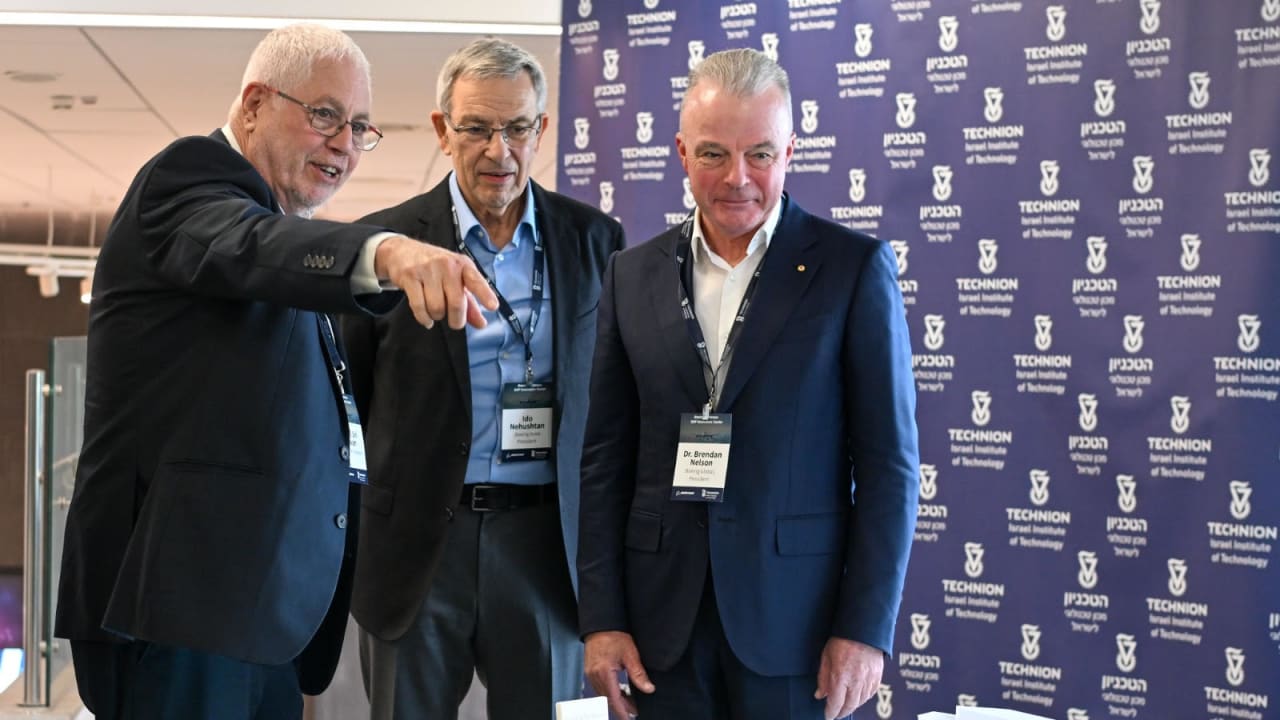
Boeing Global President Dr. Brendan Nelson visited the Technion-Israel Institute of Technology in Haifa on Monday to mark the shift of a Boeing-Technion sustainable aviation fuel initiative from feasibility work into hands-on development aimed at producing cost-competitive “electrofuel” made from green hydrogen and captured carbon dioxide.
The visit highlighted the Boeing–Technion SAF Innovation Center, launched in 2023, which is focused on advancing sustainable aviation fuel (SAF) pathways that could reduce aviation emissions while strengthening energy security and building a local innovation ecosystem, according to the partners.
Nelson, a physician by training and a former senior Australian government official, was appointed president of Boeing Global in January 2023, according to Boeing’s executive biography. During the Technion visit, Boeing said the initiative was part of the company’s broader effort to support sustainable aviation fuel development alongside other decarbonization measures.
“In addition to delivering high-quality fuel-efficient airplanes to our customers, Boeing works globally and regionally to enhance energy security, support the growth of the civil aviation industry, and create new economic opportunities through sustainable aviation fuel and other technologies,” Nelson said in remarks provided by the partners.
Boeing’s delegation also included Maj.-Gen. (res.) Ido Nehushtan, president of Boeing Israel, and Haggai Mazursky, described as the head of the SAF project. They were welcomed by Technion President Prof. Uri Sivan and senior Technion leadership, including Prof. Noam Adir, executive vice president for research, and Prof. Yuval Garini, executive vice president for innovation and industry relations.
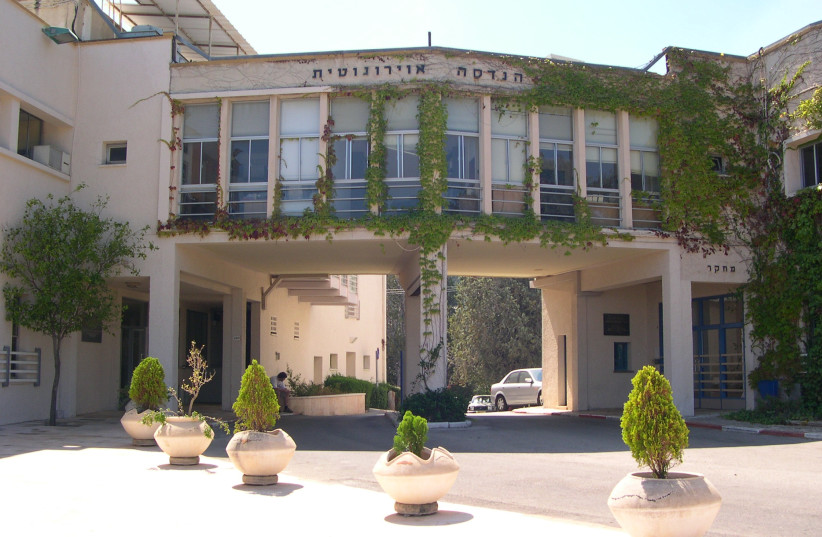
Technion leaders framed the project as a national-scale effort that could link academic research to industrial capability.
“This is a historic collaboration of national importance for the State of Israel,” Sivan said. He added that the partnership represented “a vote of confidence” in Technion researchers and their ability to develop cleaner fuel production technologies.
From feasibility to 'Power-to-Liquid' development
According to the Israeli Sustainable Aviation Fuel Knowledge Center (iSAF), the Boeing–Technion SAF Innovation Center’s work has centered on “electrofuels” produced via Power-to-Liquid (PtL) processes that combine green hydrogen with captured carbon dioxide. The partners said the next stage would push the process toward practical development that can support commercial production at a competitive cost.
The center has been led by Prof. Gideon (Gidi) Grader of the Technion’s Wolfson Department of Chemical Engineering, according to Technion faculty information. The partners said 11 Technion faculty members and dozens of doctoral students from five faculties have worked on fuel production and qualification topics, including catalytic processes, combustion, safety, life-cycle analysis, and an experimental fuel-testing facility.
Boeing’s Israel footprint and a growing SAF ecosystem
Nehushtan said Boeing’s relationship with Israel spans decades, including commercial ties with El Al and defense cooperation with the Israeli Air Force, alongside a supplier network that integrates Israeli-made systems into Boeing products. Boeing’s published Israel background material describes a relationship that goes back more than 75 years, alongside commercial and defense partnerships and local supplier activity.
The Technion-Boeing initiative has unfolded alongside government-backed efforts to accelerate SAF research and development. In February 2025, the Israel Innovation Authority announced a NIS 100 million investment to establish a national SAF research consortium, bringing together industrial companies and academic research teams to develop technologies for renewable aviation fuels.
Industry and academia have also convened around SAF-IL, a consortium referenced in the Technion-hosted iSAF conference agenda as part of Israel Innovation Authority activity.
Work continued after October 7
The partners said the Boeing–Technion announcement had originally been planned for October 2023, but the initiative continued after the October 7 attacks and the war that followed. Nelson was quoted in the material describing the center as a “project of resilience and innovation,” and argued that Israel had the capacity to tackle aviation’s emissions challenge through research and commercialization.
Boeing said sustainable aviation fuel remains a major lever for reducing aviation emissions, and in a separate Boeing sustainability statement the company has said SAF can reduce CO2 emissions over the fuel’s life cycle by up to 85%, depending on feedstock and production pathway.