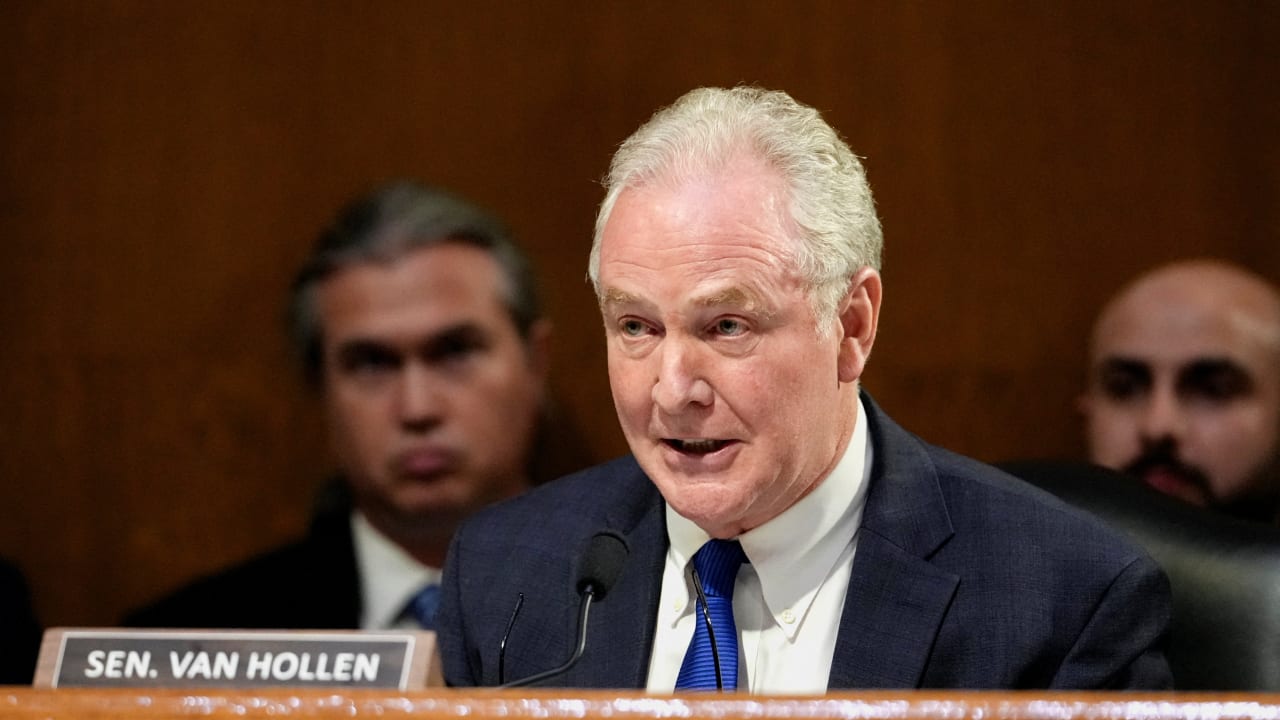
WASHINGTON - Senator Chris Van Hollen of Maryland, one of the most outspoken critics of Prime Minister Benjamin Netanyahu’s government in Congress, announced Thursday that he is challenging Senate Democratic leader Chuck Schumer for the position of Senate majority leader, in a move that could have significant implications for the future of US-Israel relations.
The announcement comes nine days after Democrats secured control of both chambers of Congress in the midterm elections, amid growing pressure from the party’s progressive wing for a change in leadership.
“In this election, Americans called on us to unrig an economy rigged against working people & fueled by political corruption,” Van Hollen wrote on X/Twitter.
“To deliver, we need new leadership. This isn’t about any one person – it’s about answering that call. That’s why I’m running for Senate Majority Leader.”
Van Hollen’s candidacy is particularly significant for Israel because of his increasingly critical stance toward Netanyahu’s government and his efforts to restrict certain forms of US military assistance and defense cooperation.

Just two days before announcing his leadership bid, Van Hollen led a group of 12 senators in demanding the removal of provisions from the Fiscal Year 2027 National Defense Authorization Act that would require expanded defense technology cooperation and intelligence sharing between Washington and Jerusalem.
The initiative, backed by 10 other Democratic senators and independent Senator Bernie Sanders, seeks to preserve the president’s discretion over US-Israel intelligence cooperation and prevent the establishment of mandatory new military technology partnerships.
The senators argued that the proposed measures could constrain American decision-making and commit Washington to deeper security cooperation despite their concerns about Israeli government policies in Gaza, the West Bank, and elsewhere in the Middle East.
Van Hollen has also criticized Netanyahu’s role in the war against Iran, describing the conflict as a strategic disaster for American interests.
Van Hollen supports efforts to block sale of weapons to Israel
In recent years, the Maryland senator has supported efforts to block sales of offensive weapons to Israel, accused Netanyahu’s government of violating international law, and sharply criticized Israeli military operations in Gaza and policies in the West Bank.
However, Van Hollen has distinguished between offensive weapons and defensive military assistance, expressing support for continued provision of systems and components essential to Israel’s defense, including the Iron Dome.
His position therefore does not amount to a demand to end all US military assistance to Israel.
Schumer, by contrast, has long been among Israel’s most prominent supporters in Congress. The New York senator, the highest-ranking Jewish elected official in American history, has opposed efforts to block certain US arms sales to Israel, even while becoming increasingly critical of Netanyahu.
The leadership challenge illustrates the growing divide within the Democratic Party over Israel, as progressive lawmakers press for greater restrictions on American military support and more aggressive congressional oversight of US policy in the Middle East.
Van Hollen has received public support from Michigan Senator-elect Abdul El-Sayed, another prominent critic of Israeli government policy, and independent Senator Bernie Sanders has also backed his candidacy.
The contest will be decided by a secret ballot among Democratic senators on December 1.
Schumer maintains he has already secured enough support to keep his leadership position, making Van Hollen’s challenge an uphill battle.
Nevertheless, the Maryland senator’s candidacy highlights the growing influence of progressive voices within the Democratic Party and raises questions about the future of bipartisan support for Israel as Democrats prepare to assume control of Congress in January.