Author, scientist, educator, fine arts photographer, high-tech start-up founder – it’s difficult to pin down Tami Ellison to a specific profession, but when I call her a polymath, which Oxford Languages defines as a person of wide-ranging knowledge or learning, she retorts good-naturedly, “I’m a poly something or other, but more like ‘Polly want a cracker.’” After a moment of reflection, she says, “I bill myself as a creative, and that applies to science, it applies to writing, it applies to photography, it applies across the board.”
Tami Ellison has been expressing her creative passions for the past 67 years. Though we attended the same elementary and high schools in Chicago, she was a year ahead of me in school, and I was not aware of her numerous talents and experiences, both when she was living in the US and after she moved to Israel some eleven years ago.
Ellison studied at the University of Illinois, earning an undergraduate degree and a master’s degree in expression patterns in developmental model systems. She worked in hi-tech and biotech for 20 years as a consultant, as well as in marketing, communication, and technology education in Chicago and Denver, where she moved in 2001 to join her mother and sister.
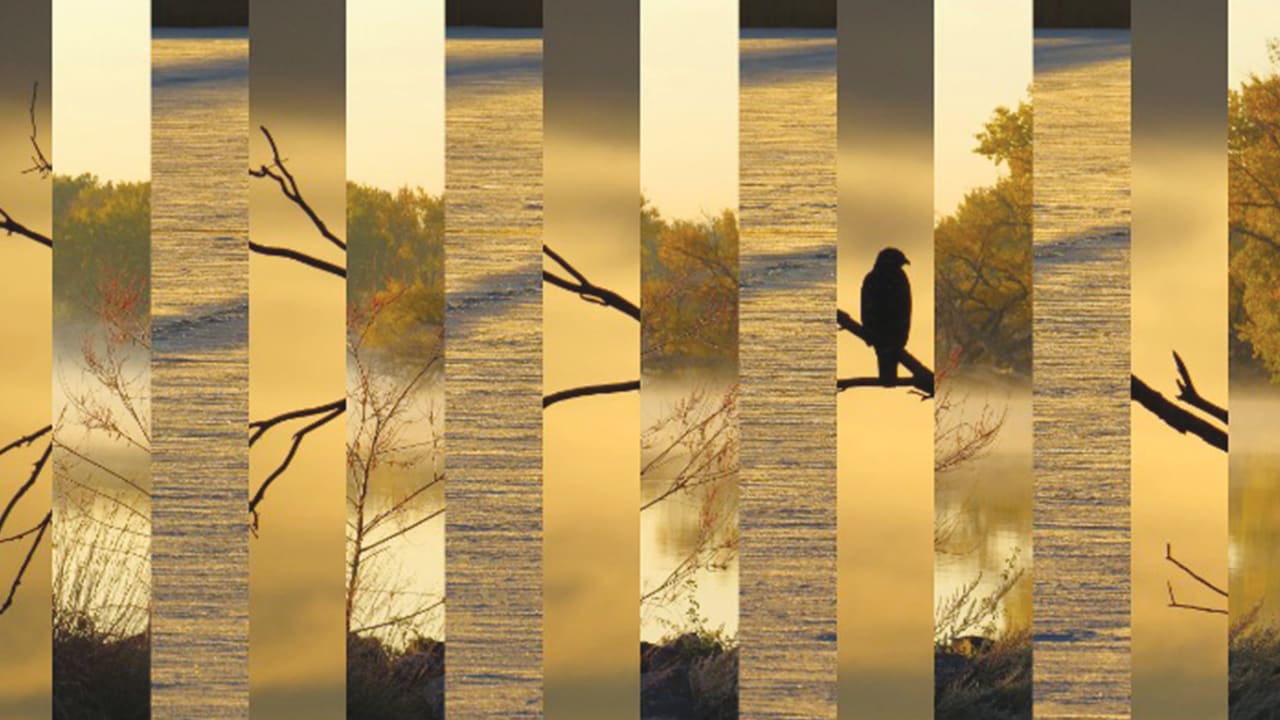
Using real-world images, Ellison produced photos using a technique known as figure-ground visual illusions, in which the brain cannot easily distinguish a main object from its background and instead shifts between two or more possible interpretations. Depending upon the image combinations that are put together, the viewer will see something different.

Figure-ground visual illusions
Using real-world images, she produced photos using a technique known as figure-ground visual illusions, in which the brain cannot easily distinguish a main object from its background and instead shifts between two or more possible interpretations.
Switching to scientist mode, Ellison says, “That’s really interesting from a neurocognitive standpoint. And because I’d been teaching young children, I had to relearn the principles of education and also how people learn. The flip side to how people learn is also how they forget, so there was a fundamental association between learning about different domains of cognition, both from a learning standpoint and from an aging standpoint.”
Arriving in Israel in 2014, she received certification as a scientist and a distinguished artist for the work she had done in the United States. Her work was featured in an exhibition at the Bloomfield Science Museum in Jerusalem in late 2014 and early 2015, during which she was also commissioned to create three new pieces. “It was a heady experience, to say the least,” Ellison says.
With the exception of a year-and-a-half stint in Maaleh Adumim during COVID—“I needed the fresh air and open space”—Ellison has lived in Jerusalem since her aliyah. During her first few years in the country, she worked as a photographer and was constantly on the lookout for new places to explore.
In 2016, her business and scientific sides converged when she set up a one-woman company to explore the role of visual illusions in neurocognition. Ellison formed a joint venture with a Denver-based group and received six US image-based patents with applications in neurocognition, image manipulation, and cybersecurity.
In 2021, after falling on the stairs while living in Ma’aleh Adumim, she began to bleed, and a checkup revealed endometrial cancer. In her breezy and informal style, she says that after undergoing surgery, within several months she was cured. “It helps reset the priorities that one has.”
Aliyah was always part of Ellison’s plan, so making aliyah alone was not much of a factor. The fact that she made aliyah as an older adult was a bigger consideration, she says. “On the aliyah form that you have to fill out from Nefesh B’Nefesh, there’s no category for single older adult. There is a box for families, for retirees, and then single young people.”
Ellison says her Hebrew is sufficient for conversational purposes. “I’ve worked with Israelis off and on since the ’90s, and I’m hands-oriented, so I can gesticulate and make myself understood.” Her community of friends is centered on mostly English-speaking people she knows from Chicago or Denver.
Another way she makes herself understood is through her writing. She had written a book after September 11, 2001, which she calls “a spiritual fiction book that dealt in Buddhism and natural healing in an East-meets-West modality.” The book, titled The Chladni Progression: The Power to Heal, an East-meets-West medical thriller, was published in June 2025.
Her second book, Strange Fire, was published in April and written in the aftermath of the Oct. 7 Hamas attacks. The story unfolds over three days as Joshua E. Katz, a 28-year-old technology entrepreneur, is determined to accelerate the messianic timeline and reunite his family. Ellison says both books are part of the spiritual fiction genre, and she is currently working on sequels to both.
“Writing for me is a way of connecting to God, and I’ve been very blessed by that,” she says. “I’m very passionate about writing. I believe that it is a way of healing, and there’s a whole neurological aspect of using the creative arts as a healing tool, whether it’s through writing, poetry, song, or painting. So it is actually, from a trauma standpoint, a really important component.”
Ellison is a firm believer in the concept of hashgaha pratit, God’s role in the daily affairs of humanity. “Everything in my life has truly been about hashgaha pratit – even my disappointment in not going to medical school. Had I gone to medical school, I’d be off in Africa doing something. I would have been a very selfish person, as opposed to going through life in a very different way.”
God’s role in people’s daily lives
To that end, she recently initiated weekly gatherings for women called the Hashgaha Cafe, in which participants discuss God’s role in people’s daily lives. “It’s basically designed for women as an opportunity to better understand the role of hashgaha pratit in our everyday lives, and to look and find those nuanced moments where God is saying ‘Hi there.’”
Ellison is happy that she made aliyah, and says, “Who I am as a person is intrinsically tied to who I am as a Jew and who I am as a person here in Israel. That spiritual growth would not have happened anywhere else. I can say that with 100% certainty. You know, we get very comfortable in who we are. Israel challenges you, and God challenges us to be better people, to do more, and to be more.
“What I like most about living here is who I’ve become. I know that’s a very selfish and self-centered perspective, but engaging with people, hearing Hebrew spoken – it’s those things. It’s about being unashamedly Jewish and not being afraid to walk around.
“I really can’t complain,” she concludes. “I’m very blessed. Life isn’t always easy here, but it’s so worth it – from the people, the places, and the opportunities to grow as families, as individuals, and to just be Jews.” ■
Tami Ellison
From Denver to Jerusalem, 2014