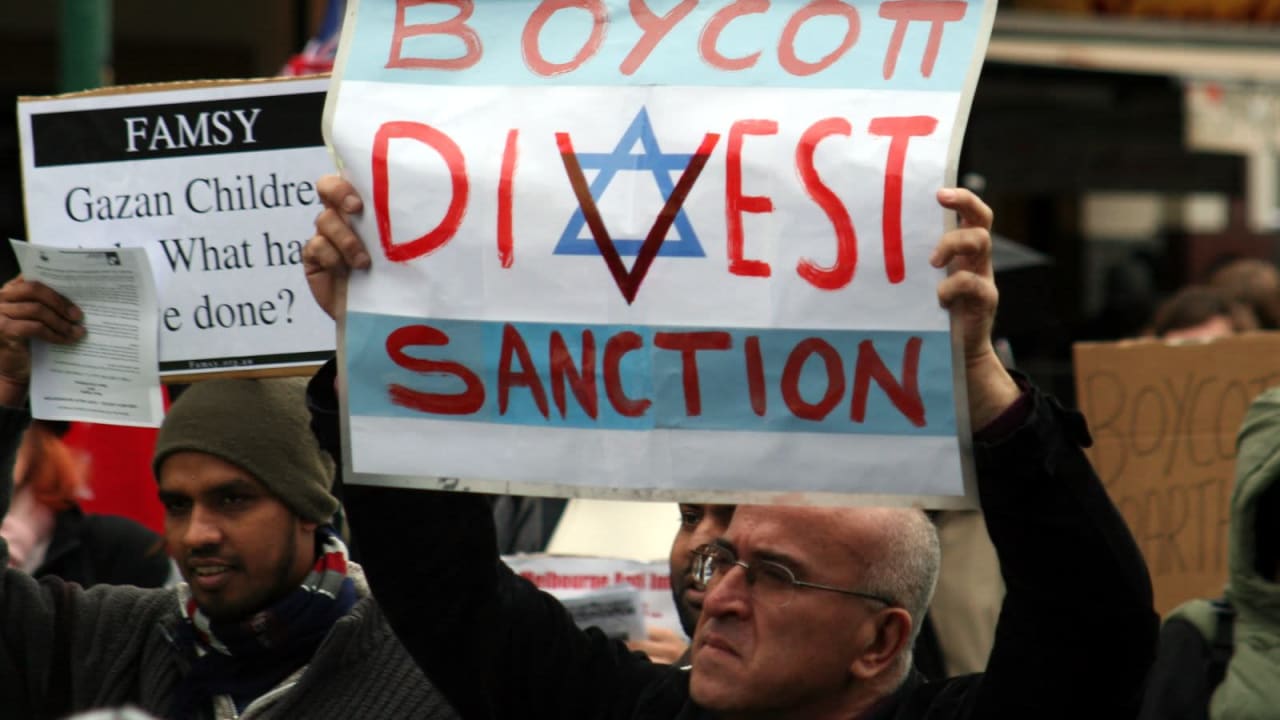
“We reject the BDS boycott of Israel since we consider cultural and scientific exchange to be essential. At the same time, we consider the logic of counter-boycott, triggered by the parliamentary anti-BDS resolution, to be dangerous.”
This argument is based on a highly contorted version of the Bundestag resolution, used to justify what is essentially a political position targeting Israel. They make no mention of the text, which states that BDS is a “reminder of the most terrible phase in German history. ‘Don’t Buy’ stickers from the BDS movement on Israeli products inevitably arouse associations with the Nazi slogan ‘Don’t buy from Jews!’ And the corresponding graffiti on facades and shop windows.”
They also conspicuously avoid directly mentioning the IHRA working definition, a central pillar of the Bundestag resolution, and the examples that refer to double standards; drawing comparisons of contemporary Israeli policy to that of the Nazis; and “denying the Jewish people their right to self-determination... by claiming that the existence of a State of Israel is a racist endeavor.” These are all characteristic of the BDS movement and are far from “legitimate criticism of Israeli policies.”
AT THE SAME time, the German cultural activists also completely and perhaps willfully ignore the dangerous reality of antisemitism, including the incitement against Israel and Israelis, including boycotts based on false accusations of war crimes and racism. This incitement is directly related to the violent attacks against synagogues, museums and individual Jews. Instead of playing a positive role in combating this evil, the participants sought to undermine the most effective mechanisms available, in some cases accompanied by shameful personal attacks on Felix Klein, the official responsible for combating antisemitism. The activists sought to undermine Klein and others while Germany held the rotating presidency of the IHRA.
In media portrayals, they appear as well-intentioned innocents whose motivations are strictly artistic, unfairly caught-up in distant wars, and suffering terribly from criticism for inviting BDS activists to participate in their events. (Many of the incidents took place before the 2019 Bundestag resolution and the alleged “misuse of allegations of antisemitism” that followed.) One prominent activist in the Weltoffenheit campaign told journalists that even after the Bundestag resolution, she still did not know anything about BDS. (“Ich weiß auch heute noch nicht ganz genau, was der BDS ist.”) Given the extensive presence of the anti-Israel boycott in Germany, this claim strains credibility.
The distortions of the Weltoffenheit text strongly echo the campaigns, launched around the same time (at the end of 2020), by powerful non-governmental organizations that are at the forefront of the anti-Israel movement, under the banner of moral agendas. Human Rights Watch is one of the most active in promoting BDS, and in campaigning against the IHRA definition, including efforts to prevent any discussion of the antisemitic aspects of the BDS movement. The US-based HRW organization is very active and has a strong following among the left-wing German elite. In parallel, numerous Palestinian and left-wing Israeli political NGOs blasted out the same message at every opportunity. Their objective is to deflect the growing international consensus that accepts the IHRA document as a guideline for assessing antisemitic behavior.
The Weltoffenheit campaign is well-financed, in order to gain wide publicity and impact, although the list of funders, as is often the case, particularly in Germany, is not transparent. It is possible that the money came from NGOs such as HRW, or from governmental programs and political foundations. Whatever the source, the public relations campaign was highly professional, gaining entirely favorable publicity in many German, European, Israeli and American media platforms, including The New York Times.
In summary, behind “Initiative GG 5.3 Weltoffenheit” are many questions, waiting to be examined by an investigative journalist or academic researcher able to look beyond the public relations blitz and high-sounding rhetoric.