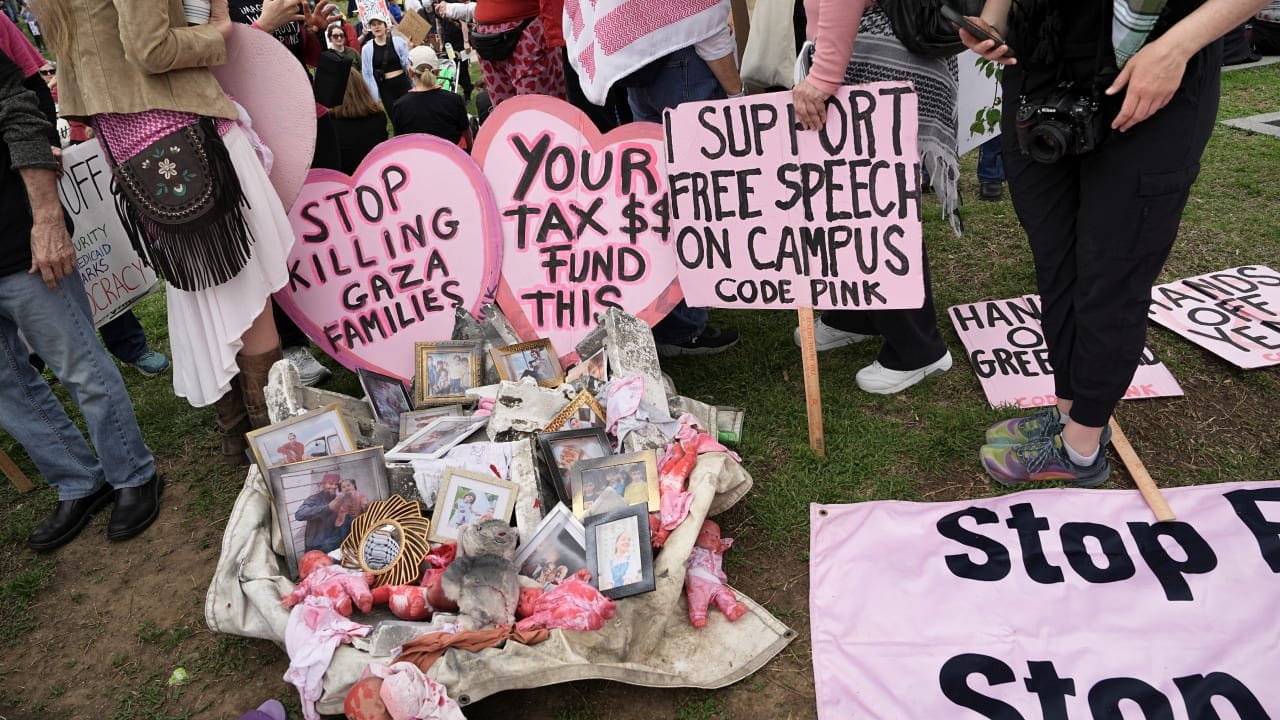
The keffiyeh covering the camera lens briefly became a perfect symbol of political hypocrisy. Those who seek to expose everyone else are unwilling to expose themselves.
Those who pursue elected officials in the name of the public’s right to know become indignant when the public wants to know something about them. In the corridors of the US Congress, the gap between preaching morality and being willing to live by it was laid bare.
According to a report by Fox News Digital, network reporters followed activists from CODEPINK and other left-wing groups for six hours on Veterans Day. The reporters said activists blocked their cameras with keffiyehs and bags, covered lenses with their hands, hurled insults, and acted violently toward them.
The reported behavior contradicts the activists’ professed commitment to openness and transparency. It reflects a tolerance for criticism only when left-wing organizations are the ones delivering it.
Those who make filming confrontations a central part of their methods cannot demand immunity from legitimate questions directed at them. When they do, the dishonesty of their commitment to open discourse becomes clear.
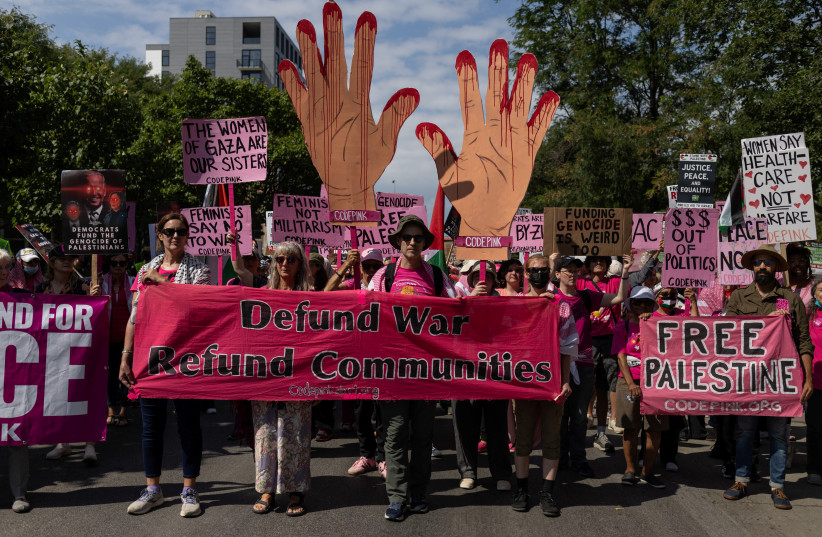
Behind the grand slogans lies a distorted worldview: we may accuse, while you may only apologize. We will decide who is moral, and you must prove that you are not a criminal.
This is the essence of political trolling. There is no need to persuade when it is possible to humiliate, and no need to listen when it is possible to produce a video. An elected official is drawn into a trap in which the question itself already contains an indictment.
If the official gives a lengthy answer, the remarks will be edited. If the official keeps walking, activists will claim the person fled. If the official becomes angry, they will have captured the image they wanted. Public debate is thus transformed into a continuous spectacle of humiliation.
Through an initiative called the Taxpayer Revolt, organizers demanded an end to funding for Israel, opposed cooperation between the US and Israeli militaries, and called for military spending to be redirected toward civilian needs.
The appealing equation of fewer weapons and greater social welfare is easy to sell. It is far more difficult to explain who will deter aggressors, who will protect allies, and what price will be paid if weakening American power encourages greater adventurism among its enemies.
The obvious question is whether weakening America would guarantee a more moral world. Why assume that an American retreat would be answered with reconciliation rather than an attempt to exploit the opportunity?
A serious peace movement must confront this reality. Those who merely condemn Western power without explaining how the victims of other powers will be protected are offering wishful thinking instead of policy.
The list of organizations supporting the initiative reveals a broad alliance of left-wing and environmental organizations, socialist groups, and Muslim organizations, including the Council on American Islamic Relations (CAIR) and American Muslims for Palestine. Friends of Socialist China also appears on the list.
This partnership is no secret. It raises a difficult question about what unites these organizations. To what extent is this a consistent defense of human rights, and to what extent is it an alliance built around opposition to America and Israel?
There is no justification for treating all Muslims as suspects. The criticism is directed at the organizations that chose this alliance and the anarchist messages they promote, not at the faith of millions of citizens.
Precisely because this is political activity, its organizers must not be permitted to shelter behind religious identity. They should be asked the same difficult questions posed to any other organization seeking to shape United States policy.
There is no hiding
The funding issue raises further questions.
A New York Times investigation described donations to CODEPINK from entities connected to technology entrepreneur Neville Roy Singham, along with a network of nonprofit organizations promoting messages sympathetic to China. His wife, Jodie Evans, is one of CODEPINK’s founders.
Those who constantly warn against the influence of the wealthy must explain to the public how they examine such influence within their own movement.
CODEPINK denies receiving funding from foreign governments or having ties to the Chinese Communist Party. Singham has denied acting at the direction of the Chinese government.
But denial does not end the discussion, and financial connections do not become irrelevant merely because their recipients describe themselves as warriors for justice.
The same demand for transparency directed at the weapons industry must also apply to its opponents.
The most severe moral test can be found in their treatment of Muslims in China. The Times investigation described Evans as defending the mass detention of Uyghurs. It is difficult to imagine a more glaring contradiction.
Those who raise the banner of human rights cannot fold it away when it interferes with their worldview. A Muslim victim does not become less important simply because the oppressor is neither American nor Israeli.
The Muslim organizations participating in this alliance must also answer a question: How can this partnership be reconciled with concern for their Uyghur brothers and sisters?
Political partnership requires the ability to identify injustice even within one’s own camp.
Solidarity that distinguishes between victims according to the identity of the perpetrator loses its moral meaning. It becomes a tool in a power struggle, wrapped in the language of compassion.
There is no need to claim that these organizations are taking over the US to understand the danger posed by their methods.
It is enough that fear of public humiliation could deter elected officials, that institutions might prefer quiet over defending principles, and that journalists could avoid asking questions for fear of becoming the next target.
This is how disproportionate power can be created - not through a persuasive majority, but through violence and the personal price imposed on opponents.
The response must be resolute. Transparency must be demanded. Claims must be examined, their full context presented, and shouting must never be accepted as a substitute for evidence.
Elected officials and journalists have no reason to accept the roles of permanent defendant and victim assigned to them by activists who believe they hold exclusive ownership of morality.
American democracy does not need CODEPINK’s permission to defend itself, and the media does not need activists’ approval to investigate them. Those seeking to influence budgets, alliances, and national security cannot hide behind protest accessories.
A pink shirt is not a certificate of integrity. A keffiyeh is not an answer to a question. Moral preaching does not erase double standards.
Anyone demanding accountability from all of America must first provide an account of their own actions.
The writer is the CEO of Radios 100FM, an honorary consul and vice dean of the Consular Diplomatic Corps, president of the Israeli Radio Association, and previously served as a monitor for Israel Army Radio and as a television correspondent for NBC News.