In the aftermath of our latest election and its seemingly inconclusive result, I’m trying to find the right word that describes how I feel, and where we go from here.
“Frustration” certainly is a word that comes to mind. After all the shouting, the sloganeering, the promising and the posturing, after millions of ballots and billions of shekels, we are essentially right back where we started.
The pollsters predicted an impasse – some might call it a dead heat – and sadly, they were not wrong. Neither the ruling coalition nor the “coalition of change” emerged to claim decisive victory, and that’s terribly frustrating. It’s like a tie in football, or having to kiss your beloved through glass – so close, yet so far away.
“Disappointment” is another emotion that grips me. I am truly disappointed that we Israelis – problem solvers extraordinaire who routinely can tackle any problem and come up with a solution – could not find a way to bridge the gaps between us and unite the nation.
We presumed that we could at least rally behind what we thought were the givens in our society – Zionism, our reverence and support for the holy soldiers of the IDF, the need to eliminate the Iranian threat, the centrality of Judaism in a Jewish state – but even these core issues did not manage to place us on common ground.

So, the word I am left with – the rallying cry that emerges – is “endurance”: the ability, the determination, the necessity to endure, despite our frustration and disappointment.
Two models of endurance
I PRESENT two models of endurance as examples.
I recently finished reading Alfred Lansing’s classic 1959 book, Endurance: Shackleton’s Incredible Voyage.
It details the two-year struggle for survival endured by the 28-man crew of the British exploration ship Endurance.
Sir Ernest Shackleton’s goal in January 1915 was to achieve the first land crossing of the Antarctic continent from coast to coast, as part of the Imperial Trans-Antarctic Expedition.
But the Endurance became trapped in the pack ice of the Weddell Sea, was crushed, and sank later that year, transforming the mission into an extraordinary survival story.
Displaying incredible tenacity and courage, the men of the Endurance spent nearly six months living on unstable frozen ice floes before they could finally escape to solid land at South Georgia Island, 650 nautical miles away.
Reading of that voyage was prep for a (kosher) cruise to Antarctica which we will hopefully take next month. While our own expedition ship is certainly an improvement on that of a century ago, we may still face our own moment of endurance.
To get to the Frozen Continent (even in summer!), one must cross the Drake Passage, which can be serenely calm, or can be one of the most treacherous voyages for ships to make. In adverse weather, waves there can top 40 feet (12 meters), thus leading to its ignominious nickname, the “Drake Shake.”
Closer to home, we recently encountered another lesson in endurance.
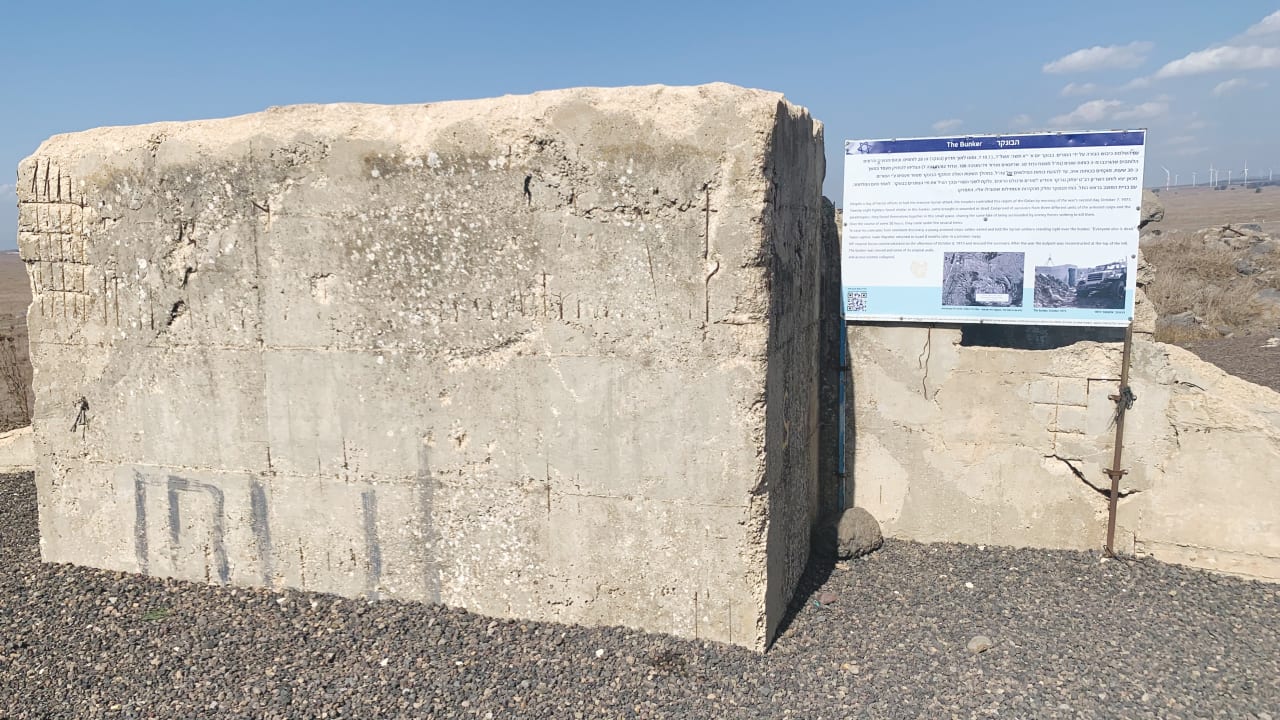
On a hike with members of our Bnei Akiva shevet, Moriah – whose members had come from all over the world to our 50th reunion (yes, that in itself is certainly a lesson in endurance!) – we visited Tel Saki on the Golan Heights.
It was there, on a lonely, volcano-formed hill, that one of the most dramatic moments in the 1973 Yom Kippur War occurred.
For 36 hours, from October 6 to 8, 1973, 60 Israeli paratroopers and tank crewmen held the outpost against an overwhelming Syrian force of 11,000 infantry soldiers and 900 tanks.
The Israeli military had been caught by surprise and was confronted with a massive Syrian invasion, led by Russian-made tanks and devastating SAM missiles.
After heavy fighting, 28 wounded Israeli soldiers took shelter inside a tiny Syrian bunker on this hill, remaining trapped and hidden behind enemy lines while under constant threat of missile and grenade attacks.
The outnumbered defenders fought ferociously against the odds and successfully delayed the Syrian advance, buying vital time for Israeli reserves to enter the battle and eventually turn the tide from defeat to victory.
The battle left a deep psychological and emotional toll on the survivors, who were singled out as outstanding heroes with an unparalleled determination to endure at all costs.
These are tough times, with every kind of crisis knocking at our doors
SO WHEN I start to wonder as to where we are going as a nation, and how we will possibly get there, I focus on our amazing capacity for endurance.
Yes, these are tough times, with every kind of crisis knocking at our doors.
Will there be another war? Will we fight it alone, or will America stand at our side? Can we reconcile with our neighbors, and with our (former) friends abroad – and with one another? Have we built a society that safeguards our children and our children’s children?
Somehow, some way, I believe we will endure. We’ve lived through tougher times; we’ve survived greater crises. God did not bring us this far, only to see us fail or falter. We’ll cross the ice field, we’ll defend the hilltop, and we will endure. ■
The writer is the director of the Jewish Outreach Center of Ra’anana. rabbistewart@gmail.com