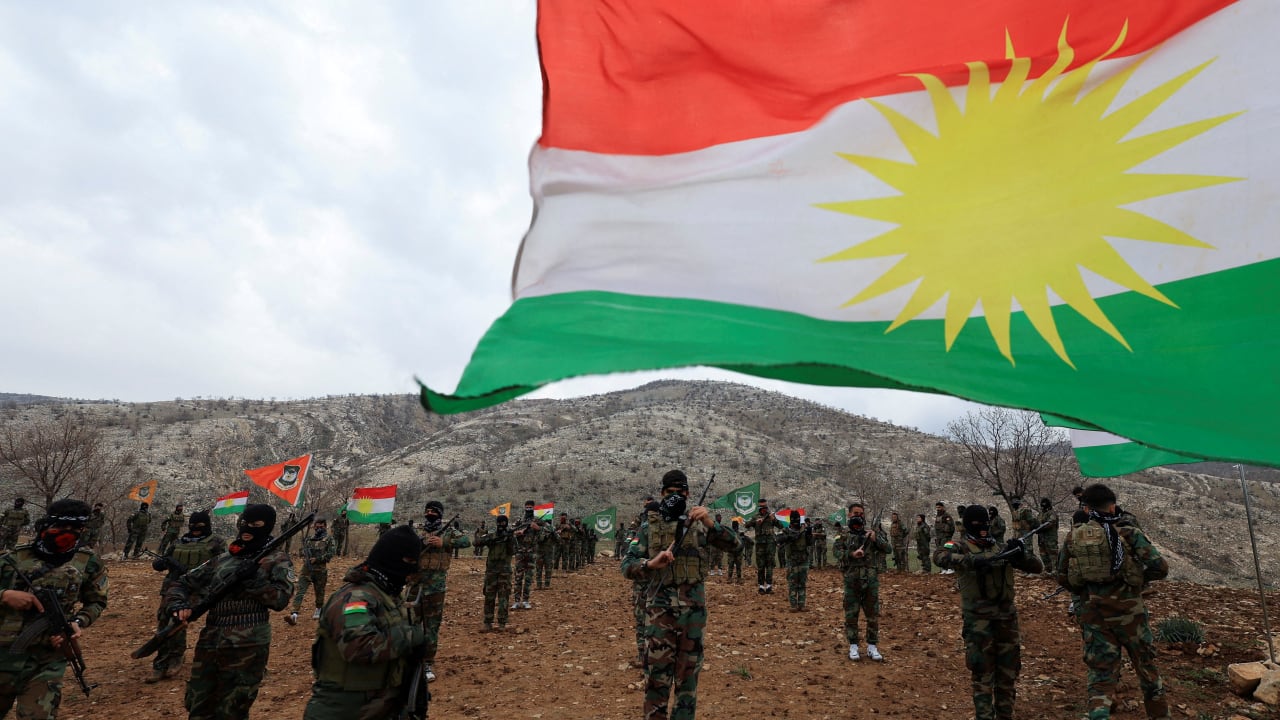
The transformation taking place in Kurdish politics today is too deep and too geopolitical to be explained by Abdullah Ocalan’s anti-Israel rhetoric. His rhetoric is not the cause of this change; it is a reflection of a much broader strategic rupture.
A recent analysis published in The Jerusalem Post interprets these developments largely through Ocalan’s anti-Israel statements and suggests that there are two factions within the PKK. However, the decisions taken by the PKK and developments on the ground point less to an open split than to a strategic repositioning.
In 2025, the PKK decided to end its armed struggle and dissolve its organizational structure. Ocalan’s call thus moved beyond a personal statement and became an organizational decision.
Different views may exist within the organization, but unless there is an alternative congress decision, parallel leadership, or an open split, there is insufficient evidence to support a “two-faction” narrative.
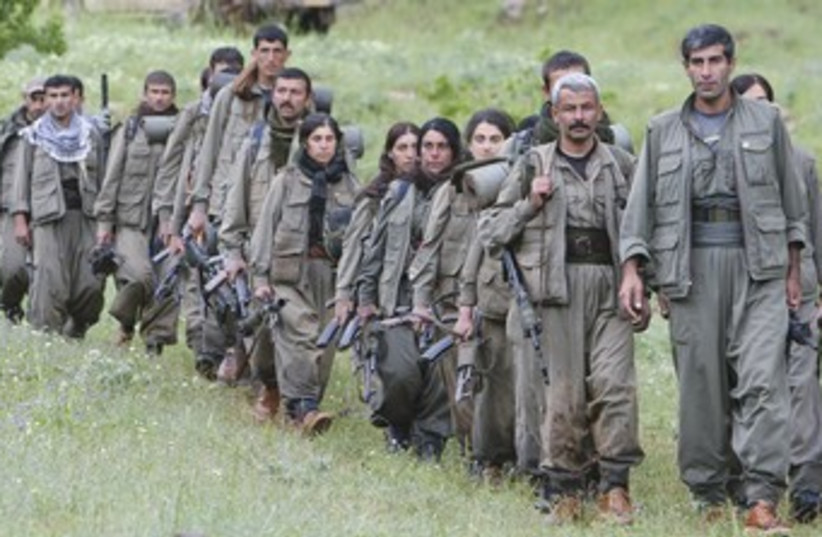
The transformation is rooted less in ideology than in changing power dynamics. Turkey’s military technology, intelligence capabilities, and international position have changed significantly. For the PKK, achieving political results through armed struggle has become increasingly difficult.
The process Ankara calls “Terror-Free Turkey” is also connected to Turkish President Recep Tayyip Erdogan’s domestic political calculations.
Kurdish voters have significant weight in Turkey’s political balance. For this reason, the process being conducted through Ocalan can be interpreted not only as an attempt to end the armed conflict, but also as an effort to reshape the Kurdish political field.
However, Kurdish society is not controlled by a single political actor.
This point is particularly important when assessing Ocalan’s statements about Israel. Ocalan has been in Turkish custody for decades, and his political space for communication is not independent of the conditions determined by Ankara. His recent anti-Israel statements therefore should not automatically be regarded as a reflection of the general views of Kurdish society.
Moreover, the fact that some of Ocalan’s statements overlap with the Erdogan government’s increasingly harsh rhetoric toward Israel does not mean that the Kurdish people’s historical approach toward Israel or the Jewish people has fundamentally changed.
Kurdish attitudes toward Israel and Jews have a much more complex historical background than today’s political rhetoric suggests. Many Kurds, because of their own experiences of statelessness, insecurity, and the struggle for collective rights, have viewed the historical experiences of Jews and Israel with sympathy.
For this reason, interpreting the statements of one political actor as the position of an entire people is misleading.
The real source of Kurdish disappointment today is not Israel, but the failure of international expectations surrounding Rojava.
During the war against ISIS, Kurdish-led forces in northeastern Syria became one of the United States’ most important local partners. As a result, many Kurds believed that this partnership would eventually translate into lasting political and security guarantees after the war.
Expectations toward Israel also emerged largely from this context. Because of Israel’s influence in Washington and its strategic position in the region, many Kurds believed that Israel could help secure Rojava’s political and security future.
But these expectations did not materialize.
The United States’ prioritization of its strategic relationship with Turkey, Rojava’s failure to receive the expected international guarantees, and the severe political and military pressure faced by Kurdish forces in Syria have shaken many Kurds’ expectations regarding international alliances.
Therefore, it is incomplete to view the PKK’s new direction merely as an ideological shift. It is also a reassessment of international expectations that failed to materialize.
The PKK’s anti-Israel and pro-Palestinian rhetoric is not new either. From its foundation, the organization was influenced by the leftist, revolutionary, and anti-imperialist political culture of the Middle East, in which the Palestinian cause occupied an important place. The participation of PKK cadres in training in Palestinian camps and in struggles against Israel in the past is part of this historical relationship.
Presenting today’s rhetoric as an entirely new development therefore ignores this historical continuity.
Heading toward a new era
At the same time, a clear distinction must be made between criticism of Israeli government policies and antisemitism. Political criticism of Israel is not hostility toward Jews. However, antisemitic conspiracy theories and collective accusations against Jews must be unequivocally rejected.
The PKK’s decision to end its armed struggle does not mean that the Kurdish question has been resolved. The political, cultural, and collective rights of Kurds remain a fundamental issue.
If the current process results only in the dissolution of the PKK and the absorption of Kurdish demands into the existing system, it could represent a significant political loss for Kurds. Conversely, if legitimate Kurdish demands remain unanswered, the emergence of a new Kurdish political movement could accelerate.
Such a movement does not need to replicate the PKK model. Instead of armed struggle, it could be built around democracy, civilian politics, pluralism, international legitimacy, legitimate Kurdish self-administration, and collective rights.
Kurdish-Jewish relations will also matter in this new period. Reducing the strategic disappointment experienced by Kurds to anti-Israel sentiment could cause further damage to a historical relationship that serves neither community’s interests.
What is needed is not mutual accusation, but concrete cooperation between democratic Kurdish and Jewish communities in political, academic, cultural, and civil-society fields.
The real question, therefore, is not whether the PKK will disappear. The real question is who and what political vision will fill the political space that emerges after the PKK.
The Jerusalem Post is right to open this debate. But interpreting the Kurdish question primarily through Ocalan’s anti-Israel rhetoric misses the larger picture.
The real story is the deep strategic disappointment experienced by the Kurds: the end of the armed struggle, Rojava’s failure to receive the international guarantees it expected, weakened expectations toward Washington, and the Kurdish search for a new political future.
These developments are moving Kurdish politics into a new era. What will determine the future is not Ocalan’s rhetoric, but whether the collective rights of Kurds can find a legitimate, democratic, and sustainable political expression.
The writer is a Kurdish exiled journalist, political analyst, and Middle East observer focusing on Turkey, Iraq, Iran, Syria, and Kurdish affairs.