
When events erupt in real time, they are difficult to process. When they unfold at a rapid, almost breathless pace, the challenge becomes even greater. Such was the experience in the desert during those first two years after leaving Egypt.
A storm of events swept the Israelite camp, such as the calamity of the golden calf, the spies’ sabotage, and Korach’s failed uprising. Trauma followed upon trauma, leaving little space for reflection. The constant swirl of upheaval made it impossible to weave these episodes into a coherent narrative, let alone situate them within the broader arc of Jewish history.
Which is why, in Deuteronomy, Moses narrates the first two years of the desert journey. The book is his great act of retelling and thus transforming the chaotic events of the previous 40 years (particularly those turbulent opening years) into a cohesive national story. He gathers scattered fragments of memory and weaves them into a single historical narrative.
Moses frames our story: It is about a nation chosen by God and charged with sacred responsibility. The story of a people who stumbled repeatedly, who betrayed the word of God, and who failed to rise to the demands of destiny. It is the story of divine compassion, of an unbreakable covenant, and of history carried forward by God’s fidelity.
As Moses is about to die when he tells the story, it is also the story of a nation on the threshold of promise, poised to enter the land, yet bracing for new trials.
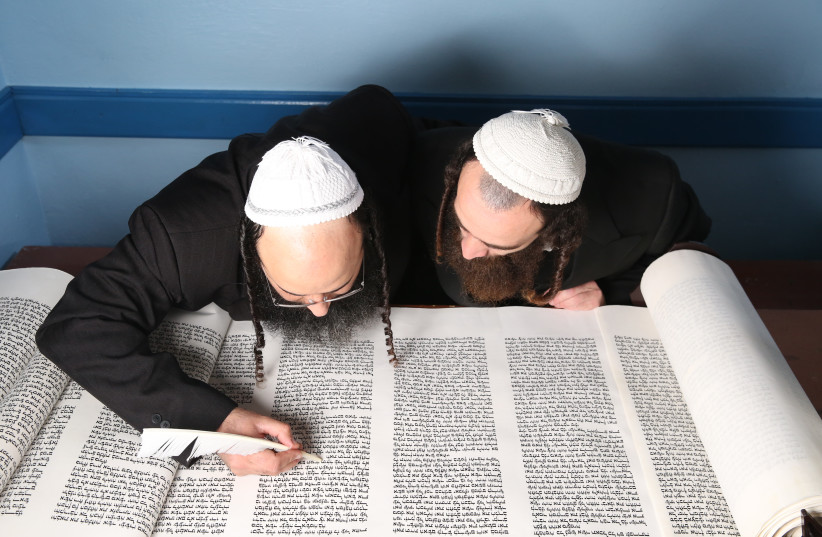
In this new-but-old land, we would encounter a society steeped in corruption and intoxicated with idolatry. Amid this cultural decay, we would be tasked with building a kingdom of God and a society set apart.
Moses delivered the Jewish story – our history, our inheritance, and the narrative that continues to shape the Jewish people across generations.
Our unbroken saga
Our story has endured. It has been carried through the ages as we have traversed vast horizons – rising to triumph and sovereignty, then plunging into the shadows of exile. From the palaces of Jerusalem to the ghettos of Europe, from the Holy Temple to the barracks of Auschwitz, our story has never faded.
With our return to the Land of Israel, the tale was rekindled, vibrant once more. Prophecies hadn’t withered; Jewish destiny still pulsed with life. The desert story that Moses told upon the plains of Jordan stirred again. Our saga reemerged from history’s depths.
The fact that we are building a state based on a national story is part of what unsettles the world and fuels the flames of anti-Zionism. Israel is the homeland of a particular people; it is the homeland of a particular faith. That is exactly what modern culture vilifies.
Distrust of ethno-states
To modern eyes, the idea of an ethno-state seems almost criminal. In the 19th century, two forces converged to lay the groundwork for the violent, fascist ethno-states of the 20th century.
As nationalist fervor swept across Europe, the concept of a nation came to be defined in increasingly ethnic and racial terms, casting minorities as outsiders who threatened national purity. Absolute loyalty to the state and its leaders was demanded, while national greatness became tied to military power, normalizing violence as an instrument of destiny.
The second factor was the infiltration of Darwinian theory into social thought. Darwin had described the natural world as a perpetual struggle between stronger and weaker species, with survival reserved only for the fittest. This biological model was quickly imported into human society, spawning what became known as “social Darwinism.” If in nature the weak were destined to perish, then – so it was argued – society, too, must rid itself of its weaker elements so that the stronger might thrive.
Together, these twin ideologies – obsessive devotion to an ethnically defined nation and ruthless logic of social Darwinism – created a moral and political climate in which fascism and Nazism could flourish, justifying oppression, exclusion, and ultimately industrial-scale murder.
After the defeat of Nazism and, later, Communism (another manifestation of nationalist superiority), the world reverted to a more tolerant outlook. Racial distinctiveness was treated with deep suspicion, seen as a potential harbinger of the 20th century’s horrors.
In place of a single race and culture, the vision of humanity became the multicultural and multi-ethnic state, hailed as the ideal model for the future.
Of course, the erosion of a state grounded in race or religion has contributed to the unraveling of moral cohesion. Values are most resilient and meaningful when they reflect the shared principles of a people united by a common heritage or faith. When cohesion is lost, values become a fragmented carnival of competing ideas, each demanding equal recognition – or inviting accusations of racism or bigotry.
The West’s burden of guilt
Not only did Western civilization develop an aversion to ethno-states, but it also began to confront its own past with deep self-reproach.
Many in the West began to look back upon the rise of Western civilization with shame, questioning its achievements and the methods by which it was built. A new narrative took hold, portraying Western civilization as the handiwork of white, male-dominated Europe, which spread its influence by imposing military might and technological dominance upon the so-called developing world.
Through this lens, the West began to view not only the ethno-states of Nazi Germany as inherently toxic but even Western Europe itself – as though it were one vast ethno-state, stained by its origins.
This cocktail of historical suspicion, moral relativism, and ideological critique has generated fierce opposition to any state built for a particular people with a unique heritage and story.
An ethno-religious homeland
To make matters worse, in the eyes of Israel’s detractors we are not merely an ethno-state but a state grounded in religion. The answer to the age-old question of whether Judaism is a race or a religion is that it is both, and both aspects are essential to Jewish identity. We are a people entrusted with a faith; our mission is not to impose it upon others or to convert the world. We were a people before Sinai, and that peoplehood remains even for those less bound to Jewish practice.
Our state must serve as a home for the race of the Jewish nation while also reflecting, at least at its foundation, the faith and religious heritage that have defined us for millennia. In short, we are building a state for a particular people, grounded in a specific faith, and aligned with its prophetic destiny. Israel is not just an ethno-state but an ethno-religious one.
Israel stands as a rare example of a nation unashamed of its identity as an ethnic state – a country with a story. As such, we have become the lightning rod for the West’s self-imposed shame. It assaults Israel by weaponizing the very sins it projects onto its own history: the rise of the West through colonization, imperialism, and, in its darkest expressions, apartheid.
We must never shrink from our story. We are both a people and a faith, bound together across time, building a state grounded in both.
In shaping the Jewish state, we strive for a democracy that nurtures tolerance, compassion, and justice – not violence or hatred. While we build a nation for our people, we also embrace a universal mission to share our knowledge, technology, and welfare with all who accept it, even in the face of hostility.
Though Israel stands as a state for Judaism, it honors the freedom of every faith within its borders. This is who we are, unwavering and unashamed – a people reborn, a covenant alive, and a nation claiming its destiny.
We are a nation, and we are a story.
The writer is a rabbi at the hesder pre-military Yeshivat Har Etzion/Gush, with Yeshiva University ordination and an MA in English literature. His books include To Be Holy but Human: Reflections Upon My Rebbe, HaRav Yehuda Amital, available at mtaraginbooks.com