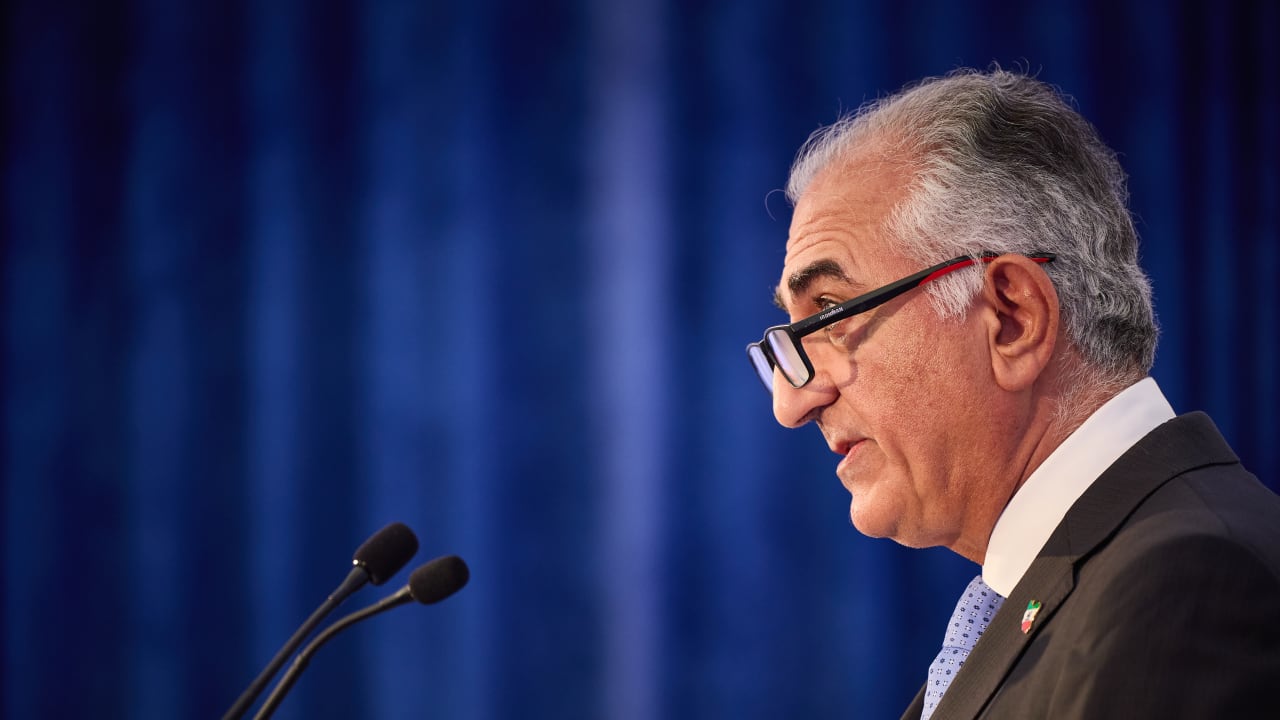
Amid the confusion pouring out of Iran – how many protesters have been killed, how many protesters are truly on the streets, who is a “Mossad agent” and who works for the regime – one thing has remained constant since the first day of unrest.
The support of Reza Pahlavi, Iran’s exiled crown prince.
As of Tuesday, at least 29 protesters have been officially reported killed, according to activist groups, though the true number is widely believed to be far higher. More than a thousand people have been arrested by regime security forces in sweeping crackdowns across multiple cities, with many detentions never acknowledged publicly.
While the Islamic Republic has sought to drown the country in disinformation and repression, Pahlavi has emerged as the most visible and coherent external voice backing the protesters. From his statements of solidarity with victims of regime violence to his increasingly detailed vision for a post-Islamic Republic Iran, he has filled a vacuum that has long plagued Iran’s fragmented opposition.
This week, after reports of shootings in the western city of Malekshahi and an attack on a hospital in Ilam, Pahlavi issued a blunt message. The killing of unarmed youth and the raiding of medical centers, he said, was “an unmistakable crime,” recalling the 2022 Zahedan massacre, in which almost 100 protesters were killed and over 300 wounded by security forces. A regime that murders young people and attacks hospitals, he added, “clearly has no legitimacy, and is nearing its end.”
Such language resonates inside Iran because it mirrors what protesters themselves are saying. Across multiple cities, chants once considered politically unutterable have returned: “Javid shah” – long live the shah. Others go further: “This is the final battle! Pahlavi will return,” and “The shah will return to the homeland, and Zahhak will be overthrown,” invoking the mythic Persian despot.

As The Jerusalem Post’s Alex Winston wrote in a recent analysis, these chants are existentially threatening for a regime built on the overthrow of the monarchy and the erasure of the Pahlavi legacy. They signal that the people’s anger has moved beyond economic grievances and toward outright rejection of the Islamic Republic itself.
The Islamic Republic represents only a fleeting moment in Iran’s long history. For most of that history, Iran was ruled by kings rather than clerics obsessed with exporting Islamic revolution and funneling billions of dollars to proxy wars in Gaza, Lebanon, Syria, and Yemen.
It is against this backdrop that Pahlavi has stepped forward, far from a distant symbol thousands of miles away, but now as a political actor influencing events on the ground. In an interview with the Wall Street Journal this week, he said, “I’ve stepped in to lead this transition.... It’s about self-determination... freedom... rebuilding our country.” He also stressed that US military intervention is not necessary, insisting that regime change needs to come from within Iran rather than without.
This posture has been months in the making. At a press conference in Paris in June, Pahlavi openly called for regime change and laid out principles for a post-Islamic Republic Iran: territorial integrity, equality of all citizens, individual liberties, and the separation of religion and state. He addressed Supreme Leader Ali Khamenei directly, urging him to step down and promising due process.
That message was reinforced in Munich in July, where Pahlavi convened more than 500 Iranian dissidents from across the ideological spectrum. Monarchists and republicans, secular activists, ethnic leaders, artists, athletes, and former political prisoners gathered in what was arguably the broadest opposition coalition in decades. There, Pahlavi outlined a five-pillar strategy: maximum international pressure on the regime, maximum support for the Iranian people, encouragement of defections from within the system, mass mobilization and organization, and detailed planning for economic and political recovery. Crucially, he emphasized that Iran’s future system, including the question of monarchy, must be decided by a national referendum.
As Winston wrote, “It is important to remember that. Pahlavi is not waiting to swoop in and sweep Iranians off their feet – he is willing to let them choose their own future. But the voices emanating from the streets suggest he has a large amount of popular support among the protesters.”
This is the core of “Pahlavi power.”
The people of Iran are no longer whispering the name Pahlavi. They are shouting it.