Iran is down but not out. The decipherable risks to Israel of a future war with the Islamic Republic are substantial. Already, Iran is working to re-start its plans for military nuclearization. Accordingly, Israel will need to reassess its own operational options.
This suggests continuously refined estimations of American support, North Korean and/or Pakistani support for Tehran, and cumulative enemy threats to “escalation dominance.” On these issues, Israel will have to decide between continuing the country’s “bomb in the basement” nuclear posture and shifting to “selective nuclear disclosure.”
If Iran were to remain non-nuclear, Israel could still find itself in a nuclear war. “Normally,” any such conflict would represent an “asymmetrical nuclear war,” but only if neither North Korea nor Pakistan would agree to act as Tehran’s nuclear surrogate. Moreover, relevant calculations by Israel and Iran would depend in part on variously anticipated actions of the United States and Russia.
What should be expected? A plausible escalation danger would lie in Iranian use of radiation dispersal weapons or Iranian rocket attack on Israel’s Dimona nuclear reactor. Even if Iran were to remain non-nuclear, Israel could at some point in time calculate that crossing the nuclear threshold would be rational.
Israel’s traditional policy of “deliberate nuclear ambiguity” goes back to the early days of the state. During the 1950s, David Ben-Gurion, Israel’s first prime minister, understood the need for a dramatic “equalizer” vis-a-vis larger regional enemies. For “BG,” those original enemies were Arab states. Now facing a recalcitrant Iran, Israel needs to update its “ambiguous” nuclear posture. The core objective of such action would be credible nuclear deterrence.
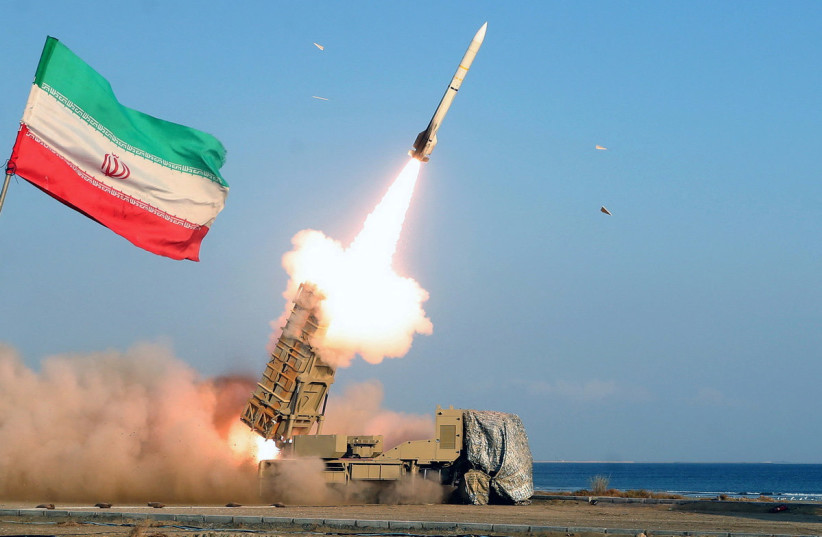
It is conceivable that Iran would at some point act irrationally, either by itself or in alliance with North Korea or Pakistan. The latter is potentially subject to coup d’état by jihadi elements and is also aligned with Saudi Arabia. At some point, the Sunni Saudi kingdom could decide to “go nuclear” itself, not for fear of Israel, but on account of Shi’ite Iran’s revived nuclear program.
Although the only gainful purpose of Israel’s nuclear weapons could be deterrence at tiered levels of military destructiveness, there will still be circumstances in which Jerusalem’s nuclear deterrence could fail. The following four scenarios could result from Israel’s multiple wars against ever-changing jihadi adversaries. This includes Hayat Tahrir al-Sham (HTS) in post-Assad Syria, Iraq, and Lebanon.
Nuclear retaliation
If a still non-nuclear Iran were to launch a massive conventional attack on Israel, Jerusalem could respond with a limited nuclear retaliation. If Iranian first strikes were to involve chemical or biological weapons, electromagnetic pulse weapons (EMP) or radiation dispersal ordnance, Israel could also decide to launch a measured nuclear reprisal. This decision would depend on Jerusalem’s expectations of follow-on Iranian aggressions and estimations of damage limitation. A nuclear retaliation by Israel could be ruled out only in certain circumstances wherein the Iranian aggressions were verifiably conventional and “hard-target” directed.
Nuclear counter-retaliation
If Israel should again feel compelled to preempt Iranian nuclear options with conventional weapons, that enemy state’s response would determine Israel’s next moves. If this response were to include “only” radiological weapons, Israel could still turn to calibrated forms of nuclear counter-retaliation (third strike). If this retaliation were to involve other non-nuclear weapons of mass destruction, Jerusalem could still feel pressed to take the escalatory initiative.
If the Iranian response to Israel’s preemption was limited to hard-target conventional strikes, it is unlikely that Israel’s decision-makers would move to any level of nuclear counter-retaliation. If, however, the Iranian conventional retaliation was “all-out” and directed in whole or in part to Israeli civilian populations, an Israeli nuclear counter-retaliation could not be excluded ipso facto.
A nuclear counter-retaliation could be ruled out only if Iran’s conventional retaliation was presumptively proportionate to Israel’s preemption; confined to Israeli military targets; circumscribed by legal limits of “proportionality” and “military necessity,” and accompanied by persuasive evidence of non-escalatory intent.
Nuclear preemption
It is almost inconceivable that Israel would ever decide to launch a preemptive nuclear strike. Though circumstances could arise wherein such a strike would be technically rational and permissible under international law, it is improbable that Jerusalem would ever allow itself to reach such circumstances.
In principle, an Israeli nuclear preemption could reasonably be expected only where: (a) Iran had already acquired authentic nuclear and/or other weapons of mass destruction; (b) Iran had clarified that its military intentions paralleled its capabilities; (c) Iran was believed ready to begin “countdown to launch;” and (d) Jerusalem believed that exclusively conventional preemptions could no longer be consistent with national self-preservation.
Nuclear war fighting
If nuclear weapons should ever be introduced into a conflict between Israel and Iran, some form of nuclear war fighting would ensue. This would hold true so long as: (a) Iranian first- strikes would not destroy Israel’s second-strike nuclear capability; (b) Iranian retaliations for an Israeli conventional preemption would not destroy Israel’s nuclear counter-retaliatory capability; (c) Israeli preemptive strikes involving nuclear weapons would not destroy Iran’s second-strike nuclear capability; and (d) Israeli retaliation for conventional first- strikes would not destroy Iran's nuclear counter-retaliatory capability. For the time being, any Iranian nuclear capacity would be limited to radiation dispersal weaponry.
In all narratives of future war against Iran that involve preemption, Israel’s tangible rights to survival would be supported by international law. Any state in world politics facing existential aggression holds an irrefutable right to “anticipatory self-defense.” Though this right is limited to uses of force that are consistent with humanizing principles of “distinction,” “proportionality” and “military necessity,” its core justification is never subject to legal challenge. “The safety of the people,” declared Roman jurist Cicero, “shall be the highest law.”
The writer is an emeritus professor of international law at Purdue University. He is the author of many books and scholarly articles on international law, nuclear strategy, nuclear war, and terrorism, including Surviving Amid Chaos: Israel’s Nuclear Strategy. lberes@purdue.edu