
An Israeli friend now living in the US explained a moment that truly exemplified a stark difference in cultures he encountered. Back home, if someone needed help, there would be no question of what to do. He would act. But in the US, he found himself hesitating.
Would someone misread his intentions? Could he be sued? The stories of court cases and the complicated notions of liability created a split-second of uncertainty, one so foreign to him as an Israeli.
If you’re nodding your head as I did when reading his commentary, you should be scared, as I am. As a 17-year-old high school student in America, I’ve noticed that we often question whether it’s our place to help.
We’ve built in so much isolation and insulation into our lives, driven by fear of liability or judgment, that our first instinct is to stay out of it.
The Israeli reflex to help
Americans tend to ask, “Is this my place to step in?” whereas in Israel, the question doesn’t even exist. Whether it’s a wedding, a funeral, a party, or even a bomb shelter, people just show up and are welcomed; they are even thanked for coming.
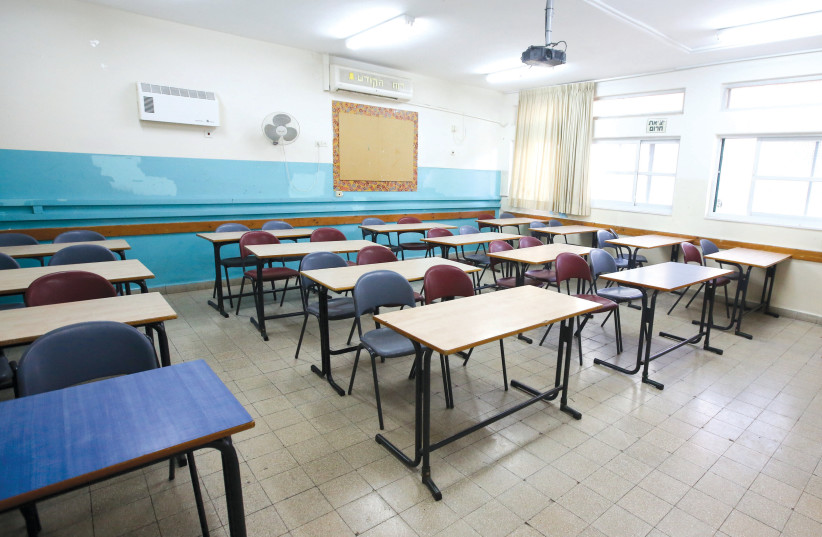
This past spring, I visited a handful of Israeli schools, and I was blown away by the reflex to welcome, to care for, and to participate. It left me wondering: Why have we lost that reflex in the US?
That kind of system – where support is the instinct, not the exception – wasn’t what inspired me to launch Pages for Ages; it’s what convinced me to keep expanding it.
The program began as an initiative designed to aid under-resourced Israeli students by strengthening their English writing skills through prize-based writing competitions. With the help of generous donors, I’ve raised over $40,000 to support schools across Israel – funds that have gone toward competition prizes and purchasing computers for writing centers.
The Israeli education network, Darca, connected me with three diverse Israeli schools: a secular school in Yeroham, a boys’ Jewish Orthodox high school in Netivot, and a Druze high school in Julis. These partnerships brought Pages to life, ensuring that we could reach students from a variety of backgrounds, thereby improving their skills and futures.
When I traveled to Israel this spring to meet the students and deliver awards, I thought I was going to celebrate their achievements. But the real reward was mine: the chance to witness their unity, humility, and warmth. At each school, the smallest gestures underscored an overarching sense of unity.
In one classroom, a photo of a fallen soldier hung near the students who wrapped tefillin each morning. One student wrapped in memory of his valiant cousin; no one needed to explain. Grief wasn’t carried alone; it was shared.
At another school, many students had missed months of classes or had even withdrawn from the competition due to conflict in the North. Amazingly, many still showed up to the award ceremony to congratulate their peers.
When a winner was announced, the reaction wasn’t envy or awkward silence but raucous applause, proud smiles, and pats on the back. I watched students celebrate each other like teammates who had all contributed to a single win. There was no scoreboard – only shared joy.
In contrast, when my Denver-based school held its end-of-year award ceremony, the atmosphere was more muted. Instead of rallying behind the winner, many of my peers quietly exchanged whispers of jealousy. It was a reminder of the hyper-individualistic culture in the US.
The value of unity over individualism
This individualism doesn’t just drive us apart – it erodes our willingness to show up for others in everyday life. And without that willingness, we lose something essential. Because the strength of a community isn’t measured by how it responds to a crisis but by how it shows up when nothing is expected. When it eats, celebrates, or mourns in unison, not out of obligation but out of habit.
Israeli unity, anchored in rituals like Shabbat gatherings, offers a model of solidarity. In the US, Thanksgiving is our closest equivalent – a single day of togetherness that often feels more like an obligation than a tradition.
To build a stronger, more connected society, we need the kind of everyday presence I witnessed in Israel, not just across faiths and the political spectrum but across all the divides of competition and politics that often isolate us from one another.
This culture of gratitude and unity can’t be limited to special occasions. It must become a norm not because it’s sentimental, but because it makes us stronger. Americans today are lonelier, more divided, and more suspicious of one another than ever. Rebuilding trust starts with one thing: showing up.
What I witnessed in Israel wasn’t extraordinary by their standards – it was normal. Its normality is what made it so powerful. None of this should suggest that Israel is a perfect country – no country is – nor should it imply that America is completely broken.
But when I had the opportunity to visit peers in their classrooms, what I witnessed was an extraordinary token of hope.
During my visit to Netivot, the students ended our gathering with a song, “Ani Ve’atah,” by Arik Einstein. One line stayed with me: “You and I will change the world, you and I, and then all will follow.”
Maybe that’s how it starts: with just two people who decide to show up. Will you?
The writer is a high school student based in Denver, Colorado. He is the founder of Pages for Ages, an initiative he launched to support English education in under-resourced Israeli schools through writing competitions and access to technology.