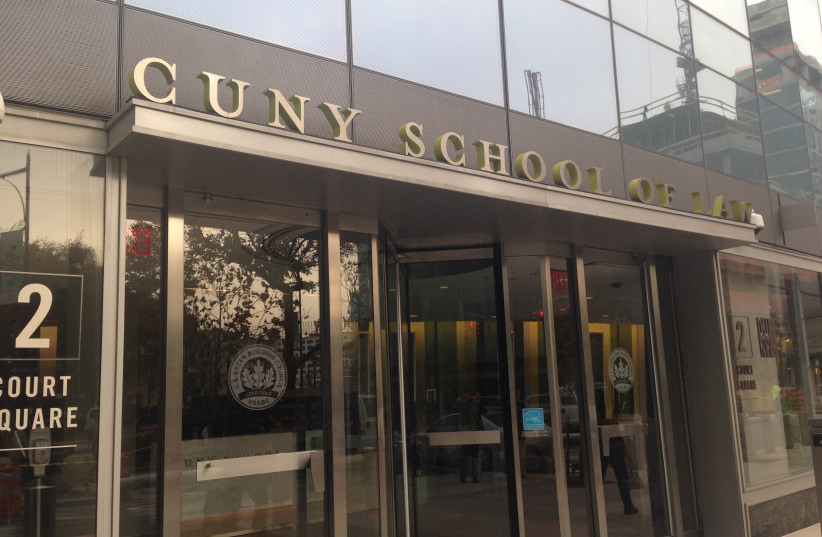
Consider the case of Fatima Mohammed, who delivered the City University of New York (CUNY) law school’s commencement address in May after being nominated to do so by her fellow graduates. A first-generation immigrant from Yemen, Mohammed used her moment in the spotlight to denounce Zionism and accuse Israelis of indiscriminate murder. So inflammatory was her speech that even an opinion piece in the liberal Nation magazine claimed she had invoked the sort of antisemitic tropes found in the Protocols of the Elders of Zion.
Astonishingly, Mohammed’s May 2021 tweet wishing for “every Zionist [to] burn in the hottest pit of hell” did not disqualify her from being elected as the graduation speaker. I’m going to go out on a limb (not really) and postulate that if she had directed such an odious tweet at, say, “every Hindu” or “every Catholic,” there would have been a different student delivering the commencement address.
Predictably, the CUNY law school, whose faculty endorsed a boycott of Israel last year, did not issue any statement regarding Mohammed’s hate-filled speech. Apparently, the school’s leadership agreed with Mohammed when she insisted, “It’s really dangerous to conflate antisemitism and anti-Zionism because those are two different things.”
What happened at CUNY is hardly unique. To cite only a few examples (among hundreds) from recent years:
In May, I was scheduled to lead a professional development training on antisemitism for the faculty and administration at a local high school. At the request of the principal, I sent my PowerPoint presentation in advance. Two days later, however, I was disinvited because some of the “more progressive” teachers strongly objected to my labeling blatant discrimination against Zionists as intolerance toward Jews. “These teachers reject the idea that they’re the same thing; they won’t listen to you,” I was told.
Still, can we really expect to overcome such close-mindedness and combat antisemitism in the guise of anti-Zionism if we Jews can’t even agree on what it means to be a Zionist?
A Brandeis University study of Portland’s Jewish community conducted this year revealed that the majority of Jewish adults expressed views I consider Zionist: 87 percent believe that it’s important for Israel to continue to exist as a refuge for the Jewish people; two-thirds consider it important for Israel to be a Jewish state; 57 percent believe that caring about Israel is essential to their Jewish identity.
Nevertheless, only a quarter of Portland Jewish adults explicitly identify as Zionist. No definition of “Zionist” was provided by Brandeis, and it’s quite plausible that many mistakenly equate Zionism with unwavering support for the Israeli government, regardless of its policies. It may also be that many progressive Jews are influenced by their so-called progressive peers who tell them that identifying with Zionism is incompatible with progressive values, falsely associating it with “apartheid” and “white supremacy.”
If the American Jewish community is going to effectively counteract rising antisemitism on the far Left, however, we must stop allowing outsiders to define Zionism and instead proudly reclaim its true meaning. Most importantly, we must call out anti-Zionism for what it is – an insidious attack on Jewish identity. ■
The writer is director of Community Relations and Public Affairs for the Jewish Federation of Greater Portland.