
Hamas and groups affiliated with the terrorist organization must end extrajudicial executions of suspected collaborators with Israel, Amnesty International demanded on Friday, accusing the organization of unlawful killings, arbitrary arrests, and reprisals against Palestinian families.
The organization, which has frequently criticized Israel’s actions in Gaza, Lebanon and the West Bank, demanded that Hamas end impunity for extrajudicial killings and reprisal attacks against Palestinian families.
“The Hamas authorities must immediately halt all unlawful killings, acts of vigilantism, and arbitrary arrests. Restoring law and order must never serve as a cover to commit grave human rights violations, carry out reprisals, or to collectively punish entire families,” Amnesty International’s Senior Director for Research, Advocacy, Policy and Campaign Erika Guevara-Rosas said.
She also took the opportunity to condemn “Israel’s ongoing genocide against Palestinians.”
In July, the Al-Qassam Brigades publicly confirmed the execution of one man for allegedly collaborating with Israel and their intention to kill another “informant” within days. The first man had allegedly informed Israel about the location of high-ranking Hamas commanders, including the “Ghost of Al-Qassam” Izz ad-Din al-Haddad.

Neither man received a fair trial, Amnesty said, noting that the group had said only that “revolutionary procedures” and internal investigations were carried out before the murder.
The execution was announced by the Hamas-linked group Resistance Security and, after his death, the man’s full name and details were circulated on social media by Hamas-linked accounts. This action, Amnesty said, put the deceased’s family at risk.
Between August 2024 and early 2026, Hamas-affiliated forces were responsible for at least 60 of the 249 cases of extrajudicial killings, according to a United Nations report published in June.
Amnesty reported that some of these executions were carried out in public, filmed, and announced on social media pages connected to Hamas.
Hamas kills ten members of family accused of Israel collaboration
Hamas alleged that it had opened preliminary internal investigations into the killings, though Amnesty confirmed that it received no evidence to suggest those responsible were held accountable.
“Those responsible for ordering and carrying out extrajudicial executions as well as arbitrary arrests, torture, and other ill-treatment must be held accountable. Despite its announcement of the dissolution of the governing committee that administers Gaza, Hamas remains fully responsible for preventing serious violations by its agencies and individuals under its control, including Al-Qassam Brigades and the Resistance Security system, Guevara-Rosas said.
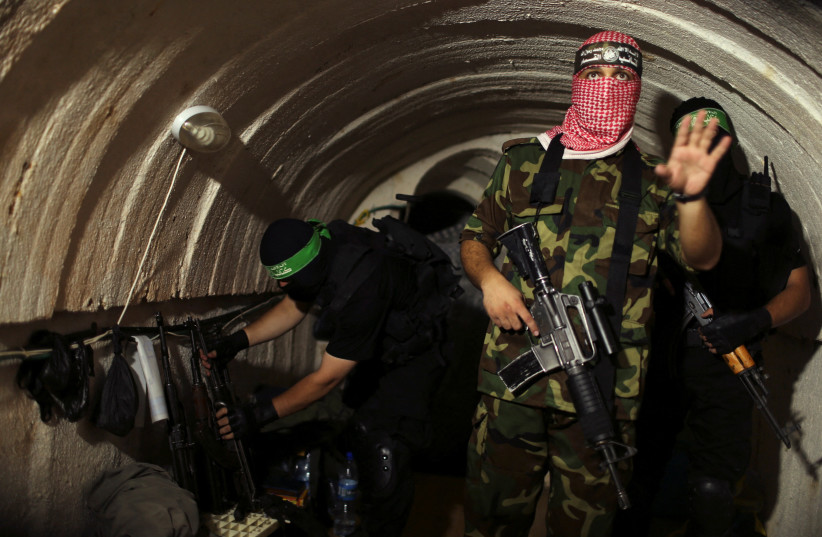
“The new leadership of the political bureau of Hamas must break with the long-standing impunity for abuses committed by its forces and its affiliates and take urgent, concrete steps to ensure truth and justice for victims and their families.”
Amnesty documented nine extrajudicial executions and one unlawful killing, all taking place after the ceasefire-hostage deal in October 2025.
Those killed were members of the Dughmush family from the Sabra neighborhood in western Gaza City, accused by Hamas of collaborating with Israel.
Hamas-affiliated forces attempted to remove members of the Dughmush family from a field hospital near Sabra. The terror group initially accused the family members of looting the hospital and using it to store weapons and explosives. A week-long standoff saw at least four members of the family killed, in addition to one Hamas member. Hamas, along with its affiliates, looted, burned, and vandalized homes in the area.
Amnesty confirmed it had received footage of two homes in the neighborhood showing the aftermath of the damage and looting.
Additionally, on October 13, 2025, eight unarmed, shackled members of the Dughmush family, some only partially dressed, were extrajudicially executed in public on allegations of collaborating with Israel.
Hamas' Mousa Abi Marzouk claims group investigating public executions
The executions were recorded and circulated online by Hamas-linked media. Amnesty noticed that the footage suggested the men had been wounded prior to their execution in a major street in Gaza City, matching reports offered by families that the bodies showed signs of torture when examined for the funeral.
“The eight men had turned themselves in after being promised a fair trial, only to be publicly executed two hours later,” a relative of one of the victims told Amnesty.
Two additional sources also told the NGO that the men had gone willingly with Hamas when they were first detained, promised that they would not be harmed.
“Both my husband and son were executed. My son was tortured before his execution, and his nails were broken… My husband was a kind, honorable man who always resisted the Israeli occupation… I want everybody to know that our family are not collaborators, and those who ordered their killing should be brought before justice,” a wife of one of the victims said.
Speaking with 11 family members of those killed, as well as two health workers, and having analyzed statements and social media posts published by Hamas and affiliated groups, Amnesty established that Hamas operated a parallel force. This force acted outside any legal norms, carried out and filmed summary punishments against Palestinians, interrogated dissidents and criminal suspects, raided civilian homes, and threatened family members of its opponents.
Head of the Hamas International and Legal Relations Department Mousa Abu Marzouk told Amnesty that Hamas had opened an internal preliminary investigation into the Dughmush family incident, asserting that the security forces had acted as an “immediate reaction without referring to higher authorities.”
Hamas has previously justified what it has called “exceptional measures” by invoking the “principle of state of necessity,” blaming Israel for the destruction of judicial and security institutions and asserting the absolute need to address chaos and “criminal gangs.”
“Unlawful killings can never be justified. The rights to life, freedom from torture, and a fair trial and due process must be respected at all times, including in emergency situations or even where the judicial system has collapsed as a result of active military hostilities. Anyone suspected of a criminal offense, including treason or collaboration, must be afforded full respect for human rights, including the rights to life, security of person, and to a fair trial, without resort to the death penalty,” Guevara-Rosas said.
Hisham al-Saftawi, a 57-year-old man, was also killed in October by individuals who identified themselves as members of Al-Qassam Brigades. His wife said that 30 masked men stormed their home in Bureij, central Gaza, and shot Saftawi in the back for refusing to comply with an arrest order.
His wife claimed she heard a man, who appeared to be the group’s commander, question the shooter: “Who ordered you to shoot?”
Saftawi’s brother told Amnesty that his family had no faith that Hamas would properly investigate the incident.
“You cannot trust the executioner to investigate itself. We call for an independent investigation and for those who shot my brother and those who ordered his arrest to be held accountable,” he said.
Hamas told Amnesty that there had been an official investigation into the killing of Saftawi and that it found the gunman had “accidentally shot” Saftawi when he attempted to flee.
“There must be independent and impartial investigations into all the killings that took place in the context of the armed confrontation between Hamas and the Dughmush family, including killings that appear to have been committed outside any exchange of fire, as well as the public execution of the eight Dughmush family members.
“The family of Hisham al-Saftawi must also see justice for the unlawful killing of their relative,” Guevara-Rosas said.