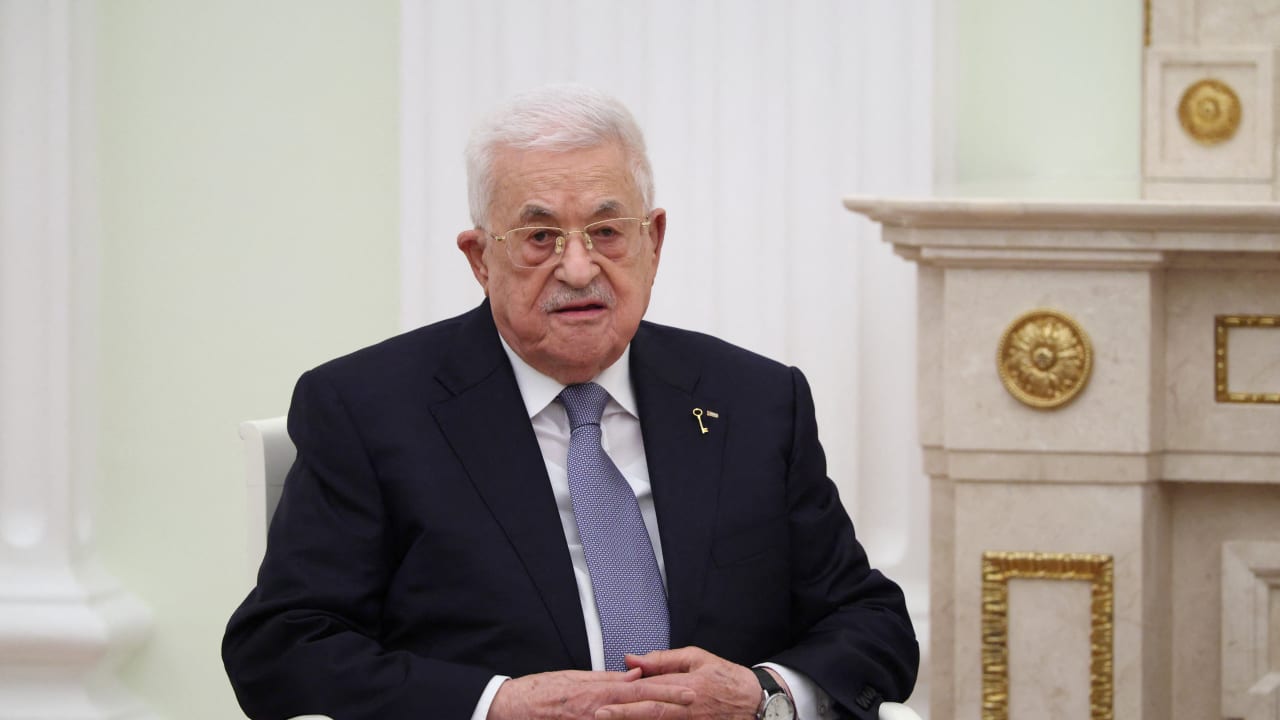
Palestinian Authority President Mahmoud Abbas cast his vote on Saturday in the Fatah movement’s elections, which will determine the composition of the “Central Committee and Revolutionary Council.”
The vote was held at the Ahmad Shuqairi Hall in the presidential headquarters in Ramallah. Palestinian Authority official media claimed that Abbas “emphasized the importance of ensuring the success of the democratic process in a way that reflects the unity of the movement and its commitment to renewing its leadership institutions.”
A total of 59 candidates competed for 18 seats on the Central Committee, while 456 members competed for 80 seats on the Revolutionary Council, which serves as the movement’s parliament.
The Palestinian Fatah movement was founded in 1959 by a number of Palestinian activists, including Yasser Arafat. Among the other founders was Khalil al-Wazir, known as Abu-Jihad.
These men were seen in the region and by some international media as romantic revolutionaries, while others saw them as terrorists.

Wazir was killed by Israel in 1988 in Tunis. Arafat arrived in Gaza in 1994, returning after “27 years in exile” to lead the Palestinian Authority in the wake of the Oslo Accords.
What hopes there were for peace back in the 1990s have largely evaporated now. The Fatah movement and the Palestinian Authority have aged, and their leaders appear like oligarchs from a fading Soviet film in the 1980s.
“This year is the year of democracy. We held an important conference for the Fatah youth, followed by the holding of local elections last April.” Abbas said.
“Today is the Eighth Conference of Fatah, and we are preparing for the elections of the National Council in November, as well as the general and presidential elections, starting with the drafting of the constitution, the political parties law, and the general elections law.”
PA divided from Gaza, which is under Hamas rule
There have been recent Palestinian municipal elections, but much is lacking. The PA is divided from Gaza.
In Gaza, the US-backed technocratic committee faces hurdles because it has no armed police and no way to confront Hamas, and reports claim that Israel has backed militias in Gaza.
The 2 million people are kept under Hamas rule. The disaster in Gaza continues. Israel’s KAN noted over the weekend that it is unclear how the technocratic government can enter Gaza while Hamas is still in control.
Israel eliminated a Hamas commander in Gaza called Izz al-Din Haddad, but this is a tactical strike. The strategy in Gaza is similar to the one since 2007. Hamas is expected to remain in control.
This leaves an aging Fatah leadership in control of the West Bank. Palestinian activist Samer Sinijlawi wrote on X/Twitter about the recent leadership race. “The attempt to turn Palestinian politics into a family inheritance is disconnected from the mood of Palestinian society.”
“After 20 years without national elections, Palestinians are demanding accountability, renewal, and new leadership – not political succession through bloodlines,” he added before noting that “even regional Arab leaders reportedly warned Mahmoud Abbas in the past against repeating the Mubarak model. History already showed how dangerous that path can become.
What shocks me again and again is that among roughly 2,500 members of the Fatah Conference, almost nobody would even dare to nominate themselves against Abbas for the presidency of the movement.”
Now the 91-year-old Abbas seems intent on cementing his legacy via his son. “This is not only politically damaging inside Palestine. It also further erodes international confidence in the Palestinian political system at the very moment Palestinians desperately need legitimacy, reform, and democratic renewal.
“The future of Palestinian leadership cannot be decided inside family circles. It must be decided by the Palestinian people through free national elections – both legislative and presidential,” Sinijlawi wrote.
Al-Ain media in the UAE has an article on the elections. It claims that they reshape the balance of power. “According to preliminary results, Yasser Abbas, the eldest son of Palestinian President Mahmoud Abbas, won membership in the Central Committee, the highest leadership body in the movement.”
PA elections took place across region
The report says the elections took place in Ramallah, Gaza, Cairo, and Beirut. There was a “strong competition between dozens of candidates from the movement’s historical leadership and the new generation, in one of the most important organizational milestones that Fatah has witnessed in years, especially with the increasing talk about internal reforms and arrangements for the next stage within the Palestinian Authority.”
The report claimed that “according to the preliminary results, Marwan Barghouti, a leader who has been imprisoned in Israeli jails since 2002, received the most votes, maintaining his position within the Central Committee, while Hussein al-Sheikh, the deputy head of the Palestinian Authority and the Palestine Liberation Organization, Mahmoud al-Aloul, the deputy head of the Fatah movement, Jibril Rajoub, and Tawfiq al-Tirawi retained their seats within the movement’s central leadership.”
The Al-Ain report says that some new names emerged, “notably the director of the Palestinian intelligence service, Majid Faraj, and Zakaria Zubeidi, a former leader of the Al-Aqsa Martyrs Brigades in Jenin camp, along with Yasser Abbas, whose political presence has become prominent in recent years after his appointment about 5 years ago to the position of “Special Representative of the President.” Faraj has been seen for some years as a possible strongman who might lead the PA in the future.
The report noted that Yasser Abbas is 64 years old, so he is not exactly young. The report said that Abbas is a “businessman who owns companies operating in multiple sectors within the Palestinian territories, and spends a large part of his time in Canada.”
The report added that the “list of candidates included prominent names within the Fatah movement, including former Palestinian Prime Minister Mohammad Shtayyeh, Major General Hazem Atallah, head of the Broadcasting and Television Authority, Ahmed Assaf, Palestinian Ambassador to Britain, Hossam Zomlot, and former minister Qaddoura Fares.” Women also competed.
Al-Ain added that “the eighth general conference is the first conference held by the Fatah movement since its seventh conference, which was held in Ramallah in 2016. The current conference is seen as a pivotal moment for the movement in light of the Palestinian and regional political changes.”
The report makes a good point in noting that the movement faces a number of challenges. Among these are “the declining political horizon, and escalating Arab and international calls for reforms within the Palestinian Authority institutions.”
The PA also faces criticism for corruption and stagnation, and the “absence of a democratic process, amid international pressure to restructure its institutions in preparation for any future role in managing the Gaza Strip after the war.”
In Israel, many on the Right want the PA to be dismantled and hope that Israel will annex the West Bank. The annexation will not lead to Palestinian Arabs getting citizenship, but rather that they remain stateless and without citizenship within an expanded Israeli state.
Israel’s leadership has, over the last decade, preferred that Gaza be separated from the West Bank, reducing the chances for a Palestinian state to emerge.
Even after the October 7 massacre, Hamas has been allowed to continue to control Gaza. While some Israelis see Hamas as the main enemy, others believe the PA, as an embodiment of Palestinian statehood, is the main enemy.