
Iranian officials warned Monday that a US proposal to escort and guide commercial vessels through the Strait of Hormuz would constitute a violation of the ceasefire.
“Any American interference in the new maritime regime of the Strait of Hormuz will be considered a violation of the ceasefire,” senior Iranian lawmaker Ibrahim Azizi said in a statement.
Azizi, who heads Iran’s parliament National Security and Foreign Policy Commission, added that the contested waterway “would not be managed by Trump's delusional posts!” and added, “No one would believe Blame Game scenarios!”
Other Iranian officials have stressed that Tehran would not back down from its position regarding control of the strategic waterway.
A statement issued Monday by the unified command of Iran's armed forces warned the US Navy against entering the Strait of Hormuz. “We have repeatedly stated that the security of the Strait of Hormuz is under the control of the armed forces of the Islamic Republic of Iran, and under all circumstances, any safe passage must be coordinated with the armed forces.” The statement explicitly threatened to attack any foreign military forces, particularly US forces, that attempt to enter or approach the strait.
Ali Nikzad, a member of the Iranian parliament, said in an interview with The Islamic Republic of Iran News Network (IRINN) over the weekend that the “Strait of Hormuz will never return to [its] pre-war state,” and that ships associated with the US and its allies would only be allowed through if they pay war reparations, further underscoring Tehran’s intention to maintain full control of the strait.
Nikzad added that Israeli vessels “will under no circumstances” be allowed passage.

Heightened maritime threat
Despite the US plan to assist stranded ships, the United Kingdom Maritime Trade Operations (UKMTO) maintained the security threat level in the Strait of Hormuz as “critical,” according to a statement on Monday.
“The maritime security threat level in the SoH remains CRITICAL due to ongoing regional military operations. Mariners should expect increased naval presence, enhanced force protection postures, potential VHF hailing, and congestion near anchorage areas,” UKMTO said.
Trump's ‘Project Freedom’ initiative
In a statement on Sunday, US President Donald Trump said Washington would begin a maritime operation to escort commercial vessels out of the Strait of Hormuz starting Monday morning, Middle East time, framing the move as a humanitarian effort to ease mounting pressure on shipping routes.
Dubbed “Project Freedom,” the initiative is intended to assist ships stranded in restricted waterways in and around the Persian Gulf. “This process, Project Freedom, will begin Monday morning, Middle East time,” Trump said.
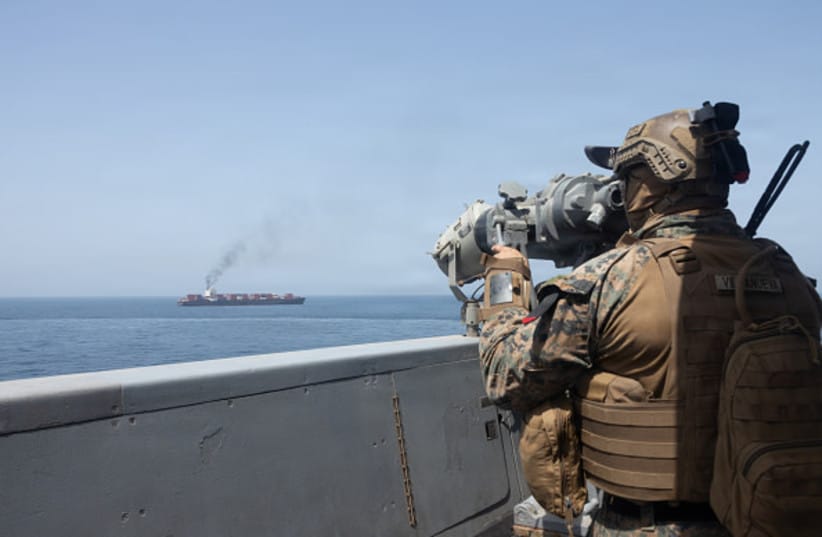
Trump noted the effort was launched following requests from countries whose vessels have been unable to exit the strait, describing them as “neutral and innocent bystanders.” He added that the US would “guide their Ships safely out of these restricted Waterways,” allowing them to resume normal operations.
While warning that the US would use force if its efforts were disrupted, Trump added that American officials were engaged in “very positive discussions” with Iran that he said could lead to broader diplomatic progress.
Meanwhile, Pakistan’s Deputy Prime Minister and Foreign Minister, Senator Mohammad Ishaq Dar, held a phone call early on Monday with Iranian Foreign Minister Seyed Abbas Araghchi, focusing on the evolving regional situation and Islamabad’s ongoing diplomatic efforts to promote stability. Araghchi stressed that diplomacy remains “the only viable path” toward resolving tensions and achieving lasting peace in the region and beyond.
Trump has said that the latest proposal submitted by Tehran to end hostilities within 30 days was “not acceptable.” Washington’s plan to guide ships through Hormuz and Iran’s rejection of the proposal have raised fears of renewed conflict that could ultimately collapse the fragile ceasefire.
Tobias Holcman contributed to this report.