
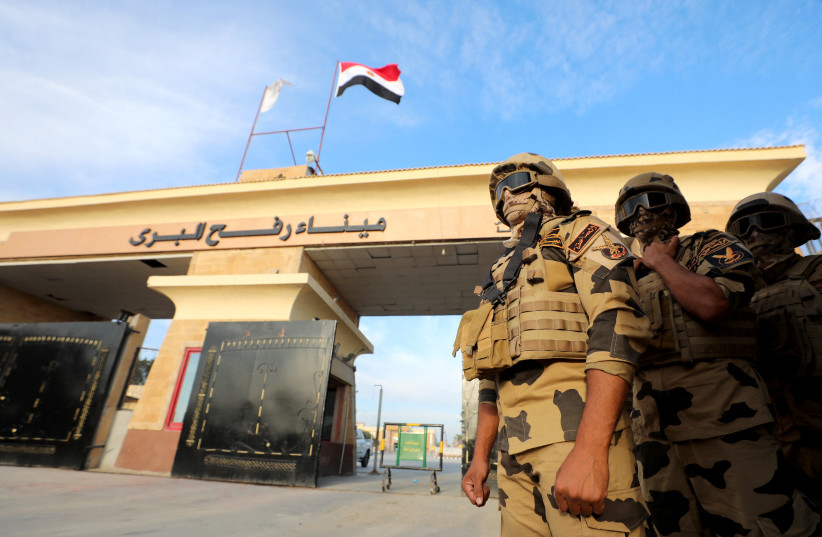
The Rafah border crossing between Gaza and Egypt partially reopened on Sunday, according to reports.
Al-Ain media in the UAE reported that “After months of a ceasefire and demands from humanitarian organizations to open it without obstacles, Israel will begin on Sunday the process of partially reopening the Rafah crossing, with passage limited to individuals and under strict supervision.”
Countries in the region that backed the ceasefire and which have worked closely with the White House on the Board of Peace will be watching what happens next closely. The re-opening of the crossing comes two days after a number of Israeli airstrikes in Gaza.
The IDF said that in response to the violation of the ceasefire agreement on Friday, in which eight terrorists were identified exiting the underground terror infrastructure in eastern Rafah, the IDF and ISA have, thus far, struck four commanders and additional terrorists from the Hamas and Islamic Jihad terrorist organizations across the Gaza Strip.”
Board of Peace questions last IDF strikes in Gaza
Palestinians in Gaza claimed that around two dozen people were killed in the strikes. The IDF said it also struck a “weapons storage facility, a weapons manufacturing site, and two launch sites belonging to Hamas in the central Gaza Strip. The terrorist organizations in the Gaza Strip systematically violate international law, brutally exploiting civilian infrastructure and the Gazan population as human shields for terrorist activities.”
The Board of Peace’s Nickolay E. Mladenov, who is an Executive Board member and serves as the High Representative of the Board to Gaza, wrote on X that “I am deeply concerned by what has taken place since Friday: Hamas armed operatives emerging from a tunnel in Rafah, Israeli strikes that tragically also killed civilians. Such developments risk the hard-won progress under UNSCR 2803 and President Trump’s 20-Point Peace Plan.” He added that “my office and I are working closely to support the [Palestinian National] Committee and find ways that prevent future incidents. We will need everyone’s full cooperation to make this possible.”
The Rafah crossing was a major crossing with Egypt, and during the era after 1967, the border was blurred as Israel controlled both sides. Later, after Egypt returned to control Sinai, there was smuggling from Egypt’s Sinai to Gaza. The IDF had to clear the area along the border, called the Philadelphi corridor, several times. After October 7, the IDF went into Rafah in May 2024 and once again cleared many buildings along the border.
Al-Ain noted that “after the ceasefire took effect, Israel stipulated that the crossing would only reopen if all hostages in Gaza were returned, a condition that was met earlier this week with the return of the body of the last hostage. Washington announced the transition to the second phase of the agreement it brokered with Egypt and Qatar.”
Israel’s COGAT, which coordinates aid entering Gaza, noted “in accordance with the ceasefire agreement and the directive of the political echelon, the Rafah Crossing will open this coming Sunday (February 1st) in both directions, for limited movement of people only.” It added that “exit from and entry into the Gaza Strip via the Rafah Crossing will be permitted in coordination with Egypt, following prior security clearance of individuals by Israel, and under the supervision of the European Union mission, similar to the mechanism implemented in January 2025.”
During the war, some politicians in Jerusalem had argued that the crossing should only open to enable Gazans to leave. This was part of a pressure campaign to try to get Gazans to leave for Egypt. Egypt does not want to have large numbers of people pressured to leave Gaza and move to the Sinai, as the Sinai already has many security challenges.
It is not yet clear how many people will be allowed to cross. It is important for many stakeholders in the Gaza ceasefire deal that the crossing remain open and that people can travel in both directions. Mohammed Shamia, 33, a displaced person from west of Gaza City, told AFP: “I have a kidney disease, and I have a referral for treatment abroad, and I am waiting moment by moment for the Rafah crossing to open… Every day that passes takes away from my life, the disease is getting worse, and there are no medical services here,” Al-Ain noted. A woman from Deir al-Balah in central Gaza said, “I received a scholarship outside the Gaza Strip, and now I am eagerly waiting for the crossing to open...hoping to achieve my ambition.”
The UN wants the crossing opened to aid organizations so they can enter without obstacles, the Al-Ain report notes. “Despite its limited scope, the measure is expected to facilitate the entry of the 15-member Palestinian National Committee for the Administration of Gaza, a technocratic body established to oversee the day-to-day management of the Gaza Strip. The committee will operate under the auspices of the “Peace Council” chaired by US President Donald Trump.”
Rafah’s opening is a major test. It will be seen as a milestone if the opening works and is not chaotic. However, if it leads to a crisis and is closed again, then this will show that there are many more hurdles to cross.