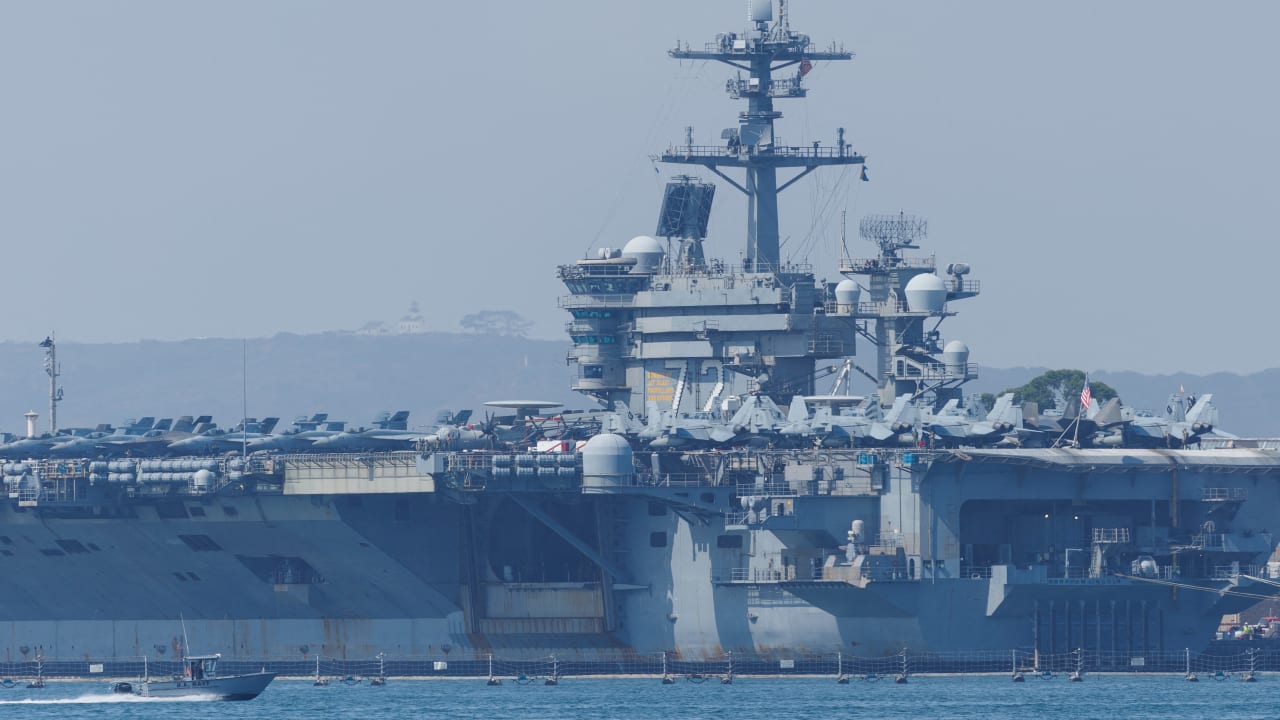
The United States Armed Forces continue to reinforce their military presence in the Middle East amid the possibility that US President Donald Trump may order an attack against Iran.
Aircraft carrier USS Abraham Lincoln and its strike teams have reached the Strait of Malacca, located between Malaysia and Indonesia. They are expected to enter the US Central Command’s (CENTCOM) area of responsibility in five to seven days. Accompanying the carrier are two destroyers: the USS Spruance and the USS Michael Murphy.
According to reports, an additional 12 F-15 fighter jets have arrived in Jordan over the past 24 hours.
More fighter aircraft are believed to be heading to the region, set to arrive in the near future, while cargo planes have landed at the US military base in Diego Garcia.
US officials told The Jerusalem Post that “all options are now on the table.” The officials added that the goal is to build a significant force in the Middle East that would provide Trump with a broad range of options should he decide to strike Iran.

Prime Minister Benjamin Netanyahu also convened several ministers in the senior defense echelon on Sunday to discuss recent developments in the region. Israeli officials believe that a “US strike on Iran is still an option.”
Trump had reportedly been persuaded on Wednesday to cancel an attack on Iran, partially due to the US’s limited operational ability in the region, as many American assets had been redeployed to the Caribbean and East Asia after the 12-day war in June.
Several Arab states had also reportedly informed the US that they would not allow American aircraft to take off from their territory in order to strike Iran.
Also on Wednesday, Netanyahu held a phone call with Trump, where he reportedly said that Israel was not prepared to defend itself in the event of an Iranian response to an American strike, given that the US military lacked sufficient forces in the region to assist as it had done in the past.
Former US ambassador to Israel and deputy assistant secretary of defense for the Middle East, Dan Shapiro, suggested that Trump, driven by a desire to fulfill rhetorical promises to the Iranian people, may be seeking a “dramatic” military exit ramp.
“Trump called for the Iranian people to go to the streets, promising he would be with them,” Shapiro told the Post. “But when the regime killed thousands, no price was paid because the US lacked the necessary forces in the region at the time.”
According to Shapiro, that dynamic is now changing. As US forces move back into the region, America’s military option is being made available. Shapiro said that Trump’s preferred “one-and-done” dramatic military style strike could lead him to specifically target Supreme Leader Ayatollah Ali Khamenei.
“What would be big and dramatic and allow him to say he fulfilled his promise? It would be to eliminate the supreme leader,” Shapiro said.
Iranian President Masoud Pezeshkian responded in a post on X/Twitter, warning that a strike against Khamenei would amount to a full-scale war with Iran.
While such a move would be popular among many Iranians, Shapiro warned of the “Venezuela effect.”
Referring to the United States’ mixed results in its attempts to oust former Venezuelan president Nicolás Maduro, Shapiro cautioned that Trump often lacks the long-term commitment required for genuine regime change.
“He doesn’t want to be pulled into a long regime-change war,” Shapiro said. “Eliminating Khamenei is dramatic, but it wouldn’t necessarily change the regime. You would likely see the Islamic Revolutionary Guard Corps (IRGC) take over, at least for a time.”
'Quiet in the streets is decieving'
However, the challenge for the Trump administration is not only that it will take at least a week to assemble the forces, but also the fact that the Iranian regime has brutally suppressed the protests.
A senior Iranian official told Reuters that more than 5,000 people were killed during the regime’s crackdown over the past two weeks, raising a key question. Given the brutal repression of the protests and the dramatic decline in the number of protesters, is there any chance that an American attack, or even the prospect of one, could bring people back into the streets?
Director of the Iran Program at the Institute for National Security Studies (INSS), and one of Israel’s leading experts on Iranian domestic affairs, Dr. Raz Zimmt, noted that while the “fear factor” currently dominates Iran, the regime’s tactics are deepening the hatred that drives the protests.
“At first glance, it looks like there is a very wide deployment of security forces, mass arrests, and citizens who are quite afraid to leave their homes,” Zimmt told the Post. However, he warned that the quiet on the streets is deceptive.
Drawing a comparison to the major crackdowns in 2019, Zimmt said that the current repression is building a different kind of psychological infrastructure. “While the suppression might contribute to fear in the immediate term, it deepens the hostility and hatred toward the regime.”
He pointed to the cultural importance of mourning rituals in Iran, especially the 40th-day memorial ceremonies, as potential flash points.
“Each funeral, each memorial service has the potential to escalate,” Zimmt noted. “We saw in 2022 how these dates can bring thousands back to the streets. The potential for friction is growing, and this level of suppression cannot be maintained indefinitely.”
Zimmt also said that he does not believe Trump’s words gave the protests significant momentum. “The large protests began even before Trump’s statements.
The strikes are usually a final push, when there are already masses of demonstrators in the streets, he added. “Let’s assume there is an American strike now. Would that encourage the average citizen to go out and protest? It’s far from certain. The fact that there is an attack does not mean the chances of toppling the regime have increased. It depends on the type of strike.”
Zimmt also noted that an attack on the Islamic Republic may not lead to the regime’s collapse. Rather, it could lead to a transition of leadership that does not truly dismantle the system.
“It’s possible that whoever comes next will not be pro-Israel either,” he said, “but they might feel that in order to survive, they must be pragmatic.”