Last Thursday, Israel targeted the Iran-backed Houthis senior leadership in Yemen. Airstrikes hit a meeting of their prime minister and other senior Houthi ministers and officials.
On Saturday, the Houthis said their prime minister had been killed in the strike. This led a number of commentators to claim that Israel had “assassinated” the “prime minister of Yemen.”
The Houthis leadership is not the official government of Yemen. Rather, they are a rebel government backed by Iran. The Houthis control only a part of Yemen.
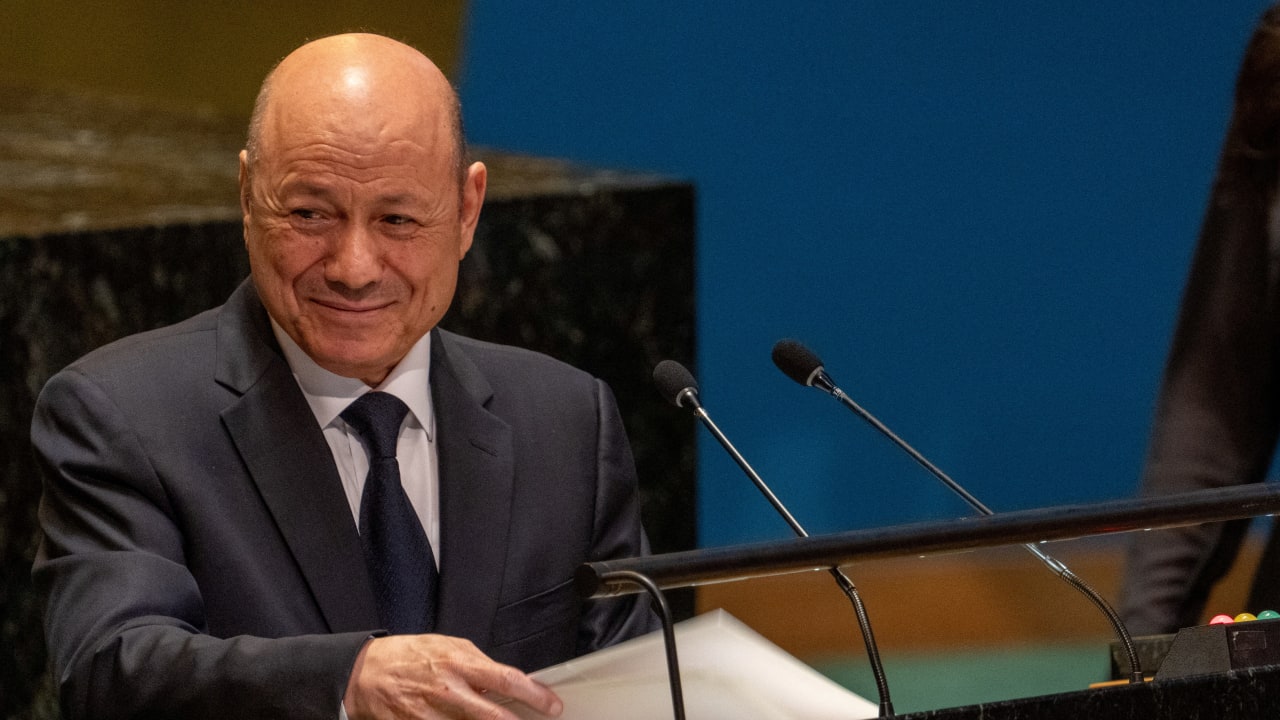
Yemen’s internationally recognized government, on the other hand, is led by the Presidential Leadership Council (PLC), whose chairman, Rashad al-Alimi, was appointed this past May. He had previously served as interior minister and deputy prime minister. Yemen also has a prime minister named Salem Saleh bin Braik, a former finance minister.
The previous prime minister, Ahmed Awad bin Mubarak, said he had resigned after facing “many difficulties,” Reuters reported. Yemen has been divided for many years.

'The PLC is committed to achieving peace'
“The Internationally Recognized Government (IRG) refers to the institutions of the Yemeni state that are recognized by the international community,” the Armed Conflict Location and Event Data (ACLED) organization reported. “The IRG is based in the interim capital of Aden since February 2015, when President Abdrabbuh Mansur Hadi fled Yemen’s capital Sanaa, after it was overrun by forces of the Houthi-Saleh alliance in late 2014.”
The current PLC consists of eight members and is chaired by Alimi, the report said.
“The PLC is committed to achieving peace within what it terms the ‘three references’: the Gulf Cooperation Council (GCC) initiative; the outcomes of the National Dialogue Conference (NDC); and United Nations Security Council resolution 2216,” ACLED reported.
The official government has its own army and has forces in parts of southern Yemen, as well as in the governorates of al-Jawf, Hajjah, Marib, Saada, and Taiz.
Yemen has been divided throughout much of its modern history. It was colonized in part by the British. When Yemen became independent, it was divided into North and South Yemen. South Yemen became a communist Soviet ally until 1990, when it was unified with North Yemen into what we now think of as Yemen.
North Yemen fought a long civil war in the 1960s. Egypt intervened to support pro-Nasser fighters against the Kingdom of Yemen, which was backed by Saudi Arabia. The civil war ended in 1970. The unified country was then ruled by Ali Abdullah Saleh from 1990 until 2012. Saleh fell from power during the Arab Spring and was eventually killed in 2017.
The Houthis emerged from the mountains of Yemen, capturing Sanaa in 2014. They then moved south toward Aden, which caused Saudi Arabia to again intervene in Yemen, this time to stop the Houthis.
The Houthis gained support from Iran and launched ballistic missiles and drones at Riyadh. This led to a complex war in Yemen, with several countries involved. In addition to Saudi Arabia and Iran, the UAE was also involved.
Yemen's old and current divisions
WHILE WE think of Yemen as a center of Iranian influence today, there was a time when al-Qaeda had a foothold there. It bombed the USS Cole in 2000 and was also home to the extremist American-Yemeni al-Qaeda figure Anwar al-Awlaki, who was killed in a US drone strike in 2011.
When Yemen became divided between the Houthis and the official government, it also suffered other divisions. The UAE, for instance, has backed the Southern Transitional Council in Aden.
In essence, Yemen’s current divisions have aspects of the divisions that existed from the 1960s to 1990s, meaning that the Houthis control parts of what were once North Yemen, and the government controls part of what was once South Yemen.
Yemen’s new prime minister, Braik, in office since May, had clashed with Alimi, chairman of the PLC, over his powers after Alimi refused former prime minister Mubarak’s request to dismiss 12 of the government’s ministers, six government sources told Reuters.
Mubarak was appointed premier in February 2024 after serving as foreign minister. He came to prominence in 2015 when he was kidnapped by Houthi militiamen while serving as Yemen’s presidential chief of staff during the Houthis’ conflict with then-president Abd-Rabbu Mansour Hadi. Mubarak had also sought to suspend the budgets of various ministries, such as the Defense Ministry, claiming there was corruption.
“There are promising signs of a shift in the balance of power in the country’s long-running conflict, [Alimi said in April], citing growing unity among anti-Houthi factions,” Asharq al-Awsat reported. At the time, the US was bombing Yemen, a decision the Trump administration made in March. US airstrikes would soon stop, however, taking the wind from Alimi’s sails.
Alimi had said he foresaw a broad national alignment in Yemen that would be ready to battle the Houthis.
“He said the emerging consensus among Yemen’s diverse political and military components to confront a common enemy was a key development on the ground,” Asharq al-Awsat reported.
“Al-Alimi met late Tuesday with the head of the Consultation and Reconciliation Commission, his deputies, and senior figures from political parties and factions represented in the body, as efforts to unify anti-Houthi forces continue,” the report said. “The meeting came amid ongoing US airstrikes targeting Houthi positions across several provinces, including the capital Sanaa, as well as Saada, Hajjah, and Hodeidah.”
Yemen had become a tool of Iran, Alimi told German media outlets. In 2024, the US Council on Foreign Relations said a truce in Yemen had been “breached by the Houthis more than once. They carried out a number of attacks on various places... under the control of the legitimate government, among which are the oil facilities, which cost the Yemeni people 70% of their basic resources.”
“Nevertheless, our efforts continued,” he said. “We have responded to all the initiatives related to the establishment of peace and stability in Yemen.”
The Houthis had tried to drag Yemen into the conflict with Israel, Alimi said. It was important to dry up funding for the Houthis, he told the UN General Assembly last year.