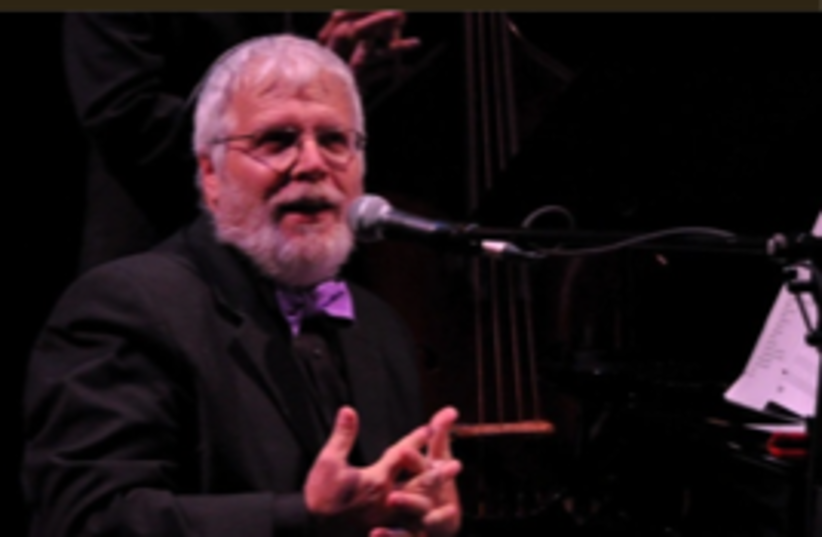
My first language was Yiddish. My father, a writer, poet, and educator, survived the war by escaping Warsaw in September of 1939. He made his way to Vilna, where he stood outside the gates of the Japanese embassy, as ambassador Chiune Sugihara was defying Tokyo’s orders and personally signed several thousand transit visas for Jews who were looking to flee war-torn Poland/Lithuania. My father received a visa to Shanghai, where he spent the war years. He met my mother, Chane, who was born here [in New York] – at the first Yiddish Folklore seminars at UCLA given by Max Weinreich, who was one of the founders of the YIVO Institute [for Jewish Research]. My mother was a musician, pianist. My father loved Yiddish songs, and they made their life’s work collecting Yiddish songs. They published several major Yiddish song anthologies, which are now online for the first time at yiddishsongs.org.
My mother was a strong musical influence in my life, as well as her sister, Malke Gottlieb with whom I studied piano for many years. I also studied at Tanglewood with Leonard Bernstein and at the Juilliard school.
I have been the artistic director of Folksbiene for over 20 years. I felt it was my responsibility to make sure that this theater company could reinvent itself and appeal to a new generation. I instituted English supertitles that accompany all our performances, We produce shows for children and parents as well, like Kids and Yiddish, which will have a new production in the fall of 2023.
I first heard the recording that was made in Israel, with Shmuel Rudensky playing Tevye, in my parents’ living room in the mid-1960s, I believe it was then that the idea became lodged in my consciousness. After many years of working in the theater and believing that Fiddler deserved to be heard in the language that Sholom Aleichem wrote the Tevye stories, I convinced my board to undertake this venture. I called Joel Grey to see if he was interested in directing, and he was. And he loved the theater where we are in residence at the Museum of Jewish Heritage in Battery Park. When we announced that we were going to do Fiddler in Yiddish directed by Joel Grey, we had over 2,500 inquiries from actors wanting to audition. We auditioned 700 of those, and we picked 30, and the press was very excited about the idea. We were set to do a six-week run, but that turned into a six-month run of consistently sold-out performances at the museum. We then transferred to an Off-Broadway theater, Stage 42, on 42nd Street, in the heart of the theater district, where we ran for close to a year. When we closed, we were set to go to China for three weeks, do a national tour starting in LA, and mount a new production in Australia to open at the Sydney Opera House and play Sydney for four weeks, and then Melbourne. But COVID had other plans. Recently, we brought the production back to New York for a seven-week run. And now there are new plans to travel to China, LA, possibly Toronto, possibly Israel, and other cities as well.
When we produced a 50-year anniversary celebration of Fiddler on the Roof at Town Hall in 2014, where we assembled over 100 alumni of past shows, Broadway, and the movie, we invited Topol to come from Israel to participate. He came and brought down the house singing ‘If I Were a Rich Man.’ He also came to see our Yiddish Fiddler in 2018 when we were at the museum and came backstage and congratulated the cast. He loved the production. He was a very special actor and human being, and we will miss him. ■