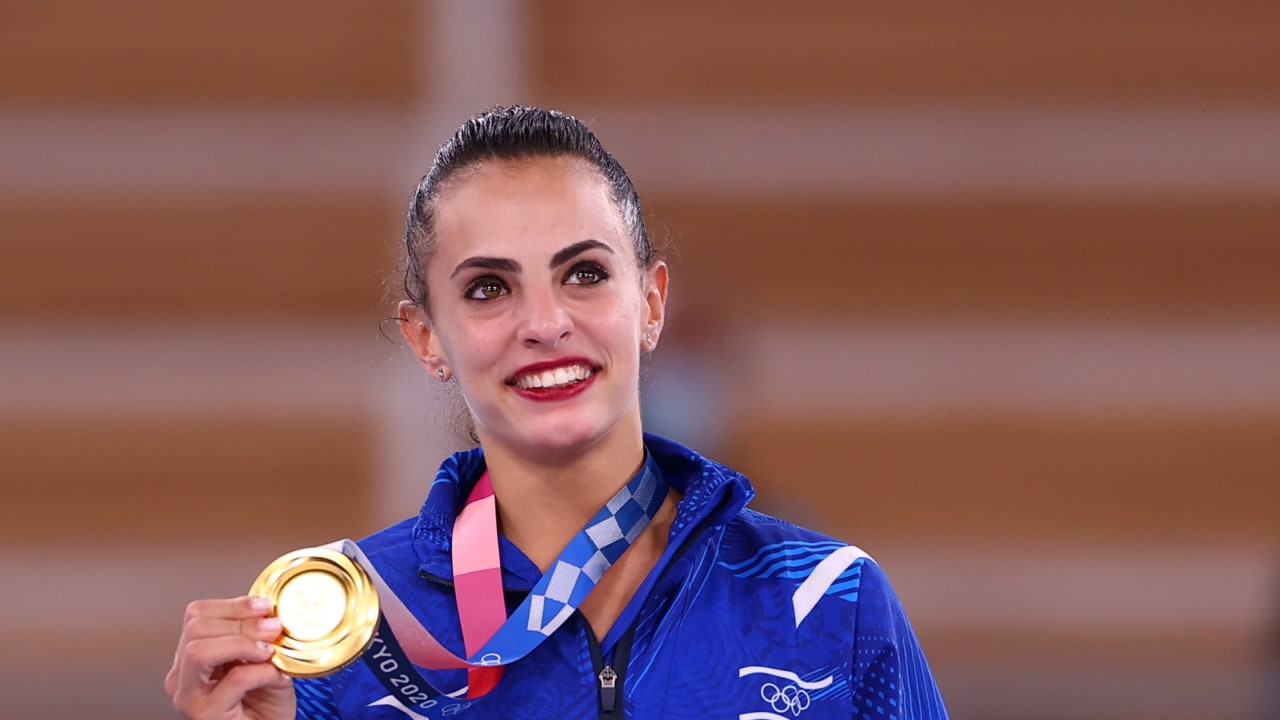
Russian news site Sports Express reported on Sunday that the Russian Gymnastics Association appealed to the International Olympic Committee about Ashram's gold medal and asked to pass it on to Dina Averina.
Vinogradnaya — who has reportedly been the target of mass online harassment since the decision — said that "Linoy performed exercises at a higher level of difficulty and therefore received a high score despite the ribbon's fall."
"I am satisfied with the score I gave," she reiterated.
“The whole world has seen the injustice,” the Russian Olympic Committee tweeted on Saturday.
The Averinas contested their scores in two rotations but both of Dina’s inquiries were unsuccessful, including one she made after Ashram was announced the winner.
Ashram’s win broke a Russian stranglehold on the Olympic title that stretched back to 2000, with sisters Dina and Arina Averina heavily favored to win the title for the ROC once more.
When Ashram's coach, Ayelet Zussman, was asked about the ROC's claims, she responded “Let me enjoy first place and the fact that I have an Olympic champion."
"The Russians are among the strongest competitors in the world, but in terms of Linoy, this was her best competition ever," Zussman continued, saying that "I always knew she could get any medal she wanted. This is Linoy Ashram, she knows when to do the right thing at the right time. "
An Olympic medal event since 1984, rhythmic gymnastics sees athletes perform exquisite contortions and maneuvers to music while using hoops, balls, clubs or ribbons.
In the difficulty level, Linoy presented exercises that were 1.3 points more difficult (in total) over those performed by Dina Averina - 0.3 higher in the difficulty level in the hoop, 0.1 in the ball, 0.7 in the clubs and 0.2 in the ribbon.
In fact, the difference between Ashram and Dina Averina at the end, which was only 0.150 points, indicates that Averina received better scores in the performance category totaling 1.150, but that was still not enough for her to reduce the gaps in the difficulty levels which Ashram had created.
In fact, Dina Averina scored 0.6 points higher than Ashram in the difficulty level with the device, but the talented Israeli scored 1.9 points higher in the difficulty level for body performance — and this is what gave her the advantage of 1.3 in the difficulty level, which was finally enough for her to win gold.
Dina Averina herself criticized the decision, saying "The Israeli gymnast made a mistake and still received a high score, it is not fair. I am in favor of fair and clean sports and not in favor of judges making strange decisions."
But Avdokhin explained that these claims are unfounded, and any mistake can be corrected by the level of difficulty and quality of execution.
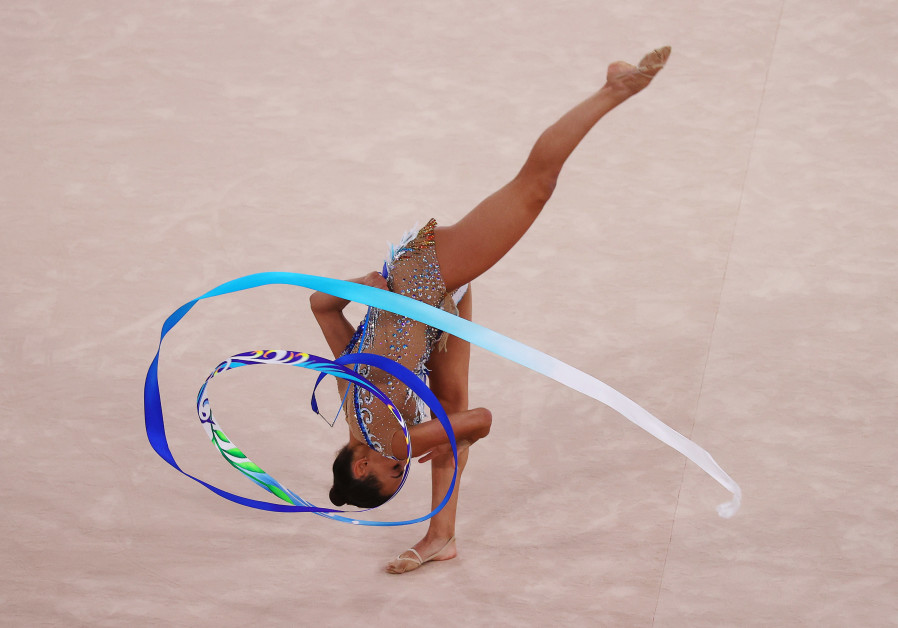
According to rules, which were adopted in 2017 and developed in part by Team Russia coach Irina Viner-Usmanova, dropping the ribbon results in a loss of 0.700 points.
This seems to be what happened in Ashram's case as well, seeing as she received a 1.3 point deduction for her performance in the ribbon exercise, and made no other major mistakes.
Avdokhin also explained that the degree of difficulty itself consists of two parts — difficulty with the device, which examines the synchronization between the body and the device on each of the four devices, and difficulty in body performance, which examines body control —jumps, turns, stability, etc.
Russia suffered another upset in the filed of Rhythmic Gymnastics on Sunday, losing the gold to Bulgaria in the group all-around finals with a score of 90.700 next to Bulgaria's 92.100, losing their stranglehold on yet another event which they had been winning consecutively since the 2000 Olympic Games.
Israel placed sixth 83.850 points overall and Italy took bronze with 87.700 points.