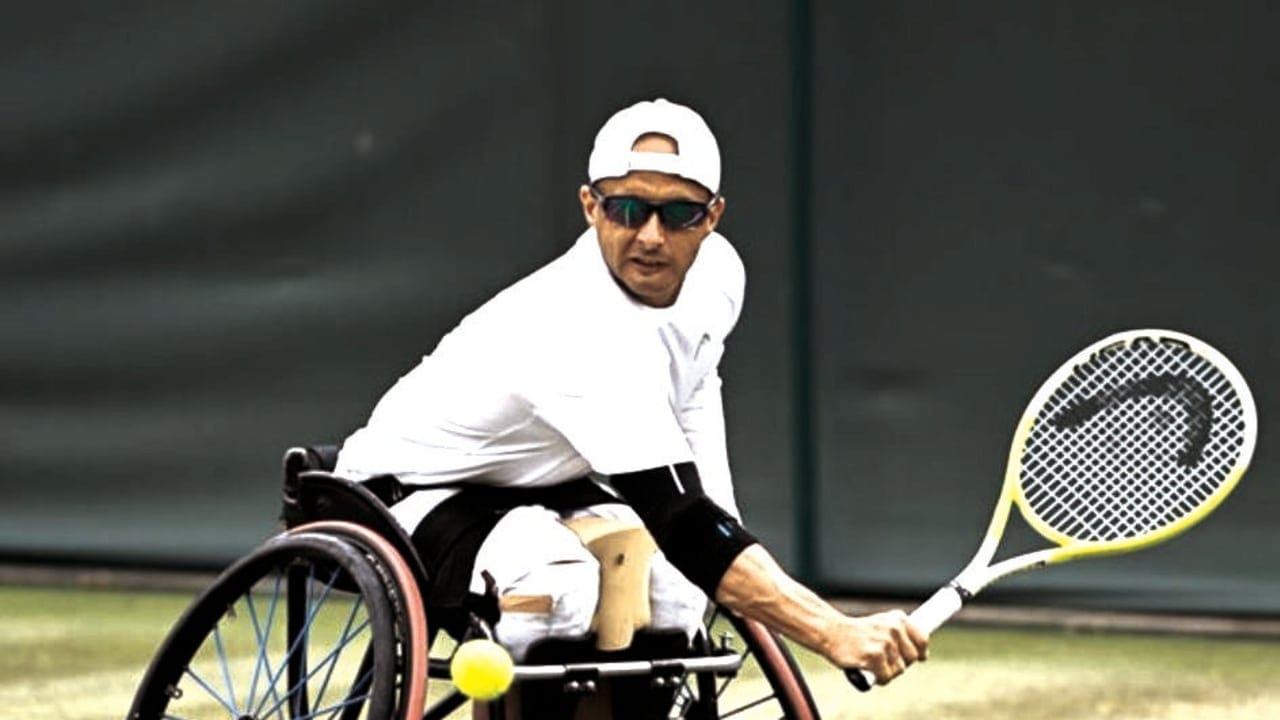
Israeli wheelchair tennis star Guy Sasson reached the pinnacle of his sport over the weekend, capturing the Wimbledon Quad Doubles title alongside Dutch partner Niels Vink in dominant fashion.
The top-seeded duo overwhelmed South Africa’s Donald Ramphadi and Great Britain’s Gregory Slade, winning 6-0, 6-2 to claim their second consecutive Grand Slam title together, following their Roland Garros triumph in June.
For Sasson, 45, who now lives and trains in Houston, Texas, the moment was deeply emotional. A decade ago, a snowboarding accident in the Alps left him paralyzed from the knees down. Since then, he has become one of the world’s most formidable wheelchair tennis players, transitioning from the Open division to the Quad category in 2023. He now ranks No. 3 in the world and owns four Grand Slam titles – two in singles and two in doubles.
Winning at Wimbledon, Sasson said, was “the peak of the mountain,” a dream he’s chased through years of rehabilitation, personal transformation, and relentless training.
“Just walking into the facilities, seeing the history, the names on the walls – knowing that next year my name will be there too – it’s an unbelievable feeling,” he said. “This is the top of the top.”

After the final, Sasson addressed the crowd in a victory speech that was broadcast live on the BBC, ending with a Hebrew quote from the Torah.
“The people shall rise up as a great lion, and lift themselves like a young lion,” a verse that appeared in the weekly portion read that same Sabbath, and which also gave its name to a recent Israeli military operation. “Am Yisrael Chai,” he declared – “The people of Israel live” – drawing loud applause and a flood of emotional messages from Israeli fans and families.
“It’s important to me to share these messages,” Sasson explained. “There are so many people watching who don’t necessarily follow tennis, but they feel connected to the meaning behind these moments. I get messages from bereaved parents, wounded soldiers, evacuees – it’s worth everything to me.”
Though Sasson fell short in the singles tournament, losing in the quarterfinals to Dutch rival Sam Schröder, he said winning the doubles title was especially meaningful.
“Of course, I was disappointed not to advance in singles,” he said. “I felt great going into it, but things didn’t go my way. Finishing the tournament with the doubles title meant a lot to me.”
Schröder would go on to win the quad singles championship, denying Sasson a shot at a rare Wimbledon double.
He and Vink, who had previously been paired with fellow Dutchman Schröder during last year’s Olympic season, began playing together this year. After early struggles – including a loss in the Australian Open final – the pair found their rhythm.
'Learning each other's strengths'
“We’re learning each other’s strengths, getting into a groove,” Sasson said. “When we connect and the vibe is right, no one can stop us.”
Despite entering the final as heavy favorites, the pair approached the match with caution.
“We were a bit nervous,” Sasson admitted. “The team we played isn’t as strong on paper, but they surprised the No. 2 seeds in the semis. That got our attention. Finals can always be tricky.”
But once the match began, Sasson and Vink quickly took control.
“We felt dominant with every point,” he said. “It was fun – we were loose, confident, and just enjoying ourselves.”
Sasson’s journey to elite status hasn’t been easy. After four years in the more physically demanding Open division, he moved to the Quad category – reserved for players with impairments in both upper and lower limbs – and quickly became a contender. The transition required him to shift not only his playing style but his entire mental approach.
“Quad is a much more thoughtful game,” he said. “In Open, it’s about power and speed. In Quad, it’s about strategy, finding your opponent’s weakness. It took some getting used to, but now I love the challenge.”
Sasson trains with renowned Belgian coach Damien Martinquet and says his age relative to his competitors – many of whom are in their 20s – requires constant discipline.
“When I don’t feel like going to the gym, I remind myself that Niels and Sam definitely are,” he joked. “I believe in the process and pushing myself to the limit.”
After Wimbledon, Sasson is setting his sights on the US Open in late August, where he hopes to continue his winning streak on his home turf. Whether he plays a warm-up tournament in Washington, DC, or trains at home in Houston will depend on his schedule and his coach’s availability.
But first, there’s a celebration.
“Like every time I win,” Sasson laughed, “I’m going to celebrate at one of Assaf Granit’s restaurants. That’s become the tradition – Paris, London, wherever I am.”
After the road he’s traveled and the mountain he just climbed, few athletes deserve it more.