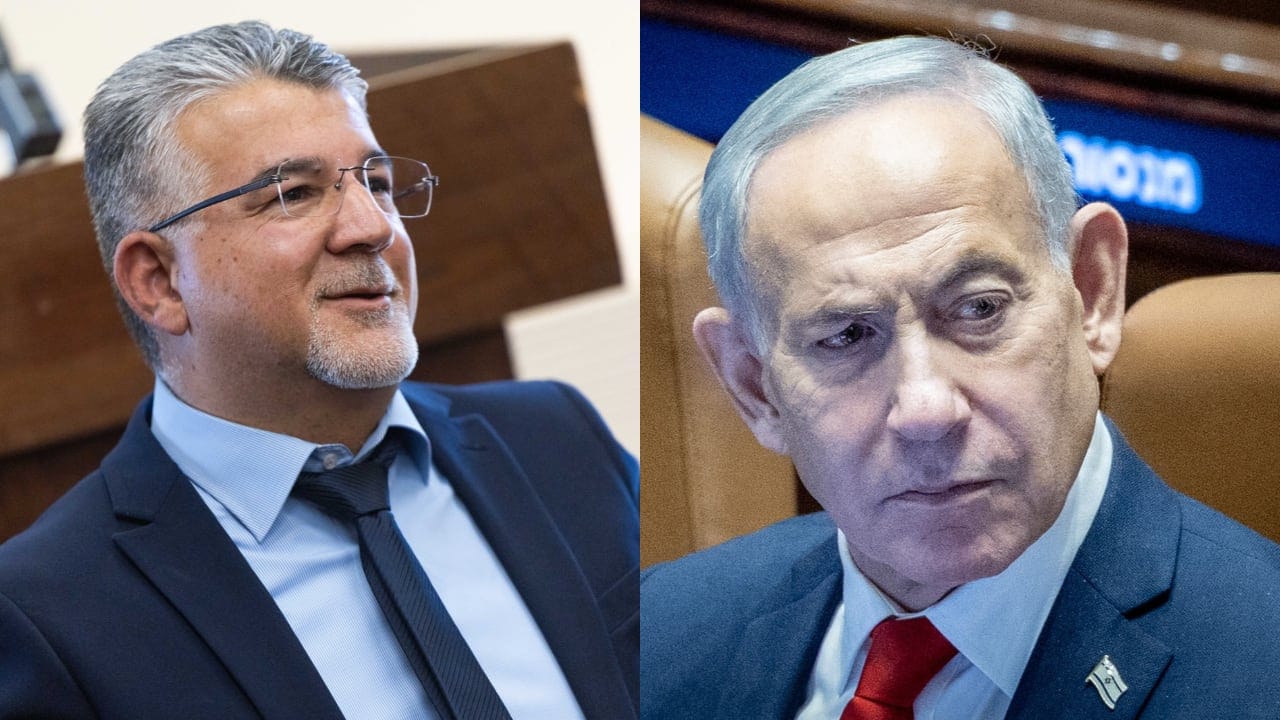
Joint List chairman Prof. Yousef Jabareen defended Arab lawmakers against accusations that they have failed to condemn Hamas's October 7 massacre, while accusing Prime Minister Benjamin Netanyahu of fueling hostility toward Israel's Arab population.
Speaking in an interview with 103FM, Jabareen addressed criticism of Arab political representatives, recent controversies involving Joint List members, and his party's efforts to replace the government.
Jabareen rejected claims that Joint List representatives had avoided condemning Hamas's actions during the October 7, 2023, attacks, insisting that their position had been consistent from the outset. "We have always maintained a very clear position: both condemnation of and opposition to Hamas's crimes and massacre on October 7. We have said this more than a thousand times, not just now, in retrospect."
The Joint List chairman said he had personally condemned the massacre immediately after the attacks and maintained that Hadash's leadership had expressed its opposition at the time.
"As a senior member of Hadash's leadership, we had a very clear position of condemnation from the very first day, in real time," he said. "There has never been a statement by an Arab Knesset member justifying harm to innocent people."

Jabareen defends Balad chairman Abu Shehadeh and MK Ahmad Tibi amid criticism
Jabareen also addressed a court ruling concerning Balad chairman Sami Abu Shehadeh over an article he had written, arguing that its contents did not justify the decision against him.
"Even in the article on which his disqualification was based, there was no call for violence, which is why we were surprised by the court's decision," Jabareen said.
The interview also touched on the controversy surrounding Joint List MK Ahmad Tibi, who came under criticism over the previous 24 hours after appearing alongside Jordanian parliamentarians known for their anti-Israel positions.
Jabareen dismissed the criticism, warning against drawing broader conclusions from an isolated incident without considering its context.
"They take a very individual case, remove it from its context, and highlight it," he said. "Have you heard any statement by MK Tibi that could justify such accusations?"
Joint List chairman accuses Netanyahu of encouraging racism against Arab Israelis
Jabareen expressed concern over what he described as growing hostility toward Arab citizens of Israel, accusing Netanyahu of contributing to an increasingly hostile public atmosphere.
He specifically criticized remarks made by the prime minister during the Knesset's swearing-in ceremony, arguing that accusations directed at Arab political parties could have dangerous consequences.
"What is this situation in which the prime minister, on the day the Knesset is sworn in, says that Ra'am and the Joint List want to destroy the State of Israel?" Jabareen asked. "This is outright incitement that puts lives at risk. He says this when our political platform is very clear."
Jabareen also accused the Israeli media of contributing to the problem by allowing racist rhetoric to become normalized in public discourse.
"They normalize racist statements on radio and television, and that filters down to the streets," he said. "Unfortunately, we constantly hear racist positions being expressed without any consequences. I feel this racism on the streets."
He also criticized Channel 13 and 103FM host Eyal Berkovic, accusing him of mocking his academic title and arguing that the remarks reflected a broader attitude toward Arab Israelis.
"Berkovic does not know me, but this is a racist attitude toward the entire Arab public, and it is time to address it appropriately," Jabareen said.
Replacing Netanyahu government is Joint List's top political priority, Jabareen says
Turning to the political situation, Jabareen said replacing Netanyahu's government remained a central priority for the Joint List, arguing that the current political climate posed a serious threat to Arab society and Israeli society more broadly.
"We see an existential danger to Arab society and to society in Israel, and that is why we place this at the top of our priorities," he said.
Jabareen acknowledged that a change in government would not immediately resolve the problems he attributed to Netanyahu's years in office, describing the process of rebuilding public institutions and restoring confidence as a long-term undertaking.
He indicated that the Joint List was prepared to allow a future government the time needed to implement broader changes across Israel's political and public institutions.
"It will take time to repair the difficult years of Netanyahu's rule, and we will allow the necessary time to carry out the required reset across all of Israel's systems, after years of abandonment, bloodshed, destruction, and despair," Jabareen concluded.