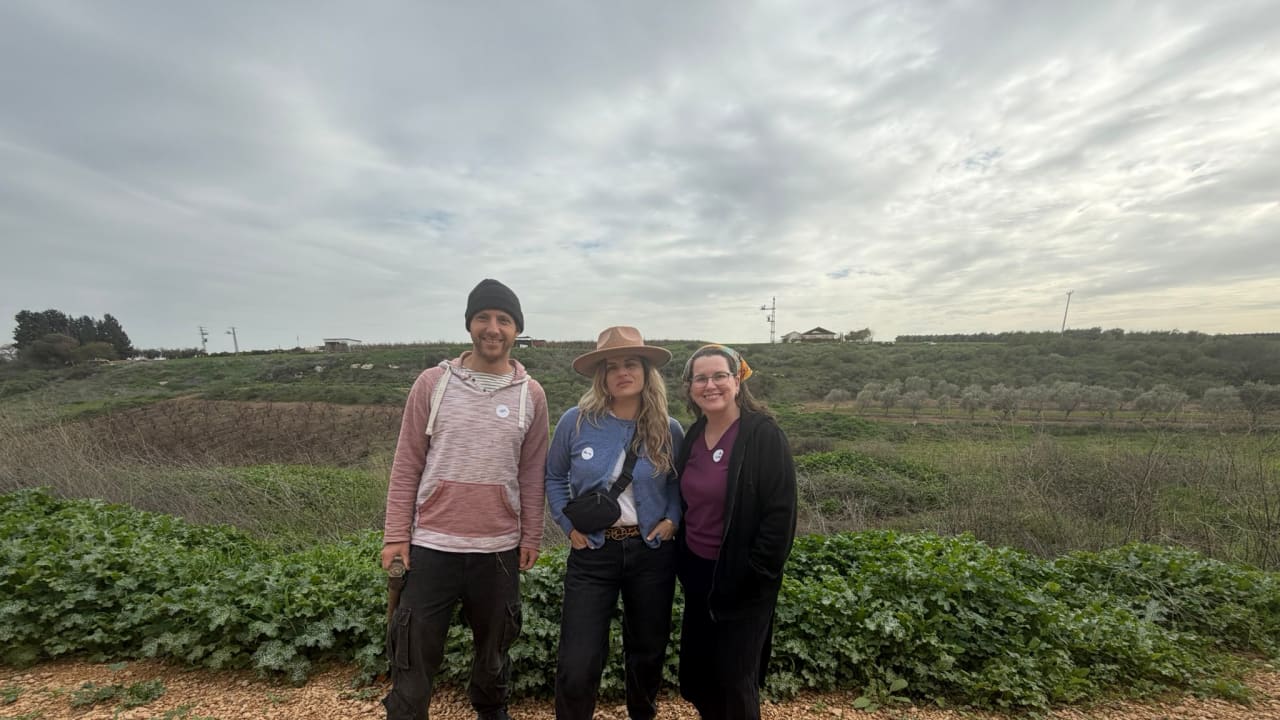
As spring arrives, the young, idealistic founders of the Galilee Eco Center are busy at work.
The now-empty tract of land in Israel’s North is waiting for something big.
Avi Friedman and Ariela Solomon, who are part of the core group that purchased the land, spoke to The Jerusalem Post two years ago when their plan was to create what they called the Chevra Eco Farm. This was in the midst of the war with Hamas in Gaza, before the attacks from Iran, and before the return of the hostages.
Now, two years later, the team is ready for the next phase, having rebranded as the Galilee Eco Center, which they foresee as “a regenerative agricultural center in Israel that combines sustainable ecology, Jewish heritage, and personal healing.”
Solomon and her husband and children, along with Friedman and his wife and children, are two of the families at the forefront of the project. They spoke to the Magazine about the recent updates.

Located near Rosh Pina, the eco center is planned to be situated on 2.2 hectares (5.4 acres) of land and will focus on regenerative agriculture. “We want to repair the relationship between the Jewish people and the Land of Israel,” Friedman said.
He sees the project as an extension of the pioneering spirit that revived the land several hundred years ago, when it was still an underdeveloped backwater territory of the Ottoman Empire.
Historic perspective
Friedman wants to teach new techniques in farming and land management, such as regenerative agriculture. For several years, he has been engaged in hosting workshops and training seminars.
“As you work the land, you can improve the soil quality as opposed to depleting it,” he explained. “If you plan correctly, over time you end up with fewer inputs.” He made reference to to the Dust Bowl, which occurred in the North American prairies in the 1930s, in which improper farming techniques, coupled with drought and an economic downturn, led to the loss of farm land and mass migration.
He added that Jewish holidays like Tu Bishvat are intrinsically linked to the Land of Israel. “I was literally watching the almond blossoms open up,” on this year’s Tu Bishvat as he tended his land in Rosh Pina.
Solomon, a native of California now living on a moshav in the Judean foothills, echoed this sentiment.
“We did our first successful crowdfund campaign on Tu Bishvat, and we’ve made so much progress since that point. It was just months after Oct. 7. Just as a regenerative ecosystem thrives because every plant enriches the soil and air for the others, so too the Jewish people endure only when each of us strengthens the shared roots that bind us to one another and to the land.

“We don’t lose hope,” she asserted.
From hi-tech to green
Solomon made aliyah 15 years ago and spent years in the fast-paced hi-tech world, as well as fundraising and nonprofit management, but nature is her calling.
“I’m a California girl, and when I came to Israel for the first time, I was 12 years old. My father was a Jewish communal worker, and my grandfather was a Holocaust survivor. I can’t explain it, but as soon as I landed here, I knew that I was going to be coming back; and even after living in this crazy country for 15 years, I will never leave.”
She met Friedman and his wife when the two ran Trumpeldor Vintage Clothing, a store in Jerusalem’s Nahlaot neighborhood. The local English-speaking young adults developed a close community bond, and when the store closed and friends moved away, it sparked a desire to recreate the sense of togetherness in a more green setting.
It was the store where Friedman met his wife, Shira, an immigrant from South Africa. The son of an Orthodox rabbi, Friedman was born in Memphis, Tennessee, and grew up mostly in Norfolk, Virginia, where he had a standard Orthodox education. “I came to Israel for yeshiva, like most Orthodox high schoolers,” he explained. “I was not very connected to the land whatsoever. I was just here because that’s what everyone else does.” Now, after serving in the IDF, getting married, and having kids, he seeks to build something meaningful.
Friedman previously lived in Moshav Beit Meir, where he and his wife made homemade olive oil, learned beekeeping and other homesteading skills. He marveled at the ancient agricultural terracing, which researchers have estimated to be between 2,000 and 6,000 years old.
“This agricultural framework they created is still there and still working, and that was very inspiring to me,” he said. “I would really like to be involved in my lifetime in creating some sort of agricultural system that also continues to give in the future.”
Solomon added that she sees the Galilee Eco Center as “developing agritech to be able to use advanced technology to monitor biodiversity, soil health.” She sees AI tools as an effective way to track and maintain farms in an effective and environmentally sound way.
Eventually, the center can welcome groups from abroad to teach stewardship of nature with respect for Jewish tradition.
They are inspired by the Jewish nature programming and farming movement in the US.
Scientific perspective
Another member of the team is Yael Maoz, who serves as chair of the Galilee Eco Center’s board. She made aliyah from the US with her husband in 2012. She earned her PhD in plant molecular biology, with doctoral research focusing on genomic rearrangements in flax in response to environmental stress from the Weizmann Institute in Rehovot.
“The land we are working with in the Galilee presents a rare opportunity,” Maoz affirmed. “Some areas have been fallow, while others have experienced intensive agricultural use, making it an ideal setting for learning how land responds to different management approaches.”
She added, “A key part of what excites me is the partnership between practice and science. Avi brings a deep passion and hands-on expertise in regenerative agriculture, and my hope is to complement that work by helping monitor what’s happening in the soil and in the plants themselves – looking at indicators such as soil health, biodiversity, and plant resilience to better understand how regenerative practices affect the land over time.”
She hopes that as Israel continues to encourage development in the North, the Galilee Eco Center can play a practical role in helping individuals and families learn how to grow food locally and sustainably.
The team is currently in conversation with the municipality of nearby Kiryat Shmona about building an intentional community of English speakers who want to be close to the land.
“It’s not just about living in Israel,” Maoz said, “but about taking responsibility for its land and helping it flourish in a thoughtful, sustainable way – something I hope, God willing, to pass on to my children and one day to my grandchildren.”
Friedman laments the phenomenon of litter in public parks in Israel and hopes the center can spread a message of “leave no trace.”
For more information: galilee-ecocenter.org/