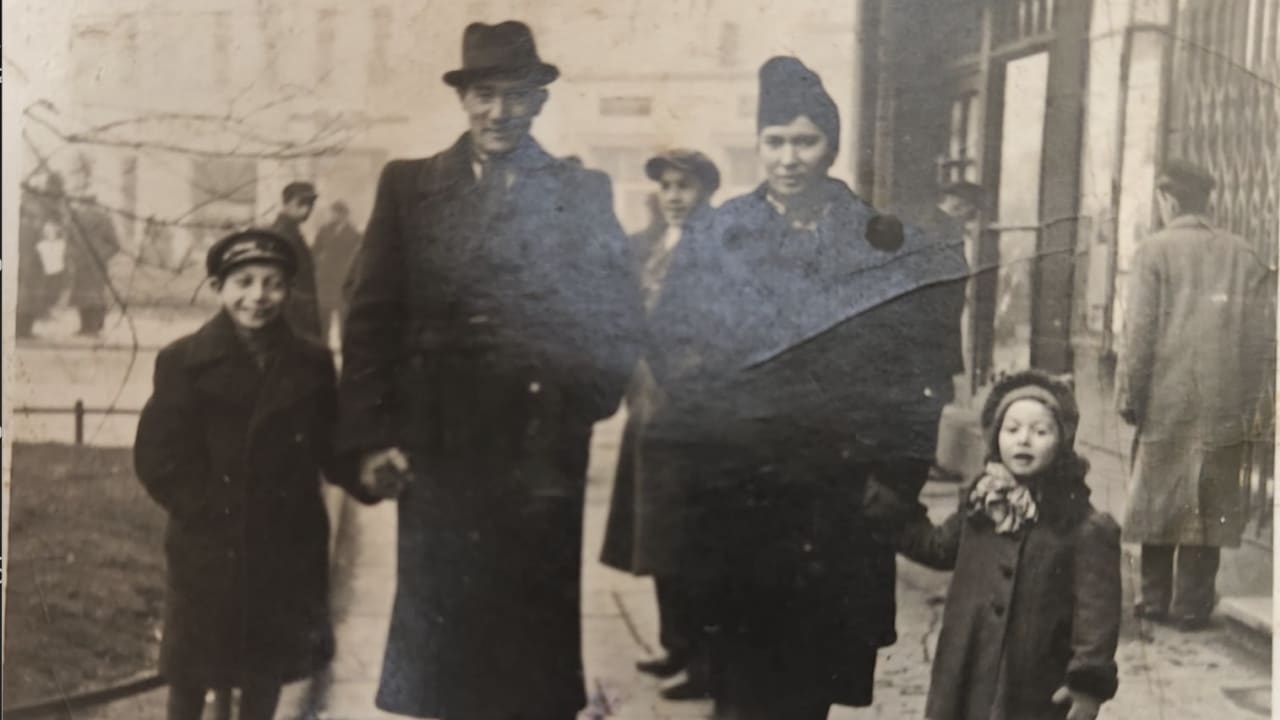
Today, September 1, marks 86 years since Germany invaded Poland and World War II began. Three Holocaust survivors participants in the 2025 March of the Living in Poland, who were children and teenagers at the time share their painful memories of the war’s outbreak and its aftermath. These women stand as a source of strength and resilience, symbolizing the rebirth of the Jewish people after the Holocaust.
Felicia Weiss (90)
“I was born in Poland, into a simple family – father, mother, and an older brother. We were not religious, but my father prayed at home, and every Friday we would gather at my grandfather Abraham’s house for Kiddush with all the uncles and aunts. Our lives were ordinary: we played in the courtyard with the other children, sang Polish nursery songs, ate pierogi — that was my childhood.
On September 1, 1939, when the war broke out, my world turned upside down. We heard the bombardments of German planes and hid in a bunker. I remember crouching under a staircase in a building when a neighbor arrived with a slice of bread and sardines, telling us that the Germans had invaded and taken over the city. Jews were forced to wear a yellow armband. From then on, we hardly went outside.

One day, we received a letter from the Gestapo ordering us to report. My father decided to hide at the factory, and my mother, brother, and I went to my aunt’s. At midnight, the Germans pounded on the doors with rifles and shouts. We were all taken to a large hall. Amid the chaos and screaming, my aunt disappeared, and I was left alone. Suddenly, I noticed a small side door. I crawled on all fours and slipped out. My father was waiting for me outside. He looked at me and said: ‘Today you are seven years old.’ From that day on, I was no longer a child.”
Afterward, they hid in various places. Felicia recalls the moment her father told her that her mother and brother had been put on a train to Auschwitz. To save her, he moved her between several Polish families. Eventually, she arrived at the Pasel family, with whom she lived for three years. They risked their lives for her and were later recognized as Righteous Among the Nations.
In April 1944, her father stopped visiting her. She never found out what happened to him. To this day, she still waits for his return.
Felicia immigrated to Israel, built a family, worked as a civil engineer for many years, and today volunteers at a health clinic.
“Even now, 86 years after the war began, the memories of my childhood never leave me: a seven-year-old girl who crawled through a small door into a life that would never again be the same. Years later, I returned to Poland with my son Amos and my granddaughter Hadar. We stood in front of my old house, but I couldn’t go inside. I just stood outside. All I felt was immense sadness.”

Bella Eizenman (98)
“I was born in Poland, in the city of Łódź. When the war broke out, I was 12 years old. Poland was occupied within days. A year later, we were imprisoned in the ghetto and all of our property was confiscated. Life in the ghetto was harsh; many died from disease and starvation, among them my brother. These images have stayed with me my entire life.”
Bella’s father was interrogated and tortured by the Gestapo. He died from his wounds and was buried in a mass grave.
In 1944, with the liquidation of the ghetto, Bella and her mother were deported to Auschwitz-Birkenau. She survived Mengele’s selection, but her mother did not. Bella was left alone in the world. From Auschwitz she was sent to Bergen-Belsen, gravely ill and near death. Toward the end of the war, she was forced on a death march, from which she managed to escape into the forest until she was liberated by the American army.
After the war, Bella immigrated to Israel, built a family, and worked as a nurse.
At the most recent March of the Living on Yom HaShoah in Poland, Bella reflected on her fears: “What will happen when there are no more survivors like me, who still serve as living witnesses and tell in the first person what happened there? I see the raging antisemitism today as further proof of the importance of establishing the Jewish state, to which my husband and I were privileged to contribute.”
At the March of the Living, she walked proudly together with her family: “So that the whole world, and all Holocaust deniers, will see that people who were there in person can still bear witness that the Holocaust indeed happened. I was especially moved to participate in the march marking 80 years since the liberation of Auschwitz. For me, who barely escaped a death march with my last strength, it was an especially emotional full circle, a march of victory.”

Shoshana Bogler (92)
“I was born on July 25, 1933, in the city of Łomża, Poland. There were five children in our family: Esther, the eldest, Deborah, me — Reizle — and after us Chaim and David. When the Germans invaded, part of Poland was annexed by the Soviet Union. My father was taken to forced labor, and we never heard from him again. We were left alone with my mother. The army ordered us to pack up quickly, and we were deported to Siberia. I remember my brothers, sisters, and me crying. Mother sold the few belongings to buy us food, and sometimes, good people gave us a piece of bread. In cold Siberia, Mother and my sister Esther worked hard, and we stayed in the apartment.
When the war was over, we were happy to leave. We went to Szczecin, Germany, which was devastated by the war. We lived in a ruined building, and to survive, we collected scraps from the bins. From 6 p.m., there was a curfew for Jews to go out on the street for fear of violence and murder. Even after everything we had been through, I experienced antisemitism again.

I joined the Hashomer Hatzair group, started learning Hebrew, and traveled with the movement to Israel aboard the ship Exodus. I was on the ship for three months, and when we arrived at the port of Haifa, the British arrested us and returned us to Germany, to a detention camp. There, I met my mother, who took me to the Kassel DP camp.
Aboard the ship Pan York, we sailed to Haifa again. This time we succeeded – we arrived in Palestine. I finished school and worked in a hosiery factory. During this time, I met Shmuel, my late husband, who was also a Holocaust survivor. We were happily married for 72 years. We have two children, five granddaughters, and nine great-grandchildren. This is our victory.”
Support Holocaust survivors’ participation in the 2026 March of the Living here:
This story is published in partnership with the International March of the Living.