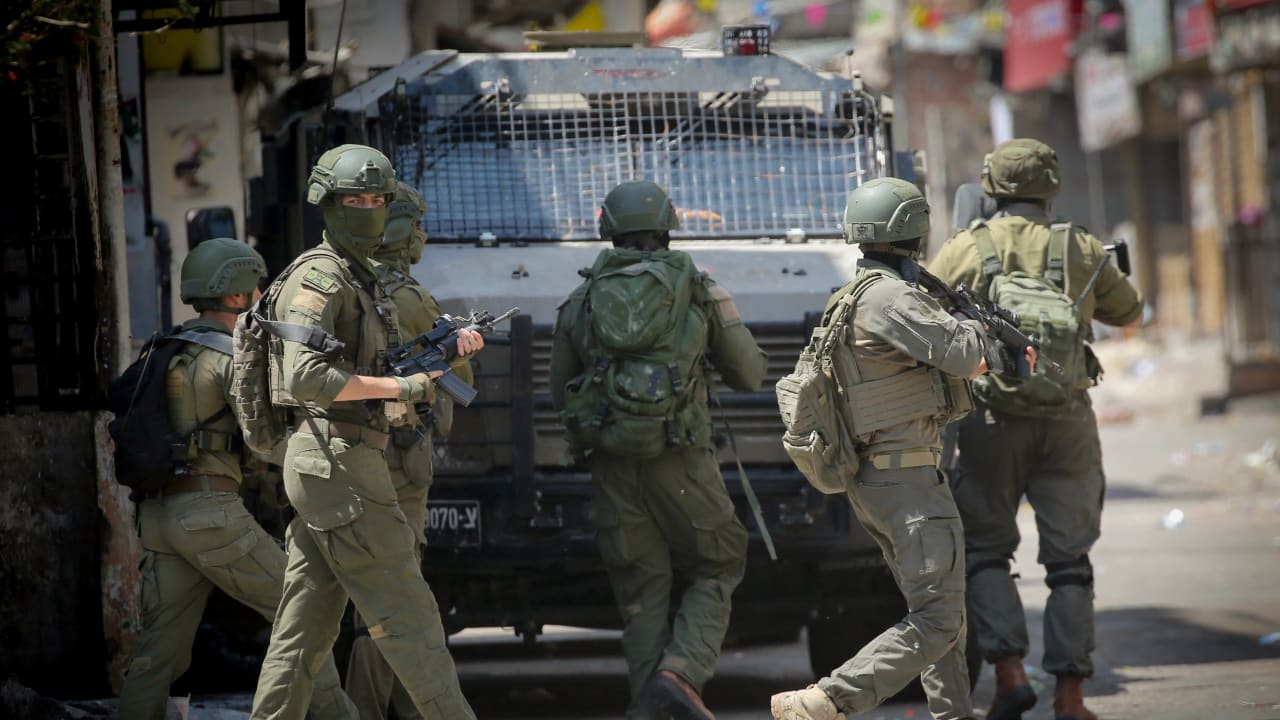
The Shin Bet (Israel Security Agency) announced on Sunday that it had detained around 60 Hamas members. The men were organized in 10 linked terror cells, according to reports. They also had 22 firearms in their possession.
Several days ago, another 20 suspects were detained in the West Bank as well. These raids are significant and occur during a period of relative calm in that area.
These unfolding events represent a considerable contrast to the last several years, during which a growing low-level insurgency emerged in places like Jenin.
The West Bank arrests come amid the IDF already being strained by other issues. It has been facing clashes and attacks by Jewish extremists in the West Bank.
In addition, the military had to deal with several haredi (ultra-Orthodox) Jews who sought to go to Joseph’s Tomb near Nablus without permission.
The Chief of Staff, Lt.-Gen. Eyal Zamir spoke at the IDF Central Command on Monday.
He said, “The mission is clear – to maintain security, protect the civilians, and strengthen the defense of the communities, while at the same time not to tolerate the unacceptable behavior from extremist and violent groups.”

Zamir added, “We must not allow the development of trends that could deteriorate into anarchy and loss of governability. If these phenomena are not addressed now, they will only spread.”
“The danger is at our doorstep,” he continued, “and therefore, alongside the security forces, a systematic and immediate response is required to address this issue.”
West Bank terror threat may be hiding
This is the latest statement by the IDF regarding the ongoing clashes in the West Bank. The question now is whether the main challenge for the IDF in the West Bank is trying to keep the peace, and that means also preventing Israeli extremists from attacking Palestinians, or whether the terror threat has merely been hiding.
This is an essential issue because two things may be happening simultaneously. There are increasing attacks on Palestinian civilians and towns in the West Bank. This could lead to a cycle of violence and reprisals. It could fuel anger.
Concurrently, the defeat of Iran and weakening of Hamas in Gaza could lead to Palestinian factions in the West Bank rethinking their strategy.
The Iran-backed proxy groups, such as the Palestinian Islamic Jihad, may feel isolated. They no longer have leaders in Damascus, for instance.
They appear to be cut off from the Islamic Republic. That means funding as well, probably. They are also cut off from Hezbollah.
In addition, the IDF has strengthened its posture along the Jordanian border by activating the new 96th Division. This is a territorial division similar to the Gaza Division, which is located along the Gaza border, or to the 210th Division, which guards the Syrian border.
Israel has divisions on other borders as well, such as the Egyptian border and the Lebanese border. The new unit will provide the IDF with more tools to secure the Jordanian border. This could reduce some weapons smuggling.
What are the overall trends in the West Bank? For now, they seem to be trending toward fewer terrorist threats. That does not mean that there is no tension and violence.
The clashes between Israeli Jews and the security forces are a challenge. This could spill over. It could lead to the creation of new cycles of violence.
On the other hand, the Palestinian factions may be biding their time. They may be speaking with the Gulf states to decide their strategy.
Hamas wanted to leverage the October 7 massacre to increase its influence in the West Bank. It tried to overthrow the Palestinian Authority or become part of the PA via some kind of technocratic government.
This may still be its long game. It remains to be seen what the relative quiet in the West Bank will bring.