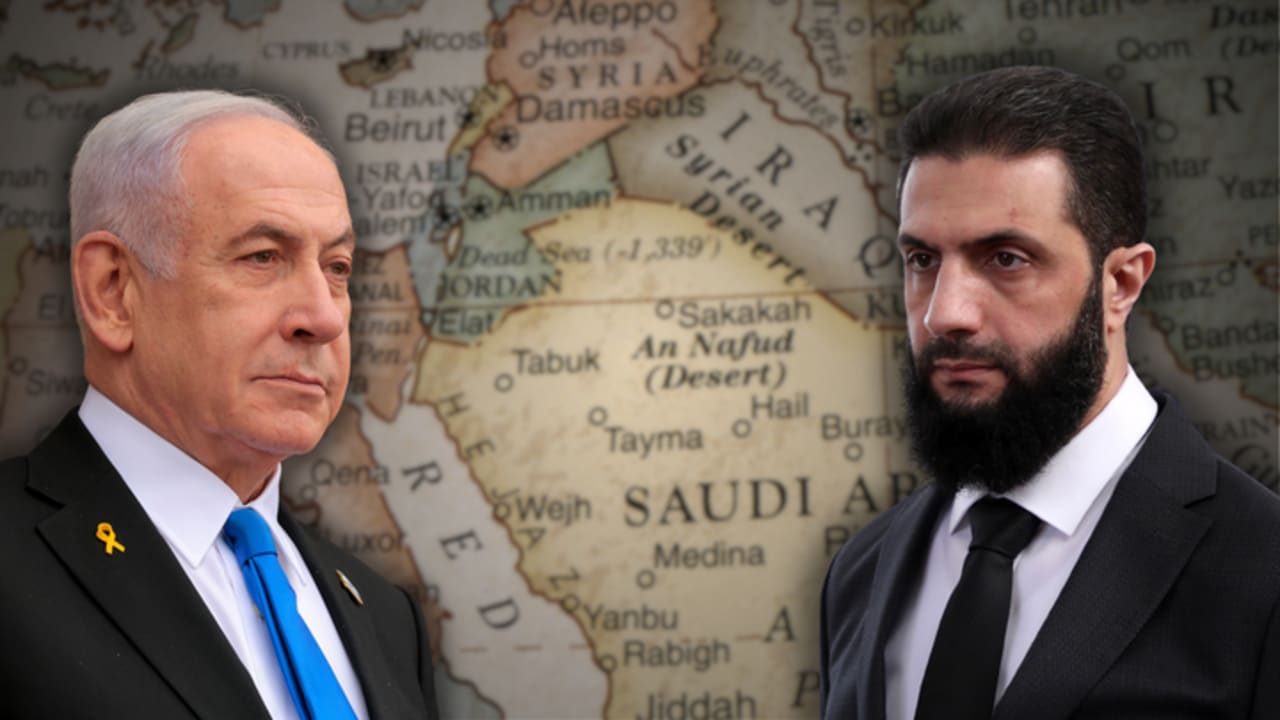
Col. (res.) Dr. Moshe Elad, a Middle East expert and senior lecturer at the Western Galilee Academic College, envisions a scenario that, until recently, seemed far-fetched — but one he now considers increasingly realistic.
“A scene in which Ahmed al-Sharaa (Abu Muhammad al-Julani), the new president of Syria, and Prime Minister Benjamin Netanyahu shake hands on the White House lawn is no longer a hallucination,” Elad said. “Such a scene might happen very soon.”
According to Elad, this reflects a major shift in the region’s power dynamics.
“Anyone who followed Sharaa’s actions during the ‘12-day War’ and expected him to disrupt the Israeli Air Force’s operations over Iran was disappointed,” he explained. “‘With what exactly?’ Sharaa asked his critics — and rightly so. Even if he had Russian S-400 missiles, it's unlikely he would have used them. Like Israel, Sharaa wants to weaken Iran, just like Saudi Arabia, Lebanon, Kuwait, Bahrain, and others.”
Elad believes Sharaa is seeking a strategic partnership.

“He is looking for an alliance with Israel. This is not a mirage. It’s a reality that many fail to recognize, but it's unfolding before our eyes.”
He connects this shift to broader US-led regional efforts.
“When US President Donald Trump hinted that ‘big things’ were coming in the region, and when his envoy [Steve] Witkoff spoke of a ‘new alignment’ in the Middle East, this included bringing Syria and Lebanon into the Abraham Accords. The inclusion of Saudi Arabia and Oman is no longer news. But if our two northern neighbors, who for decades supported terror against us, join, even through a strategic pact, that’s a dream becoming reality.”
Still, Elad urges caution.
“It may not be tomorrow that we enjoy hummus in Damascus or kanafeh in Ras Beirut, but the direction is clear — a tectonic shift we began witnessing before the war with Iran.”
Iran’s defeat as a turning point
Elad says Tehran’s recent military failure marked a historic change.
“Now that the Arab world has seen how Iran, despite its image, has been exposed as a paper tiger, a significant obstacle to Arab-Israeli rapprochement has been removed.”
From hostility to a handshake
Elad outlines how the region’s hostility toward Israel has gradually eroded.
“In 1949, Israel was surrounded by eight countries that wanted to destroy it. Our major success then was reaching UN-mediated armistice agreements with Egypt, Syria, Jordan, and Lebanon. For the Arab world, those signatures were humiliating — a core part of the Nakba narrative.”
Despite the anger and failed attempts to annihilate Israel’s 650,000 Jews at the time, Elad notes that the tide began to turn.
“In the 1960s, Egypt’s [Gamal Abdel] Nasser tried to rally the Arab world with his ‘Return to Palestine’ campaign. But in June 1967, the Six-Day War shocked the world, as Israel dealt a crushing blow to three major Arab armies.”
Twelve years later, Egypt’s Anwar Sadat signed a full peace deal. King Hussein of Jordan followed in 1994. Iraq collapsed in 2003. Libya fell soon after. Syria’s Assad regime, long defined by anti-Israel ideology, collapsed in November 2024. Hezbollah in Lebanon was severely weakened recently, clearing a path for a more moderate government in Beirut.
Sidestepping the Palestinian question
Elad emphasizes a key change in regional diplomacy.
“Until recently, no Arab country would engage with Israel without a solution for the Palestinians. I always wondered why nations like Indonesia and Malaysia, so far removed from the conflict, refused to establish ties.”
The answer, he said, was always the Palestinian cause.
“‘Approve a Palestinian state and the Arab world will welcome you,’ they said. But now we’re seeing a bypass. Palestinians might join the Abraham Accords without preconditions — because they see Syria, Lebanon, Saudi Arabia, Oman, Indonesia, Malaysia, and even Pakistan moving forward.”
Israel’s role in the new Middle East
Elad concludes that Israel is leading a transformation.
“The Abraham Accords, signed in 2021, became a showcase of Israeli innovation for Arab states — in medicine, agriculture, science, and technology. It’s that famous metaphor: the train has left the station. Whoever doesn’t get on will regret it. And Israel is waiting for the next countries to board.”