I was walking down a street in Dnipro when a Ukrainian military policeman appeared out from between two parked cars.
He said something in Ukrainian as he sauntered over, motioning for identification. I didn’t know what the soldier said, but I had anticipated ahead of time that this could happen.
He wanted to check if I was a draft dodger and was ready to press me into service.
Ukraine’s conscription system has sharpened since the Russian invasion in 2022, with the draft age dropping to 25 in 2024 under the pressure of the unending conflict.
Draft dodging has been an issue, with some residents hiding in their apartments for much of the day out of fear of being caught in the streets. Teams of recruitment officers had reportedly been deployed to cities to seek out those avoiding enlistment.

I couldn’t help but grin and laugh as the officer approached me, a bad habit that emerges in grim or solemn situations. The soldier paused, surprised by my reaction. I held out a finger to signify that I needed a moment as I fished around in my pockets for my passport.
“I’m a foreign journalist,” I said.
Ukrainian authorities tighten conscription law
I handed the soldier my passport. As he shuffled through the pages of the document, on the other side of the street another man was approached by two soldiers.
The officer attending to me nodded, satisfied, and returned my passport.
“Have a good day,” he told me.
I was thankful I had avoided a greater problem and hadn’t left my passport in the hotel. My counterpart across the street wasn’t so lucky.
Two more men had appeared to drag the pedestrian down the street. I don’t know Russian or Ukrainian, but I could identify the series of curses that he spat at the military policemen.
The four soldiers pulled him toward an unmarked van. A fifth soldier opened the sliding side door, and his comrades hurled the conscript candidate inside. The van door slid shut, and the pedestrian was gone.
The measure is harsh, but the problem of draft dodging has become part of a broader crisis of manpower, according to locals, as Ukrainian soldiers have been worn down by a long and bloody war.
Defense Minister Mykhailo Fedorov said on January 14 that around 2 million Ukrainians were wanted for violating military registration regulations, and almost 200,000 soldiers were absent without leave (AWOL), Kyiv Independent reported.
At a recruitment center for a prestigious unit in Dnipro, mannequins stood at attention modeling the latest standardized uniforms and equipment, but those stationed there admitted that they received few visitors seeking to enlist.
They conduct more online interviews with foreign volunteers in the office than with locals. At a training base near the frontlines, new soldiers intermix with the more experienced.
One officer said that new recruits believe the draft to be a death sentence until their expectations are tempered by reality. Most of the training soldiers had new rifles; some had older models, but all had the standardized kits displayed in the recruitment office.
What distinguished the new soldiers was the unease and uncertainty in their eyes. At the training base they learned about first aid, trench warfare, and defense against drones.
Reconnaissance, attack, and suicide drones filled the skies of the Russia-Ukraine war, and any buzzing sound quickly drew the eyes of soldiers to the sky.
Many military officers emphasized the importance of drones to fill the gaps in soldiers and to avoid further casualties.
The answer to most problems, from the brutality of urban warfare to frontline logistical challenges, is to send a drone rather than risk a soldier.
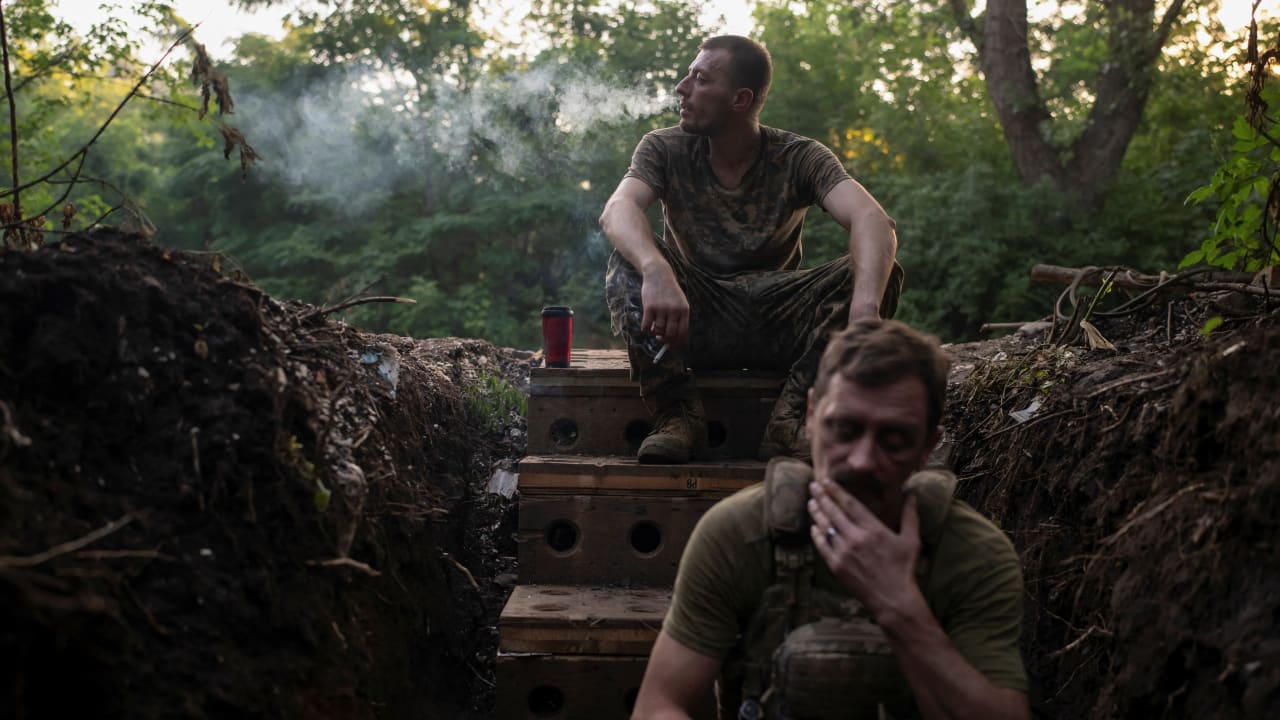
One of the soldiers’ trainers at the training base walked with a cane; it is not uncommon for wounded veterans to withdraw from the front to teach what they have learned to the next generation.
Many of the soldiers I spoke to had also been wounded at least once but returned to the front. For all those who were AWOL, there seemed to be at least as many men willing to face those uncertain skies to save their country.