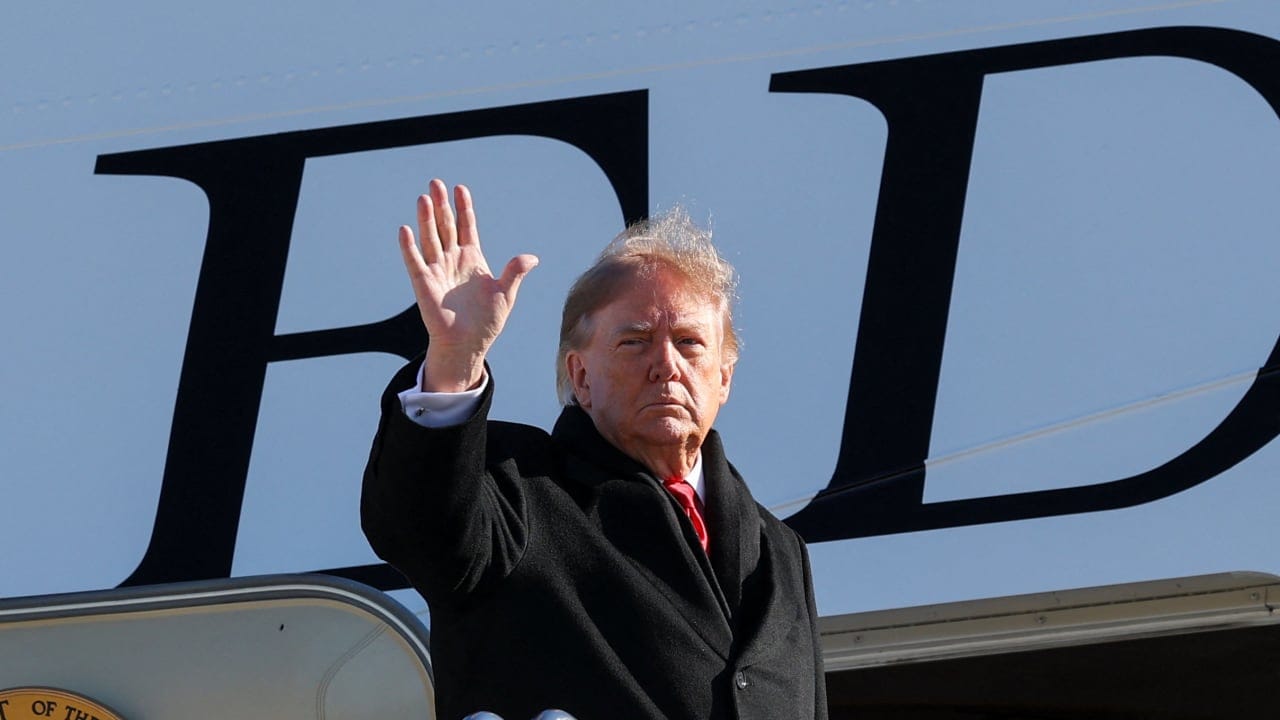
US President Donald Trump said Iran is exploring chemical and biological weapons as alternatives to nuclear weapons, warning that Tehran would face devastating consequences if it carried out a reported plot to attack Washington.
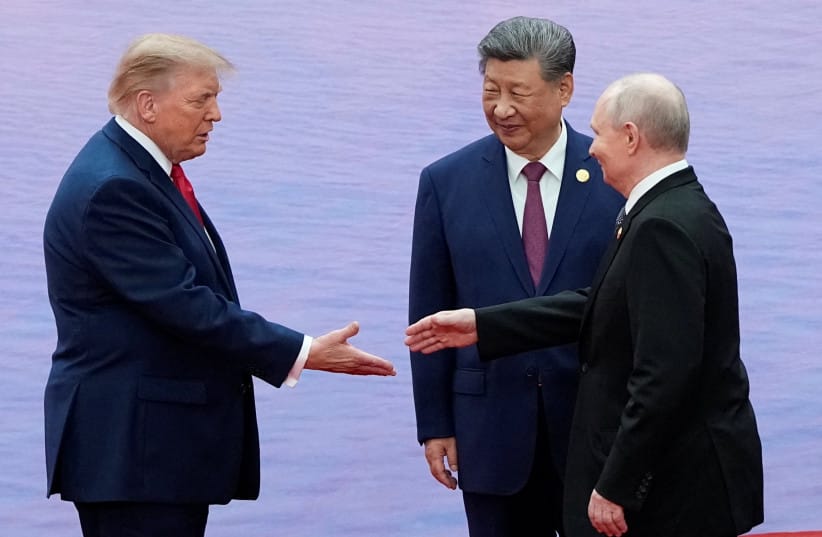
Speaking in an extensive Fox News interview with White House correspondent Jacqui Heinrich ahead of his meetings with Chinese President Xi Jinping and Russian President Vladimir Putin, Trump said American efforts to block Iran's nuclear ambitions had prompted Tehran to examine other forms of unconventional warfare.
"Well, there is indication that Iran is looking at gases, looking at bio because we've shut them out with the nuclear," Trump said.
"Nuclear is much harder, and they're looking at gas, and they're looking at the bio. You know, the biological weapons, not nice, and other things."
The remarks came after Heinrich asked the president about reports of a possible Iranian plot to detonate a radiological "dirty bomb" in Washington, DC, and the security concerns that have led some senior administration officials to reside on military installations.
Trump did not explicitly confirm the details of the reported dirty bomb plot. However, when asked whether people in Washington should be alarmed, he responded: "I don't think so. No, I mean, look, if it does happen, we wipe them out."
Pressed on whether that was a promise, Trump replied: "Oh, I give you my word."
The president also introduced an unexplained reference to the beginning of next year.
"We're going to have a new year coming up, and we'll see what happens after January 1st," he said.
Trump did not elaborate on the significance of January 1 or indicate whether he was referring to a potential military operation, diplomatic development, or another decision concerning Iran.
He nevertheless reiterated his hostility toward the Iranian leadership.
"We didn't start this war," Trump said, describing the regime as "nasty people."
'One way or the other, we'll finish it off'
Despite his warnings, Trump confirmed that the United States remains in contact with Iran and that Tehran is interested in reaching an agreement.
"Yeah, we talked to them. We talked to them. They want to make a deal, but I want a deal that can be lasting," he said.
The president emphasized that any agreement should survive future changes in American leadership.
"I want a deal so that if we have a stupid president, which is a big possibility, because you know you see some of the people running," Trump said, adding that he wanted an agreement capable of outlasting a "bad president" or a "weak president."
When Heinrich asked whether US forces would remain in the region until such an agreement was secured, Trump replied: "Yeah, I'm going to finish it off. Yeah, soon. I mean, one way or the other, we'll finish it off."
The statement left open whether the president intends to conclude the confrontation through negotiations, further military action, or a combination of the two.
Trump also repeated sweeping claims about the damage inflicted on Iran's military capabilities.
"We've defeated their navy. We've defeated their air force. We've defeated their anti-aircraft," he said.
According to Trump, Iran's missile capabilities have been reduced to approximately 12% to 13% of their previous levels.
"They want to make a deal," he said, later adding: "They have nothing left. Their leaders are gone. Their ships are gone. Their planes are gone."
He claimed that no American personnel had been killed during the past six months and that, although US forces had been involved in the conflict for seven or eight months, active fighting had occupied only three or four weeks.
Those figures were presented by the president without supporting evidence during the interview.
Trump on Iran negotiations: 'We got to know that they can't be trusted'
Trump also offered a revealing account of his dissatisfaction with an earlier diplomatic effort involving a memorandum of understanding with Iran.
After describing the US blockade of Iran as one of the most effective measures of the war, the president acknowledged that he had reluctantly agreed to a diplomatic approach involving a memorandum, despite his longstanding preference for more definitive agreements.
"We had a little memorandum of understanding. I never believe too much in memorandums. You go right to a contract, forget the memorandum," Trump said.
When Heinrich asked whether pursuing the memorandum had been a mistake, Trump acknowledged that the process had delayed progress but argued that it had served a useful purpose.
"It delayed things a little bit. It wasn't a mistake. Actually, we got to know them very well during that period, and we got to know that they can't be trusted," he said.
The exchange offered a glimpse into Trump's assessment of the negotiations: Although he viewed the memorandum process as less effective than pursuing a binding agreement, he maintained that the discussions had provided Washington with a clearer understanding of Tehran's intentions.
Heinrich then asked whether that experience explained why Vice President JD Vance had been removed from the Iran negotiations.
Trump rejected the suggestion.
"No, no, he's doing a very good job," the president said.
Asked whether he would make the same decision to go to war if given another opportunity, Trump responded: "Absolutely yes."
"What we're doing is the right thing. I think long term will be adjudged very well," he added.
The president also acknowledged that the conflict had carried political risks during the election period, but said electoral considerations had not determined his military decisions.
Trump says he does not need China or Russia's help on Iran
The president offered a complicated assessment of the role China and Russia might play in ending the conflict.
Asked whether he intended to seek their assistance, Trump initially answered yes, before insisting Washington was not dependent on either country's involvement.
"Well, you know we don't need any help," he said. "I'm not going to go in asking for help."
Trump argued that neither Beijing nor Moscow had intervened militarily against American forces.
"They haven't fired. They haven't put ships in the water," he said.
Addressing allegations that China and Russia had provided intelligence assistance to Iran, Trump said Washington was aware of what was being shared and downplayed its significance.
"We know exactly what they're giving. It's peanuts," he said.
The president also openly acknowledged that the United States and China conduct intelligence operations against one another.
"They say, 'Oh, they spy on us.' Well, we spy on them too. I think we spy better than they do," Trump said.
"I can't tell you what we do. But let's put it this way: I know everything. We spy on China; they spy on us."
Trump dismissed the idea of asking Beijing to stop its intelligence activities, suggesting that China would simply make the same request of Washington.
Despite those remarks, he repeatedly praised his relationship with Xi, describing it as one based on friendship and mutual respect.
Nuclear arms reductions on the trilateral agenda
Trump also discussed the prospect of negotiating nuclear arms reductions among the United States, Russia, and China.
He cited approximate arsenals of 4,000 nuclear weapons for the United States, 3,800 for Russia, and between 400 and 500 for China, while acknowledging the difficulty of persuading nuclear powers to reduce their stockpiles.
"If you tell me reduce your nuclear force by 2,000, that's a hard thing for me to do," Trump said.
"You only need about 10 if you really want to know the truth. That's the kind of power we're talking about."
He also expressed openness to the idea of inspections involving all three countries.
Asked whether he would propose inspections, Trump responded: "I think it's fine."
The president did not outline a formal arms control proposal or specify what verification arrangements he envisioned.
'Tell them to relax': Trump dismisses fears over US outages
The interview also focused on widespread technological disruptions affecting American banking services, air traffic control, and classified communications at the National Security Agency.
Heinrich asked whether Americans were justified in questioning the government's explanations after multiple systems experienced problems in quick succession.
"A little bit, but they're all individual events," Trump replied.
"These are big companies. They're putting in new equipment, and things happen when you put in new equipment."
Trump also addressed reports that some Americans had begun stockpiling food and water amid fears of further infrastructure failures.
"Tell them to relax. Everything's good. These are individual events," he said.
The president blamed aging aviation infrastructure and criticized the previous administration's approach to modernization, saying he wanted a single major contract to overhaul the air traffic control system rather than a series of smaller projects.
He said the administration should consider major technology and defense companies, including IBM and Raytheon, to carry out the work.
Trump nevertheless issued a warning to any foreign government that might attempt to attack American infrastructure.
"If anybody did that to us, and we found out about it, they know what the repercussions would be with me," he said.
"Nobody's going to play games with us."
'We have to take care of our geniuses'
On technology policy, Trump defended America's leading technology executives, singling out Nvidia chief Jensen Huang and Elon Musk.
"We have to take care of our geniuses. By the way, we don't have that many of them," Trump said.
"When we have brilliant people like Jensen, we can't say, 'Oh, you know, he did this or he did.' We have to take care."
The president argued that Washington should allow American semiconductor companies to sell certain products to China, while restricting access to their most advanced technology.
He emphasized the rapid pace of chip development and expressed confidence in the technological lead held by the United States.
Trump also claimed that his support for Musk during his first term had been instrumental in the entrepreneur's subsequent success.
"I helped Elon a lot in my first term. I helped him a lot. He was in big trouble," Trump said.
"A lot of people don't know that. You wouldn't probably have Elon today."
Trump pointed to the development of reusable rockets as an example of the technological achievements he believes the United States must support.
The interview came as the president prepared for meetings with the leaders of China and Russia, with Iran, nuclear arms reductions, and the war in Ukraine among the subjects he intends to discuss.
But on Iran, Trump left his most consequential question unanswered: whether his promise to finish the conflict "one way or the other" would ultimately mean a lasting diplomatic agreement or renewed military escalation.