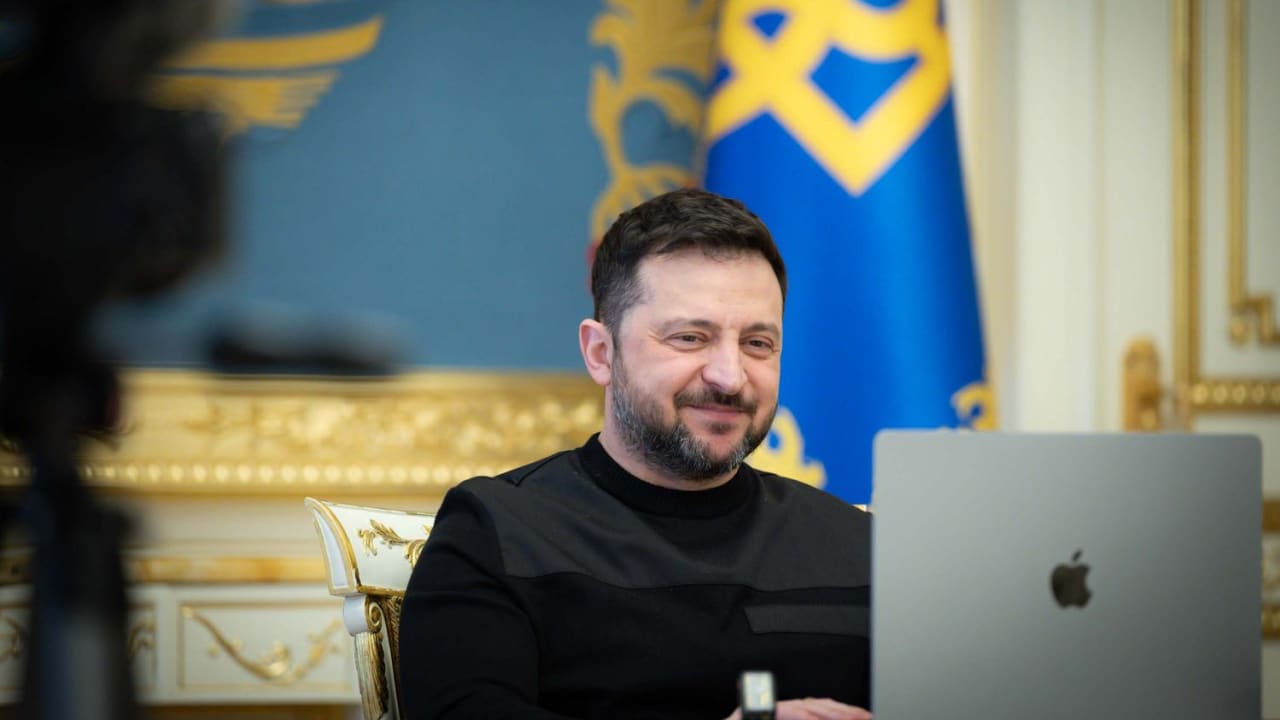
Ukrainian President Volodymyr Zelensky said Russia helped Iran improve its Shahed drones after first using Ukraine as a testing ground for the weapons, warning that the same threat now facing Israel, Gulf states, and US forces had been honed through years of attacks on Ukrainian civilians.
“We had a terrible experience with these drones,” Zelensky told The Jerusalem Post in a remote video interview on Monday, describing the years-long barrage Ukraine has faced. “We had 350 or 500 Iranian drones, Shaheds, each day, each day and night.”
His message, repeated throughout the interview, was straightforward: The threat now confronting the Middle East did not emerge overnight. Ukraine, he said, saw it first, endured it first, and paid for the lessons learned in civilian blood.
“Ukraine was kind of an experiment place for these drones in the end,” Zelensky said. “You can’t even compare the first class [of] Shahed, what was at the very beginning of the war, and today’s Shahed.”
The interview offered one of Zelensky’s clearest descriptions yet of how he believes the Russia-Iran military partnership evolved from Tehran supplying drones to Moscow to Russia later helping Iran improve and adapt them in return.

‘They lied, of course’
Zelensky said Ukraine tried early on to stop Iran from supplying Shahed drones to Russia, warning Tehran directly that the weapons would be used against civilians.
“We asked them not to give weapons because otherwise, if they will give them weapons, like Shahed, they will kill our civilians,” he said. “‘And you will be allies,’” he told Iran.
According to Zelensky, Iranian officials denied they were truly siding with Russia and tried to minimize the scale of the transfer.
“They said that ‘Okay... we are not allies in this,’” he recalled. He said the Iranians told Ukraine: “‘We sold Russians this part of Shaheds, and it will be 1,200 or 1,300, and that’s all.’ But it was not true. They lied, of course.”
That early phase, he said, quickly grew into something much larger.
Licenses, factories, training
Zelensky said Iran did far more than simply send drones. He accused Tehran of helping Russia build up domestic production capacity, including through manufacturing know-how and direct assistance.
“They gave licenses on production,” he said. “And they created and helped them build two factories.”
He added that in the early stage of Russian drone operations, “they helped them, they trained them.” By “them,” Zelensky means the Iranians.
That matters, Zelensky argued, because the war has now entered a new phase in which Russia is scaling back missile production while sharply increasing drone output, including cheaper systems designed for mass deployment.
“Russia began to move,” he said. “They are shifting from the number of missiles. They began to decrease the production of missiles and to increase the big number, big volume of drones, different drones, not only Shaheds, now other drones, cheaper drones.”
Then came the warning he clearly wanted heard beyond Ukraine.
“They will go to the cheaper and cheaper drones, but to have hundreds of thousands of these drones,” Zelensky said.
Asked directly whether Russia is now giving Iran upgraded Shahed drones – or technical know-how – in return, Zelensky answered without hesitation. “Yes, I’m sure,” he said.
He said evidence had emerged from a Shahed drone destroyed in a Middle Eastern country, though he declined to identify the country publicly.
“We saw some details from one of the Shaheds, which was destroyed in one of the countries of Middle East,” he said. “I will not tell you, sorry, because we said that we will not tell publicly what country was it.”
What Ukraine found, he said, pointed to Russian involvement.
“We saw some details. It was Russian details. We know it because Iranians didn’t produce it.”
Pressed on whether that meant Russia had helped Iran improve the drones now attacking targets in the region, Zelensky said: “I think that means that Russians also helped them, [just] like Iranians helped [the Russians] at the very beginning of the [Russia-Ukraine] war.”
Practice on civilians
One of the darkest parts of the interview came when Zelensky described how these drones were refined.
Each new version, he said, emerged only after repeated use in real attacks, mostly against civilians and civilian infrastructure rather than battlefield targets.
“Each time when we changed the technologies, they of course had this bloody experience, on our people, on our land,” he said.
He described Shaheds as weapons used less for tactical battlefield effect and more to spread fear, sow chaos, and wear down society.
Zelensky said the drones were refined through repeated mass attacks on civilians and civilian infrastructure, not mainly on battlefield targets.
“You can’t get to a new version without using thousands of them,” he said. “And they were used mostly not on the battlefield.”
He said the Shaheds were used to test and improve the technology through real attacks on cities, power systems, and essential services.
“Mostly, they use 99% of Shahed, especially to make practice on civilians,” Zelensky said.
The goal, he argued, was to create chaos, kill civilians, and cripple daily life.
“They want to kill as many civilians as possible,” he said. “And they want to destroy energy, oil, gas, and any kind of power generation.”
He said the target list includes electricity, water, and the systems needed for daily life, a warning with obvious relevance for countries now bracing for continued escalation.
“It will be very hot,” he said of the coming months in the Middle East. “They will do everything not to be a possibility for the country to give electricity to people. So not to have conditions. So not to have water, not to have drinking water.”
Ukraine offers help
Zelensky said Ukraine is already trying to help countries facing this threat by dispatching military experts to examine local air defense systems and offer practical advice.
Zelensky said Ukraine has already sent three teams of military experts to help countries assess their air defense systems and counter the Iranian drone threat.
“We are ready,” he said. “I said that we will send three groups of our military experts.”
Those teams are already in place, he added.
“Now, three groups are there,” Zelensky said. “Now it’s up to the countries how to involve our expertise.”
He stressed that Ukraine’s role is purely defensive.
“They asked our expertise about air defense,” he said. “Air defense, it’s not attacks.”
On Iran’s threats: ‘Nothing new’
Asked about Iranian threats against Ukraine over its support for Gulf states, Zelensky dismissed them as familiar.
“Nothing new,” he said. “I heard during these four years a lot of different messages.”
Asked whether he feared the warnings, he said Ukrainians have lived with such threats for years.
“No, we don’t [fear] any kind of such messages,” Zelensky said. “We live with such messages each day... That’s why it’s not something new for us.”
He also drew a distinction between the Iranian regime and the Iranian public.
“I think that a lot of people in Iran, really civilians, they want to live a normal life and to be free,” he said.
Putin, pressure, and the wider war
Zelensky tied the drone threat to what he sees as the international community’s failure to stop Russian President Vladimir Putin.
“It’s a pity,” he said. “We don’t see the power in the world who can really stop Putin.”
He argued that weak sanctions, especially those that still allow Russia to profit from oil and gas sales, have helped fund the same war machine now affecting both Ukraine and the Middle East.
“Not everybody put sanctions on Russia, didn’t stop the oil and gas benefits from energy sales,” Zelensky said, adding that Russia uses that money for weapons and, now, to provide “intelligence and drones to Iran.”
He also warned that any easing of sanctions would only strengthen Russia’s defense industry.
“Russia will get benefits on oil sales,” he said, “and of course they will move all this money to the weapon industry.”
Message to Netanyahu, Israelis
Asked about possible contact with Prime Minister Benjamin Netanyahu, Zelensky said the Israeli side had reached out about a potential conversation and that he was ready.
Asked what message he would give Netanyahu, Zelensky replied: “He has what I need and I have what he needs. So I’m ready for this dialogue.”
He also offered a message to Israelis living under attack.
“I think you have a long history and long experience of living under attacks,” he said. “I hope that people will not lose their relatives, their very close people, and first of all, their children, because this is our future, this is our life.”
“I wish fewer losses during any kind of challenge, any kind of attack, any stage of this war.”
For Zelensky, the lesson goes beyond one war or one region. Russia’s battlefield experience, he said, is being turned into exportable knowledge, new technology, and methods that will not stay confined to Ukraine.
“This is big knowledge from the battlefield,” he said. “This is new technology based on Iranian technologies.”
“All these will have impact on other regions,” he said. “I always said Africa, Middle East, and Europe.”
In that sense, Zelensky’s interview was also a warning about what the rest of the world is now beginning to face: a drone war that started over Ukrainian cities, then spread outward, grew cheaper, grew smarter, and became harder to stop.
In Zelensky’s telling, Putin and Iran built that threat together.