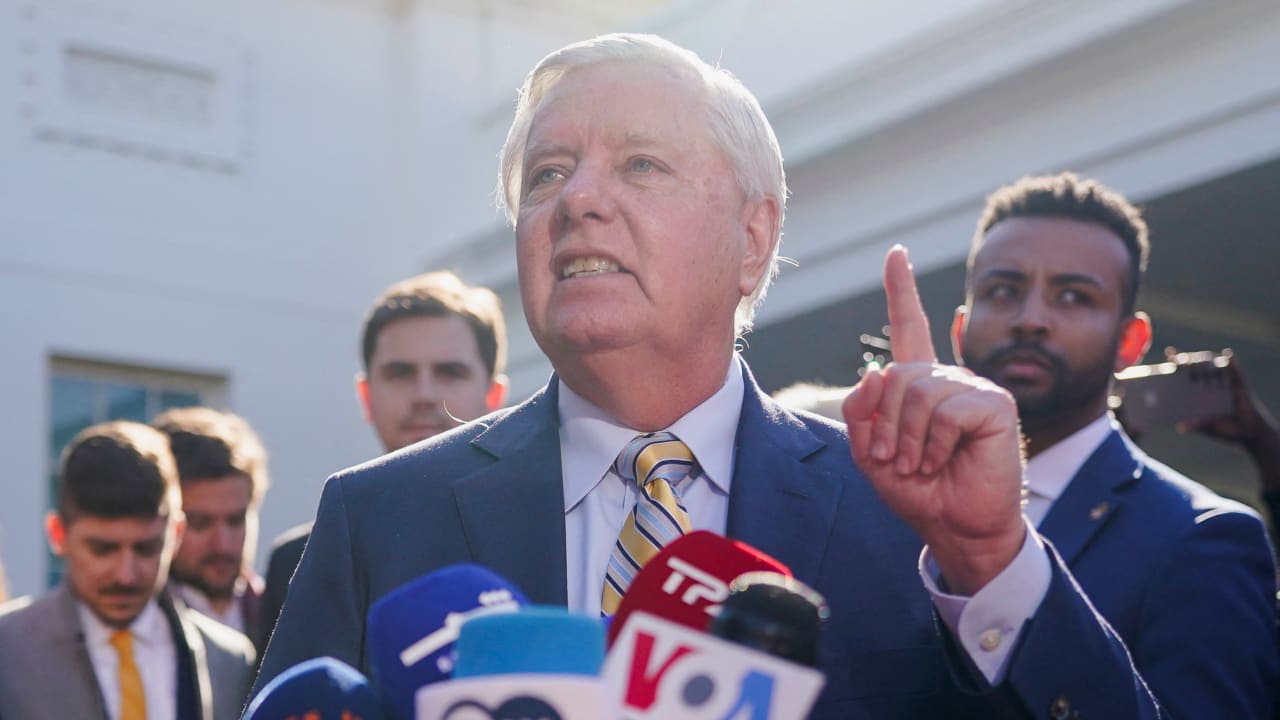
If Iran refuses to return to the negotiating table, the United States should "go all in with Israel to eliminate the nuclear threat," US Senator Lindsey Graham told The Jerusalem Post on Friday following Israel’s dramatic overnight strike on Iranian military and nuclear targets.
Graham, one of President Donald Trump’s closest allies in Congress, described the Israeli operation as “breathtaking,” and said it could be the most successful coordinated military and covert campaign in the history of the Jewish state.
Trump, currently serving his second term as president, had reportedly issued a 60-day ultimatum to Iran ahead of Thursday night’s operation, warning the regime to halt uranium enrichment and dismantle its nuclear infrastructure or face consequences. That deadline expired earlier this week.
Speaking just hours after the IDF launched Operation Rising Lion—a sweeping combination of airstrikes and Mossad-led sabotage targeting dozens of Iranian sites—Graham praised Israel’s timing and strategic prowess. “I wasn’t overly surprised,” he said.
“It was a critical moment to strike. The more time you gave Iran to move things around, the harder success would look like.” He added that “the element of surprise was achieved... and though nobody should have been overly surprised, this is a contender for the most successful military-covert operation combo in the history of Israel—and that’s saying a lot.”

Playing with the enemy’s mind
According to Graham, the strike marked an extraordinary achievement in Israeli defense planning. “Israel’s a master at playing with the enemy’s mind,” he said.
“I think they were able to manipulate certain events that made the strike more successful. They’ve been thinking about this for a very long time.”
He emphasized the unprecedented coordination between intelligence and the military, noting that “some of the covert operations took a lot of planning, a lot of forethought. The military strikes were precision at its best. The combination of the two… again, I think, competes for the most successful military-covert operations in Israeli history.”
He added that the damage inflicted went far beyond hardware: “They did a lot of damage to the intellectual infrastructure and physical infrastructure. They took out key players in the security services and key sites in Iran’s nuclear program. So it was breathtaking, really—the best way to describe it.”
Graham confirmed that President Trump had extended a final diplomatic proposal before the strike. “President Trump, with Russia and Iran, put very reasonable offers on the table,” he said. “He’s gone the extra mile. But it just reinforces the nature of the regime we’re dealing with.”
He continued: “You know they’re not going to give up their enrichment capability—because they want to make the nuclear bomb, and they want to make a bunch of them. Now that Israel has struck, President Trump is again offering to negotiate.”
But Graham made clear that if Tehran rejects this final opportunity, the US must not hold back. “If Iran refuses, I think it’s in the United States’ national security interest to go all in to help Israel finish the job when it comes to Iran’s nuclear program,” he said.
“We should go all in with Israel to eliminate the threat to the best of our capability.” He added: “There are things that we can do Israel can’t do. And yeah, that would be my counsel: now that you’ve started this process, you need to finish it.”
Graham laid out the stark choice now facing the international community. “There are two ways this can go,” he said.
“One is diplomacy—where Iran comes to the table, gives up their enrichment program, and turns over their highly enriched uranium. The world moves toward avoiding bloodshed. The second scenario is that they refuse to come to the table. They threaten us and continue to strike back against Israel. And at that point, the United States must make a decision. My advice would be to go all in to help Israel finish the job when it comes to the Iranian nuclear threat.”
No regime change at the moment
Long a vocal critic of the Iranian regime, Graham reiterated his view that the fall of the Islamic Republic would benefit both the region and the world. “I’ve been in the camp of wishing for a regime change for a long time. It would be a godsend to the Iranian people for this regime to go away, and it would be the most stabilizing thing I could think of for the world,” he said.
“I’m willing to risk that it can’t be any worse.” Still, he clarified that regime change is not the primary objective of the current military effort. “I think the focus of these operations is the nuclear capability and the missile capability against Israel. I don’t think the focus at this point is regime change.”
Graham believes Thursday night’s operation has fundamentally shifted the strategic equation. “Now that the game has been joined in terms of the nuclear program, it is imperative that we end this nuclear program as a threat,” he said. He expressed support for President Trump’s decision to offer one final diplomatic opening.
“The next phase is either diplomacy or more kinetic activity. The President is right to offer Iran one last chance for a diplomatic solution—but it’s got to be the last chance. If Iran refuses to take it, again—we need to be all in.”
He concluded with a message of solidarity for Israel.
“Israel finished the job of neutralizing the Iranian nuclear threat as well as the conventional missile threat to Israel. It’s been a pleasure, and I pray for you and your country. We’re in this together.”