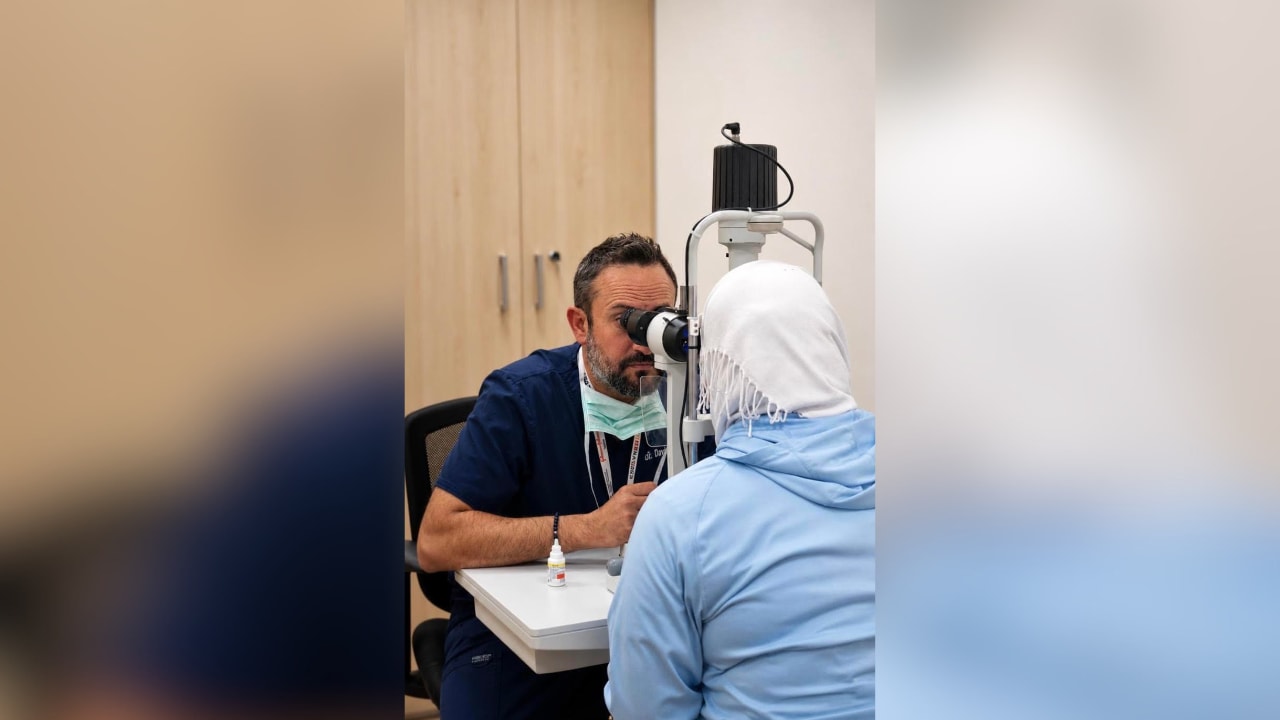
A 38-year-old Jerusalem teacher regained much of her vision after surgeons at Hadassah Medical Center implanted a ring made from donated human corneal tissue to treat an advanced case of keratoconus, the hospital said.
The patient, identified as Aya, had experienced severe deterioration in her eyesight after years of living with the condition, which causes the normally round cornea to thin and bulge outward into a cone-like shape. The resulting distortion can make everyday activities, including reading, driving, and working at a computer, increasingly difficult.
Aya had previously relied on specialized rigid contact lenses, which can create a smoother optical surface over the misshapen cornea. In recent years, however, her eyes could no longer tolerate the lenses. She experienced redness, pressure, pain, and headaches and eventually stopped driving.
Her work as a high school teacher also became difficult. She struggled to use a computer for more than a few minutes and had to stand close to the board while teaching. At times, she required help navigating her surroundings.
An optometrist eventually referred her to Prof. David Smadja, director of the Refractive Surgery Unit in Hadassah’s Ophthalmology Department.

Smadja recommended a procedure known as corneal allogeneic intrastromal ring segment implantation, or CAIRS. The emerging treatment uses tissue obtained from a donated human cornea to reshape and stabilize the patient’s cornea.
During the procedure, surgeons used a femtosecond laser to cut a precisely shaped segment from the donated tissue and create a channel inside Aya’s cornea. The tissue was then inserted into the channel, helping flatten the cone and produce a more regular corneal surface.
Smadja performs surgery alongside Anterior Segment Surgery Unit director
The surgery was performed by Smadja and Dr. Itay Lavy, director of Hadassah’s Anterior Segment Surgery Unit.
Synthetic plastic ring segments have also been used to reshape the cornea in patients with advanced keratoconus. Smadja said donor tissue may integrate more naturally with the patient’s cornea and could reduce some complications associated with synthetic implants.
For patients whose condition cannot be adequately managed with glasses, contact lenses, or other treatments, a partial or full corneal transplant may eventually be required. Hadassah doctors said the donor-tissue procedure could delay or, in some cases, prevent the need for a full transplant.
Patient conscious throughout procedure, noticed immediate vision improvement
Aya remained awake during the operation under local anesthesia and said she noticed a change almost immediately.
“I felt my vision improve even during the operation,” she said.
After several days of recovery, she returned to teaching, computer work, and driving. Hadassah said her vision had risen from approximately 10% before surgery to about 90% with glasses afterward. Her eye pressure and pain also subsided, according to the hospital.
“I got my independence back,” Aya said.
Published research has described CAIRS as a promising treatment for appropriate keratoconus patients. Studies have reported improvements in visual acuity and corneal shape, although researchers have said larger prospective studies and longer follow-up are needed to establish its long-term effectiveness and safety.