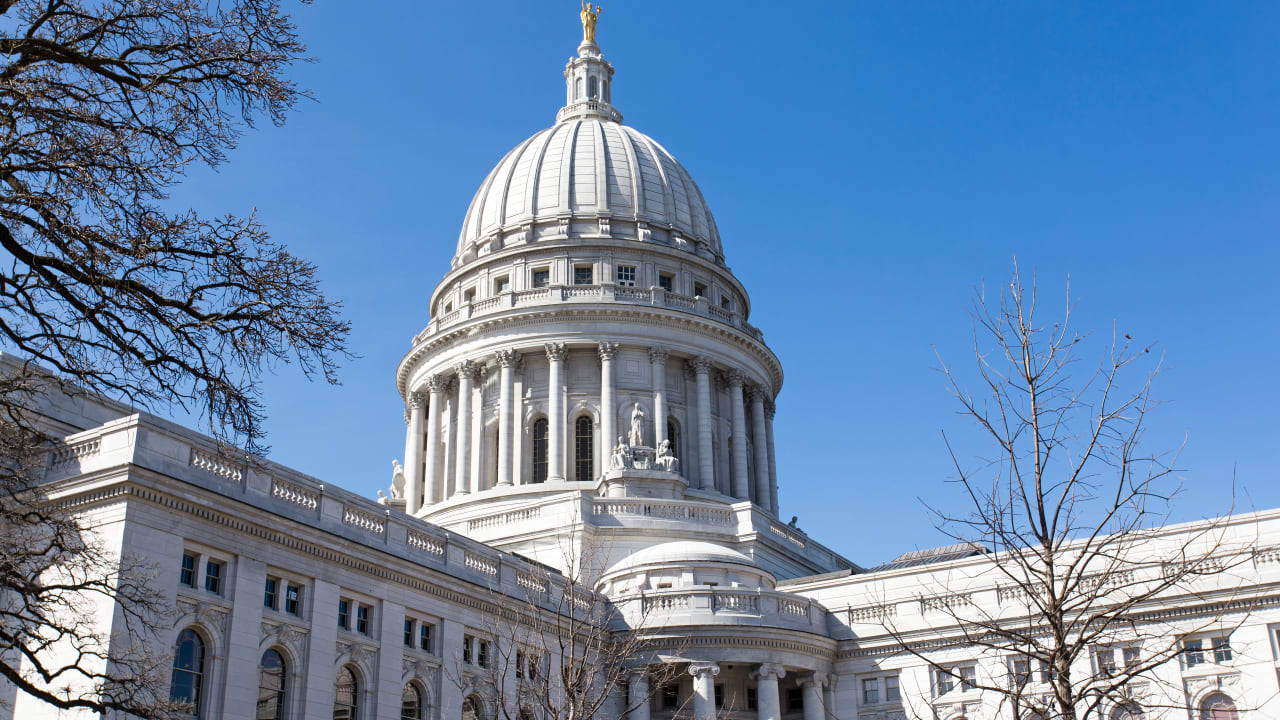
The Wisconsin Senate Committee on Judiciary and Public Safety held a public hearing last week on bipartisan legislation aimed at strengthening the state’s response to antisemitism by formally adopting the International Holocaust Remembrance Alliance (IHRA) Working Definition of Antisemitism into state law.
The bill, SB 445, would require state and local authorities to use the IHRA definition, including its 11 contemporary examples, when evaluating discriminatory intent in civil rights violations and determining enhanced penalties for hate crimes. The measure is sponsored by a bipartisan group of lawmakers led by Senators Rob Hutton, Rachael Cabral-Guevara, Dianne Hesselbein, Jesse James, Brad Pfaff, Patrick Testin, Jamie Wall, Van Wanggaard, and Bob Wirch.
A companion bill, AB 446, sponsored by a broad coalition in the Wisconsin Assembly, was heard earlier this year by the Committee on State Affairs.
The legislation states that government entities and officials should consider the IHRA definition when assessing whether crimes or discriminatory acts were motivated by race, religion, color, or national origin, particularly in cases involving enhanced criminal penalties.
The bill is supported by the Combat Antisemitism Movement (CAM), whose representatives testified during the hearing at the State Capitol in Madison.
CAM Director of State Engagement David Soffer told lawmakers that the bill would provide clarity and consistency in addressing antisemitism.
“SB 445 will make a difference in combating antisemitism,” Soffer said. “It helps identify what is, and just as importantly, what is not, antisemitism, and gives state institutions the tools they need to properly recognize and address antisemitic conduct. The Jewish community is asking for action, and this bill answers that call.”
Also testifying was CAM Public Affairs Officer Natalie Sanandaji, a survivor of the October 7 Hamas attacks. She warned lawmakers that contemporary antisemitism increasingly disguises itself as political activism.
“When people call for October 7 to be repeated, when they chant to ‘globalize the intifada’ or glorify those who carried out mass murder, they are not calling for peace,” Sanandaji said. “They are calling for the killing of Jews.”
Written testimony was also submitted by CAM President of U.S. Affairs Alyza Lewin, who emphasized that the IHRA definition does not restrict legitimate political speech.
“The IHRA definition provides a framework for identifying modern antisemitism while protecting free expression,” Lewin wrote. “It does not prohibit criticism of Israel. It simply draws the line when criticism becomes demonization, delegitimization, or the application of double standards to Jews or the Jewish state.”
“Hate that is ignored does not disappear,” she added. “It escalates. If we want to stop antisemitic violence, we must first be willing to recognize antisemitism in all its contemporary forms.”
According to data compiled by CAM’s Antisemitism Research Center, 37 U.S. states have now adopted the IHRA definition in some form. Wisconsin’s proposal is part of a broader nationwide effort to address rising antisemitism through legislation, education, and law enforcement coordination.
Over the past year, CAM has worked closely with lawmakers in multiple states on similar initiatives. Legislative efforts have been introduced in Arkansas, Kansas, Kentucky, Missouri, Nebraska, Nevada, Oklahoma, and Tennessee, with six of those states enacting new laws since April 2025.
In June, elected officials and senior government representatives from 17 states gathered in Kansas City for the first-ever CAM-organized State Leadership Summit on Antisemitism, aimed at coordinating policy responses and sharing best practices nationwide.
If enacted, SB 445 would place Wisconsin among a growing number of states using the IHRA definition as a formal tool to confront antisemitism in law enforcement, education, and public policy.